

Tomatidine Reduces Inflammation in Skeletal Muscle
Tomatidine Attenuates Inflammatory Responses to Exercise-Like Stimulation in Donor-derived Skeletal Muscle Myobundles
Mariah Malan Parafiniuk, Taryn Ashley Shenoy, Zon Thwin, Mauro Parlavacchio, Siobhan Malany
Department of Pharmacognosy, College of Pharmacy, University of Florida, Gainesville, Florida 32611, USA. [email protected]
PUBLISHED 30 April 2025
CITATION Parafiniuk, M., Shenoy, T. A., Thwin, Z., Parlavacchio, M., & Malany, S. (2025). Tomatidine Attenuates Inflammatory and Functional responses to Exercise-Like Stimulation in Donor-derived Skeletal Muscle Myobundles. The European Society of Medicine. Retrieved from https://doi.org/10.3892/br.2025.1360
Keywords
Tomatidine, inflammation, skeletal muscle, exercise, myobundles, cytokines
Abstract
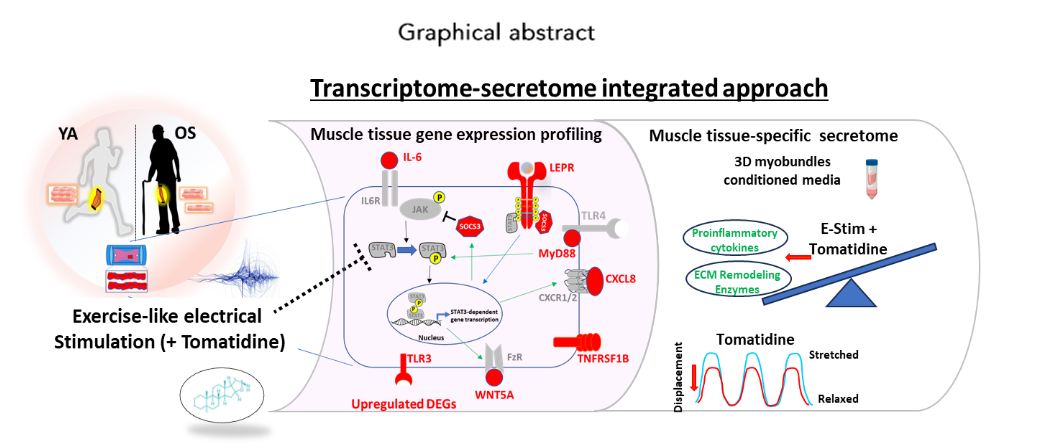
The physiological effects of physical exercise are recognized for their beneficial impact on both the cardiovascular and musculoskeletal systems serving as preventive and therapeutic strategies for cardiovascular disease, diabetes, and obesity. Repeated exercise induces an adaptive and transient response, including the release of cytokines, known as myokines, which play a critical role in the prevention and treatment of various chronic diseases. In this study, we investigated the effects of tomatidine on exercise-like stimulation in donor-derived skeletal muscle myobundles.
Introduction
Repeated exercise induces an adaptive and transient response, including the release of cytokines, known as myokines, which play a critical role in the prevention and treatment of various chronic diseases. In this study, we investigated the effects of tomatidine on exercise-like stimulation in donor-derived skeletal muscle myobundles.
Methods
MUSCLE BIOPSY AND PARTICIPANTS CELL CULTURE
Microfluidic 3D cell culture was performed by isolating donor-derived myofibers from human skeletal muscle biopsies. Biopsy samples were obtained from healthy, vastus lateralis individuals aged 21–40 years.
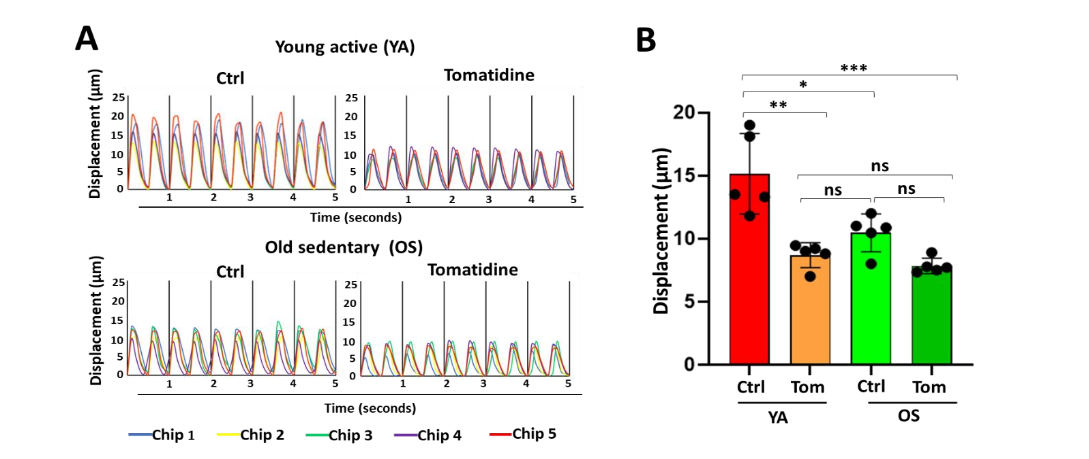
3D CELL CULTURE AND MYOBUNDLES
Myofibers were injected into the PDMS chips to a final cell density of 15 and 20 million cells/ml for Vandal OS-derived cells, respectively as previously described.
| Groups | Sample # | Cohort Description | RNA (ng) | RIN |
|---|---|---|---|---|
| 1 | Young E-Stim Vehicle (Ctrl) | 2741.5 | 9 | |
| 2 | Young E-Stim Vehicle (Ctrl) | 1766.3 | 8.4 | |
| 3 | Young E-Stim Vehicle (Ctrl) | 1626.3 | 8.9 | |
| 4 | Old E-Stim Vehicle (Ctrl) | 1793.4 | 8.7 | |
| 5 | Old E-Stim Vehicle (Ctrl) | 2072.7 | 8.6 | |
| 6 | Old E-Stim Vehicle (Ctrl) | 2200.3 | 7.6 | |
| 7 | Young E-Stim Tomatidine | 1989.1 | 9.8 | |
| 8 | Young E-Stim Tomatidine | 2184.1 | 9.1 | |
| 9 | Young E-Stim Tomatidine | 2002.3 | 9.2 | |
| 10 | Old E-Stim Tomatidine | 2088.5 | 9.2 | |
| 11 | Old E-Stim Tomatidine | 2365.4 | 9.5 | |
| 12 | Old E-Stim Tomatidine | 2087.4 | 9.1 |
Differential Expression and Functional Annotation of RNA-seq Data
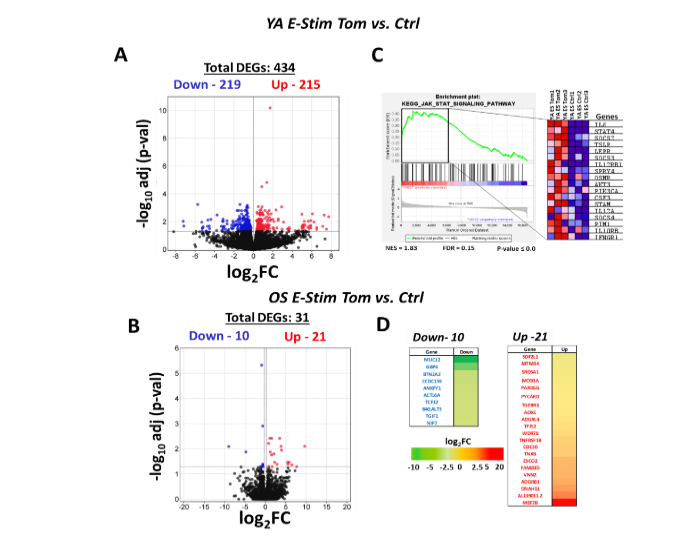
Differential expression analysis was performed using the DESeq2 package, with an FDR corrected p-value (p<0.05). The results were further analyzed using Gene set enrichment analysis (GSEA).
Discussion
Understanding muscle cell-autonomous mechanisms that disrupt regenerative muscle inflammation following exercise is critical for developing therapeutic strategies to mitigate muscle injury.
References
- Gronckel, P. et al. A Review of Exercise as Medicine in Cardiovascular Disease: Pathology and Mechanism. Aging and disease 11, 327 (2020).
- Izquierdo, M. et al. International Exercise Recommendations in Older Adults (IERA): Expert Consensus Guidelines. The Journal of nutrition, health and aging 25, 824–853 (2021).
- Seydou, U. S. A., Batildo, D., Visaria, A. & Maliny, S. K. The importance of exercise for glycemic control in type 2 diabetes. Front. Physiol. 10, 500 (2019).
- Kim, J.-H., Yu, S.-M. & Son, J. W. Human Tissue-Engineered Skeletal Muscle: A Tool for Metabolic Research. Endocrinol Metab 37, 408–414 (2022).
- Hind, L., McMillan, J., Arce, D., Hinds, S. & Kumar, A. Isolation, Culturing, and Differentiation of Human Skeletal Muscle Cells. Bio-protocol 7, e2101 (2017).