





Tranexamic Acid and Thromboembolic Risks in Surgery
Intravenous Tranexamic Acid is Associated with an Increased Incidence of Thromboembolic Events in High-Risk Patients
Dale N. Segal MD¹, Grace Xiong MD¹, Alex Crawford MD¹, Harry Lightsey MD¹, Brendan Striano MD¹, Brian Goh MD PhD¹, Hao-Hua Wu MD¹, Harold Fogel MD¹, Daniel Tobert MD¹, Stuart Hershman MD¹
- Department of Orthopaedics, Massachusetts General Hospital, Harvard Medical School, Boston, MA, USA
OPEN ACCESS
PUBLISHED: 28 February 2025
CITATION: Segal, D.N., et al., 2025. Intravenous Tranexamic Acid is Associated with an Increased Incidence of Thromboembolic Events in High-Risk Patients Undergoing Instrumented Multilevel Thoracolumbar Fusions. Medical Research Archives, [online] 13(2). https://doi.org/10.18103/mra.v13i2.6352
COPYRIGHT: © 2025 European Society of Medicine. This is an open-access article distributed under the terms of the Creative Commons Attribution License, which permits unrestricted use, distribution, and reproduction in any medium, provided the original author and source are credited.
DOI https://doi.org/10.18103/mra.v13i2.6352
ISSN 2375-1924
ABSTRACT
Study Design: Retrospective cohort study.
Objective: Tranexamic acid (TXA) is increasingly being used to assist in perioperative hemostasis for patients undergoing orthopedic surgery. Though TXA has been shown to be safe in the general population, there is little literature on its safety profile in patients undergoing multilevel spine surgery who are high-risk because of a personal history of a thromboembolic event. In this context, we sought to directly evaluate complications in high-risk patients undergoing multilevel thoracolumbar fusion who received TXA.
Methods: In this retrospective cohort study, we identified high-risk patients, defined as those with a history of deep venous thrombosis (DVT), pulmonary embolism (PE), myocardial infarction, or stroke who underwent posterior thoracic or lumbar instrumented spinal fusion of ≥3 levels. Patients were separated into two groups based on receipt of TXA during their surgical care. The primary outcome was a composite of DVT or PE in the perioperative period.
Results: A total of 113 patients were included, 16 of whom received TXA. The TXA cohort had a higher number of vertebral levels treated, longer operative time, and greater intraoperative blood loss/transfusion requirement. The DVT/PE rate in the TXA cohort was 18.8% compared to 4.1% in the non-TXA cohort. Multivariable regression analysis to adjust for operative levels demonstrated a statistically elevated odds of developing a DVT/PE in patients who received TXA compared to those who did not (OR 9.1 95% CI 1.04 – 75.4, p = 0.046).
Conclusions: High-risk patients who underwent multilevel thoracolumbar fusion and who received TXA were at increased odds of developing a postoperative DVT/PE compared to those who did not. We suggest replicating this study methodology in a setting with access to larger representative cohorts, such that additional covariates can adequately be adjusted against.
Keywords: Tranexamic acid, venous thromboembolism
INTRODUCTION
Tranexamic acid (TXA) is an antifibrinolytic agent that has been demonstrated to be safe and effective in limiting blood loss in orthopedic surgery¹⁻⁵. Major spine surgery is often associated with significant perioperative blood loss and as such, TXA can has become a popular adjunctive to manage blood loss⁶. Subsequently, TXA has been shown to reduce transfusion requirements and shorten hospital length of stay when used in spine surgery⁷. However, use of TXA is not without several clinical considerations. As an antifibrinolytic, use of TXA raises concerns regarding increased risk of thrombotic events. This concern is particularly common in patients who may be more prone to thrombosis such as those with a personal history of pulmonary embolism (PE), deep vein thrombosis (DVT), myocardial infarction (MI), cerebrovascular accident (CVA), etc. Studies in the arthroplasty literature have demonstrated no increased risk of thromboembolic events in these “high risk” patients who received intraoperative TXA compared to those who did not⁸⁻⁹. Similarly, administering TXA in the trauma setting has not been shown to increase the risk of thromboembolic events¹⁰. Outside of the orthopaedic population, administration of TXA was not associated with increased risk of death or thrombotic event in a population of patients undergoing cardiac surgery. Despite no increased risk of thrombosis in this high risk population, patients treated with TXA had fewer blood transfusions and reoperations¹¹.
Given its ability to facilitate hemostasis, the use of TXA in high risk patients undergoing multilevel spine surgery is appealing, however, its safety profile in this specific patient population has not been reported in the literature. In this context, we sought to evaluate the use of TXA in these high-risk patients undergoing multilevel thoracolumbar fusion surgery. Our primary outcome was a composite of thrombotic events including DVT or PE.
Methods
After obtaining institutional review board (IRB) approval from Mass General Brigham, approval number 2020P003357, we retrospectively reviewed the electronic medical record of patients who underwent multilevel (≥3 vertebral levels) posterior lumbar and/or thoracic instrumented fusion surgery between January 2015 and 2021. Informed consent was waived as identifying information was not included. Current Procedural Terminology (CPT) codes 22842, 22843, or 22844 were used to screen for patients undergoing multilevel instrumentation, and manual chart review was used to confirm patients who underwent an instrumented, multilevel, posterior thoracolumbar fusion. Exclusion criteria included surgery for tumor, infection, multilevel instrumentation without fusion, age <18, and incomplete medical data. A previously validated model using machine learning phenotypes was then used to identify those multilevel fusion patients with a prior, documented history of DVT, PE, MI, and stroke¹². Chart review confirmed the relevant medical history. Patients were separated into two cohorts, those that received intraoperative TXA and those that did not. Patients in the TXA group received 1 to 2 grams of intravenous TXA within 30 minutes prior to or 30 minutes following incision. Perioperative anticoagulation was at the individual surgeon discretion and was typically started on postoperative day 2 or 3 in the absence of complications such as profound anemia or epidural hematoma. The primary outcome of the study was a composite of DVT and/or PE. Secondary outcomes included development of MI, sepsis, pneumonia, urinary tract infection (UTI), surgical site infection (SSI), death, and 30-day readmission. Additional variables extracted included body mass index (BMI), gender, smoking status, American Society of Anesthesiologists (ASA) score, perioperative utilization of chemical anticoagulation, estimated blood loss, surgical time, number of levels fused, and transfusion requirement.
Bivariate unadjusted comparison between groups was conducted using Wilcoxon rank-sum testing for non-parametric continuous data and Fisher’s exact testing for categorical variables. Multivariable analysis was conducted utilizing a logistic regression model with DVT/PE as the primary outcome and TXA administration as the primary predictor. In order to avoid model overfitting given the sample size, the number of operative levels was utilized as a covariate. Number of levels fused was chosen as the covariate it is a proxy for multiple relevant considerations including surgical time, surgical complexity, and degree of invasiveness of the surgical procedure. Statistical significance was set a-priori at a p-value <0.05. Analysis was conducted using Stata 17.0 (StataCorp, College Station, TX).
Results
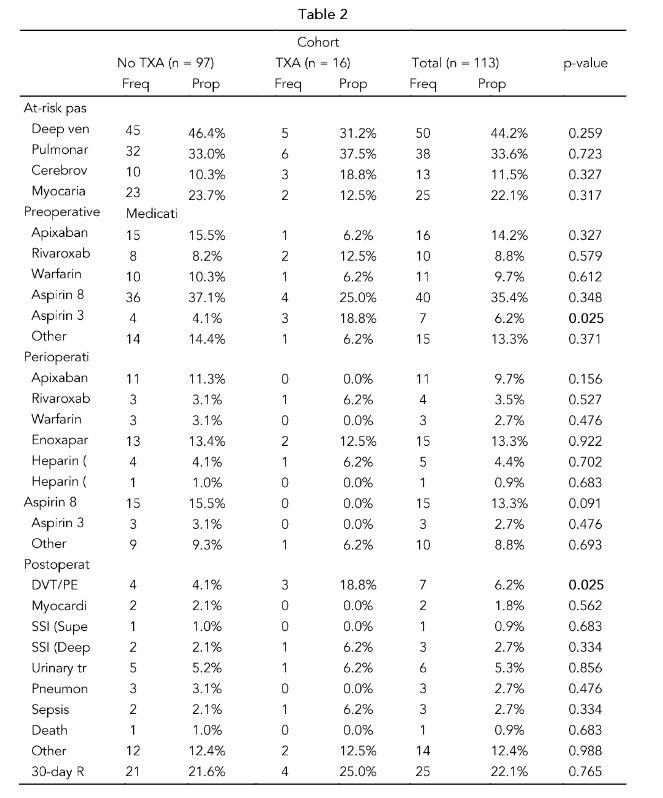
A total of 113 patients met initial inclusion criteria, of which, 97 did not receive TXA and 16 received TXA. There was no difference in age, BMI, gender, smoking status, or ASA class between the two cohorts [Table 1]. Significant differences between the TXA and non TXA cohorts were found with regard to surgical characteristics. The TXA cohort had a higher number of operative levels, longer operative time, and greater intraoperative blood loss/transfusion requirement [Table 1]. There was no difference in the pre- or perioperative anticoagulation regimen between the TXA and non-TXA groups (Table 2). Perioperative anticoagulation was administered at the discretion of the treating surgeon, however, when used was typically started on the 2nd or 3rd postoperative day.
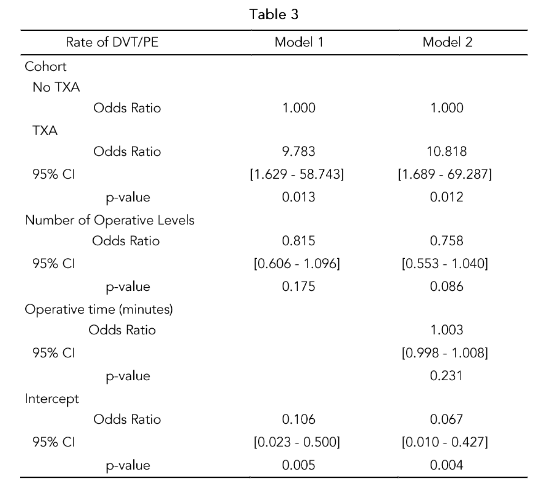
The overall DVT/PE rate in the study was 6.8%. The rate of DVT/PE in the TXA cohort was 18.8% compared to 4.1% in the non-TXA cohort (p=0.058). There was no statistically significant difference in myocardial infarction, sepsis, death or 30- day re-admissions between the two groups (Table 3). Multivariable exact logistic regression analysis to adjust for number of operative levels demonstrated a statistically increased odds of developing a DVT/PE in patients who received TXA compared to those who did not (OR 9.1, 95% CI 1.04 – 75.4, p = 0.046).
A total of 113 patients met initial inclusion criteria, of which 16 received TXA and 97 did not receive TXA. The baseline characteristics of the patients are summarized in Table 1.
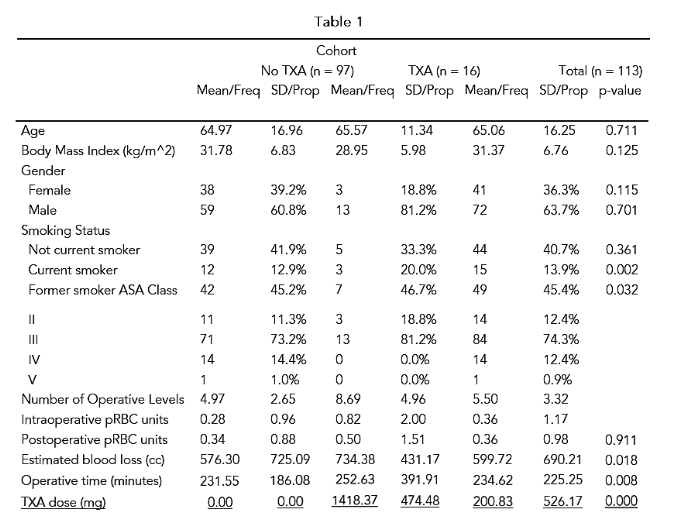
There was no difference in the incidence of thromboembolic events between the TXA and no TXA groups (p=0.259). Additionally, there was no difference in the number of operative levels (p=0.317).
References
1. Heyns M, Knight P, Steve AK, Yeung JK. A Single Preoperative Dose of Tranexamic Acid Reduces Perioperative Blood Loss: A Meta-analysis. Ann Surg. 2021;273(1):75-81.
2. Clay TB, Lawal AS, Wright TW, et al. Tranexamic acid use is associated with lower transfusion rates in shoulder arthroplasty patients with preoperative anaemia. Shoulder Elbow. 2020; 12(1 Suppl):61-69.
3. Belk JW, McCarty EC, Houck DA, Dragoo JL, Savoie FH, Thon SG. Tranexamic Acid Use in Knee and Shoulder Arthroscopy Leads to Improved Outcomes and Fewer Hemarthrosis-Related Complications: A Systematic Review of Level I and II Studies. Arthroscopy. 2021;37(4):1323-1333.
4. Zhu X, Shi Q, Li D, et al. Two Doses of Tranexamic Acid Reduce Blood Loss in Primary Posterior Lumbar Fusion Surgery: A Randomized-controlled Trial. Clin Spine Surg. 2020;33(10):E593-E597.
5. Ko BS, Cho KJ, Kim YT, Park JW, Kim NC. Does Tranexamic Acid Increase the Incidence of Thromboembolism After Spinal Fusion Surgery? Clin Spine Surg. 2020;33(2):E71-E75.
6. Theusinger OM, Spahn DR. Perioperative blood conservation strategies for major spine surgery. Best practice & research Clinical anaesthesiology. 2016;30(1):41-52.
7. Liu ZG, Yang F, Zhu YH, Liu GC, Zhu QS, Zhang BY. Is TXA beneficial in open spine surgery? And its effects vary by dosage, age, sites, and locations: A meta-analysis of randomized controlled trials. World Neurosurg. 2022.
8. Porter SB, Spaulding AC, Duncan CM, Wilke BK, Pagnano MW, Abdel MP. Tranexamic Acid Was Not Associated with Increased Complications in High-Risk Patients with Hip Fracture Undergoing Arthroplasty. J Bone Joint Surg Am. 2021;103 (20):1880-1889.
9. Porter SB, White LJ, Osagiede O, Robards CB, Spaulding AC. Tranexamic Acid Administration Is Not Associated With an Increase in Complications in High-Risk Patients Undergoing Primary Total Knee or Total Hip Arthroplasty: A Retrospective Case-Control Study of 38,220 Patients. J Arthroplasty. 2020;35(1):45-51 e43.
10. Porter SB, Spaulding AC, Duncan CM, Wilke BK, Pagnano MW, Abdel MP. Tranexamic Acid Was Not Associated with Increased Complications in High-Risk Patients with Intertrochanteric Fracture. J Bone Joint Surg Am. 2022;104(13):1138-1147.
11. Myles PS, Smith JA, Forbes A, et al. Tranexamic acid in patients undergoing coronary-artery surgery. New England Journal of Medicine. 2017;376(2):136-148.
12. Yu S, Ma Y, Gronsbell J, et al. Enabling phenotypic big data with PheNorm. J Am Med Inform Assoc. 2018;25(1):54-60.
13. Shi P, Wang J, Cai T, et al. Safety and Efficacy of Topical Administration of Tranexamic Acid in High-Risk Patients Undergoing Posterior Lumbar Interbody Fusion Surgery. World Neurosurg. 2021; 151:e621-e629.