

Vitamin D Deficiency in Children and Adults: A Study
Vitamin-D Deficiency A common problem of children and adults: A cross-sectional study with Pharmacological and physiological perspectives
Ashique Ali Arain 1, Nasreen Kazi 2, Ghullam Muhammad Phull 3, Shah Nawaz Jamali 4, Aziz Ahmed Solangi 5, Abdul Wadood Shah 6
- MBBS, M. Phil (Pharmacology), Associate Professor, Department of pharmacology, Liaquat Institute of Medical and Health Sciences, Sindh, Pakistan
- MBBS, M. Phil, Ph D (Pharmacology) Professor and Head of Pharmacology Department Bilawal Medical College, Jamshoro, Sindh, Pakistan
- MBBS, Phil (Physiology), Associate Professor, Department of Physiology, Gambat Medical College, Khairpur Mirs, Sindh, Pakistan
- MBBS, Ph.D (Pharmacology), Professor and HOD Department of Pharmacology, Dow University of Medical and Health Sciences, Karachi, Sindh, Pakistan
- MBBS, M. Phil (Pharmacology), Lecturer Department of Pharmacology, Bilawal Medical College, Jamshoro
- MBBS, M. Phil (Community Medicine), Assistant Professor, Department of Community Medicine, Bilawal Medical college Jamshoro, Sindh, Pakistan
OPEN ACCESS
PUBLISHED: 31 July 2025
CITATION: Arain, AA., Kazi, N., et al., 2025. Vitamin-D Deficiency A common problem of children and adults: A cross-sectional study with Pharmacological and physiological perspectives. Medical Research Archives, [online] 13(7). https://doi.org/10.18103/mra.v13i7.6721
COPYRIGHT: © 2025 European Society of Medicine. This is an open-access article distributed under the terms of the Creative Commons Attribution License, which permits unrestricted use, distribution, and reproduction in any medium, provided the original author and source are credited.
DOI https://doi.org/10.18103/mra.v13i7.6721
ISSN 2375-1924
ABSTRACT
Vitamin D has been involved in multiple biological processes of the human body with a normal range between 30-50 ng/ml to maintain the health of the skeleton, bones and teeth in children as well as adults. This fat-soluble vitamin has many physiological functions for normal health so it’s deficiency as well as insufficiency disturbs the normal physiological functions of the body resulting into bone related pathologies along with other health issues. This Observational type of research study was conducted in Hyderabad region of Sindh Province from January 2019 to January 2021 on 1000 patients through Consecutive type of sampling technique. Statistical analysis was performed on SPSS version 22, t-test was used for comparing the mean vitamin D concentration of different study groups. There was no significant difference was found between male and female genders 13.18+7.3 ng/dl 14.3+8.6ng/dl 0.793 but there was significant difference observed between children and adults 11.13+7.4 ng/dl 14.5+9.3ng/dl 0.0001.
Conclusion: majority of the study participants Male, female adults and children were suffering from vitamin D deficiency
Key Words: Vitamin-D, Gender, Children
Introduction:
Human bony skeleton is of utmost important in the body and Vitamin-D has that much importance for the skeleton to develop and maintain its integrity. This fat-soluble cholesterol derived vitamin is endogenously synthesized through sun light converting 7-Dehydrocholesterol to cholecalciferol, 25-hydroxycalciferol and 1,25 dihydroxycalciferol by the skin, liver and kidneys respectively. Dietary sources like Milk, eggs, liver and fish are rich in this important vitamin, human body needs at least 15ug/day up to the age of 70 years on daily basis. Hypoparathyroidism, Osteomalacia, renal osteodystrophy and Rickets are well treated with vitamin D. Vitamin D also maintains and modulates the immune system through cathelicidin, a peptide with antimicrobial properties along with the amplification of the macrophages as well as B-cells activity.
The documented prevalence of Vitamin-D deficiency is between 30%-90% and being reported as the cause of childhood infections. The deficiency of this Vitamin is attributed to either the intake or the synthesis reduction. Although the deficiency of Vitamin-D has increased in the recent times but its history is very old as reported by Dr. Daniel from England and Trousseau France in 1645 and 1861 from respectively. Many factors have been discussed and explored for causing this decline in serum vitamin D levels few of them are age, gender and religion as focused by some researchers including a Korean author. The goal for the management of vitamin D deficiency is to increase the serum levels above 30ng/ml to normalizes the body calcium and to reverse the hyperparathyroidism. The recommended dose for vitamin D deficiency or insufficiency is administration of higher doses of vitamin D (4000 units/day) or (50000 units/wk) for several weeks. We have been searching on this important issue for last 5 years from smaller levels to gradually a relatively larger scale, the current work is a continuation of our that effort. We tried to evaluate the difference in vitamin D levels at the age and gender level in the study participants.
Methodology:
Patients were selected from OPD (Out Patient Department) of Liaquat University of Medical and Health Sciences (LUMHS) Hyderabad, Isra University hospital Hyderabad and few private clinics of Hyderabad city. Both male and female gender of an age range between 05 to 50 years were included excluding the patients on therapy of vitamin D and patients of renal failure. Blood sample were drawn under international protocols and laboratory guide lines following informed written consent from patients or their attendants. Vitamin D levels were checked in the Isra University laboratory and LUMHS research laboratory. Statistical Analysis of the collected data was accomplished using SPSS (Statistical Package of Social Sciences) version 22. Mean, SD (standard deviation), minimum, maximum for vitamin D were calculated for male and female participants as well as age wise results were presents in tables and figures.
Results:
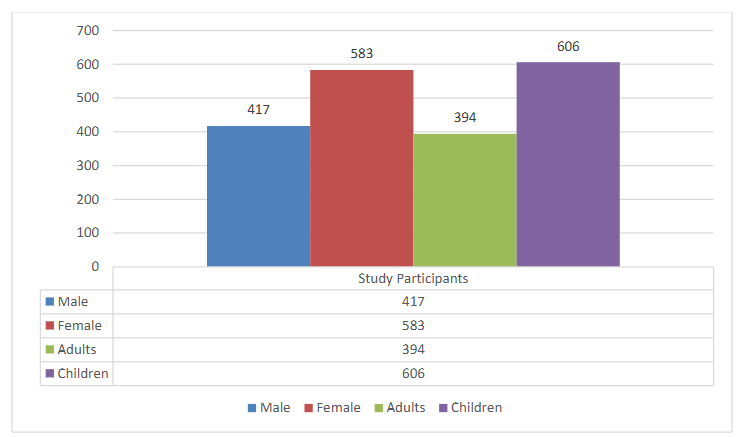
Total 1000 were evaluated out of which Males were 417(41.7%), Females were 583 (58.3%), Adults were 394 (39.4%), Children were 606 (60.6%), The mean age in children was 10.9+2.4 years and in adults it was found to be 46.0+7.6 years. The mean Vitamin-D level in children was 11.78+3.95ng/ml where in adult groups it was calculated as 13.74+7.95ng/ml. The minimum levels of vitamin –D was observed as 3.0ng/ml while the maximum was 50ng/ml. Normal or above normal vitamin D was found it 350(35%) patients whereas below normal vitamin D was seen in 650(65%) patients.
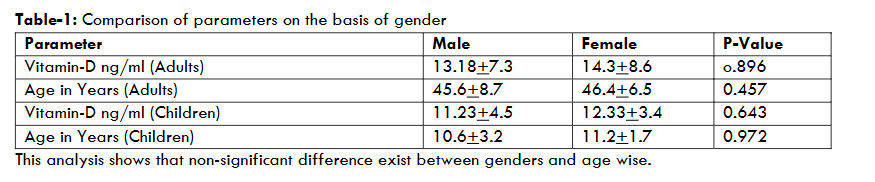
Vitamin-D in Adults males 13.18+7.3 ng/ml was compared with vitamin D in adult female 14.3+8.6ng/ml the difference was non-significant statistically (P-value o.896) similarly the age difference between adult males and females 45.6+8.7 years and 46.4+6.5 years was also non-significant(p-value0.457). The difference between Vitamin-D levels in male and female Children 11.23+4.5ng/ml and 12.33+3.4ng/ml was also non-significant (0.643). There existed non-significant age difference between male and female children 10.6+3.2 years and 11.2+1.7 years (P-value 0.972).
However, the difference between vitamin D levels in children 11.78+3.95ng/ml and vitamin D levels in adults 13.74+7.95ng/ml was statistically significant (p-value 0.0001) not shown in tables.
Table-2: Basic study observations
| Variable | Observations |
|---|---|
| Male | 417 (41.7%) |
| Female | 583 (58.3%) |
| Adults | 394 (39.4%) |
| Children | 606 (60.6%) |
| Mean age in children | 10.9+2.4 Years |
| Mean Age in Adults | 46.0+7.6 Years |
| Mean Vitamin-D in children | 11.78+3.95ng/ml |
| Mean Vitamin-D in Adults | 13.74+7.95ng/ml |
| Minimum levels of vitamin -D | 3.0ng/ml |
| Maximum Vitamin-D | 50ng/ml |
| Normal or above normal | 350(35%) |
| Below Normal | 650(65%) |
This analysis shows that the majority of the population studied was found to be suffering from deficiency of vitamin D irrespective of age and gender. The cause needs to be evaluated.
Discussion:
Our study finding are consistent with finding by Farhan J D et al (2018) from KSA where the vitamin D deficiency was reported to be 64% and 41% from years 2013 and 2017 respectively. A USA based study by Scott MG et al (2015) showed 50% of the study participants were deficient in serum vitamin D levels which was consistent to our observations. An Australian study by Boyages SC et al (2016) also reported 50% of the study population deficient for serum vitamin D levels. Current findings are in line with our previously published work back in 2017 and 2018. The hidden mastery behinds this vitamin D deficiency globally needs solution but early assessment and timely prescriptions for Vitamin D supplementations may save patients from agony. The exact cause needs to be discovered at national and international levels but what be done for the prevention of deficiency is to educate the Public for awareness through community-based workshops at schools and community center as well as through telecommunication and social media platforms. Doctors and other health workers should be trained for recommended dosage, duration, monitoring, therapy and counselling regarding vitamin D deficiency and associated diseases. There were multiple weaknesses in our previous and current study due to our limited financial sources but we are planning a larger scale study involving 5000 normal individuals including adults and children with multiple parameters, funds are being sorted from different funding agencies for this purpose, any collaborator at national or international levels will be welcomed.
Conclusion:
The majority of the study participants, males, females, adults and children were suffering from vitamin D deficiency non-significant difference was seen on gender basis while significant difference was observed on age basis between adults and children.
References:
- Denise R. Ferrier. Vitamin in Lipponcot’s biochemistry Reviews. Richard A. Harvey, Wolters Kluwer 6th edition 2014:373-394.
- Afshan Kamran, Syed Mahboob Alam, Farida Qadir. Prevalence of vitamin D deficiency and insufficiency among adult asthamatic patients of Karachi. Pak .J. Pharm, 2014; 27(6):2139-2144.
- Ahmed SZ, Anila J, Kamran H, Farah A Hassan D et al. Serum vitamin D concentration in Asthamatic children and its association with recovery time from an asthma exacerbation. BJMMR, 2015; 10(6):1-10.
- Iftikhat Ejaz, Amna Ahmed, Sumayya Aftab, Iqra waheed et al. Frequency of nutrition rickets in children and association with iron deficiency anemia. JFJMC 2013; 7(3):38-39.
- Garg D, et al. Association of serum vitamin D with acute lower respiratory infection in Indian children under 5 years: a case control study. Int J Contemp Pediatr. 2016; 3(4):1164-1169.
- A. Khakshour, A.S. Farhat, A. Mohammad zadeh, et al. The association between 25-dehydroxy vitamin D and lower respiratory infections in children aged lessthan 5 years in Imam Reza hospital, Bojnurd, Iran. J Pak Med Assoc. 2013; 65(11): 1153-1155.
- Nighat H, Abdul Ghaffare N, Khalid Mehmood A.Khan. Frequency nutritional rickets in children admitted with severe pneumonia. J Pak Med Assoc. 2010; 60(9):729-732.
- Kazi MY, Aamir K, Rana MN, Farooq MA. Frequency of vitamin D deficiency in children presenting with frequent sino-pulmonary infections. Pak Pediatr J. 2013; 37(2):101-105.
- Lee JA, Hwang JS, Hwang IT, Kim DH, Seo JH et al. Low vitamin D levels are associated with iron deficiency anemia in children and adolescents. Pediatr Hematol Oncol. 2015; 32(2):99-108.
- Daniel D. Bikle. Agents that affect bone mineral homeostasis. In Katzung text book of Pharmacology 12th edition Mc Graw Hill, USA. 2012; 769-787.
- Farhan J D, Ibrahim M. Vitamin D Testing Interval; an Area of Challenge. Biomed J Sci&Tech Res 6(2)-2018. BJSTR.MS.ID.001333. DOI: 10.26717/BJSTR.2018.06.001333.
- Scott MG, Gronowski AM, Reid IR, Holick MF, Thadhani R, et al. Vitamin D: the more we know, the less we know. Clin Chem 2015; 61(3): 462-465.
- Boyages SC. Vitamin D testing: new targeted guidelines stem the over testing tide. Med J Aust 2016; 204 (1): 18. || Doi: 10.5694/mja15.00497.
- Ashique Ali Arain, Syed Muhammad Ali, Quamar Zaman Phull, Ali Abbas. Vitamin-D Deficiency: A Neglected Topic Alarms the Health Care Providers. JOPA 2017; 29 (3): 7-1.
- Ashique Ali Arain, Syed Muhammad Ali, Madiha Shah. Vitamin -D Deficiency: A Clinical Problem Searching For Solution. journal of advanced pharmaceutical science and technology, 2018; 1(3):48-52.