


Diminished Dorsal Finger Creases in Myositis Patients
Diminished distal dorsal finger crease is associated with handgrip weakness in inclusion body myositis
Research Article
Matthew N. Prinsen MD1, Ava Yun Lin MD2, Kevin Dooley MD3, Conrad C. Wei MD, PhD4, Leo H. Wang MD, PhD5
1.Department of Neurology, University of Michigan
2.Department of Neurology, Washington University in St. Louis
3.Department of Neurology, Washington University in St. Louis
4.Department of Neurology, University of Michigan
5.Department of Neurology, Washington University in St. Louis
OPEN ACCESS
PUBLISH: 31 July 2025
CITATION: Preston, Mk., et al., 2025. diminished distal dostal finger crease is associated with handgrip weakness in inclusion body myositis. Medical Research Archieves,[online]13(7).DOI: https://doi.org/10.18103/mra.v13i7.6773
COPYRIGHT: © 2025 European Society of Medicine. This is an open-access article distributed under the termsof the Creative Commons Attribution License,which permits unrestricted use, distribution, andreproduction in any medium, provided the original author and source are credited.
DOI: 10.18180/med.2025
ISSN 2375-1924
Abstract
Sporadic inclusion body myositis (IBM) is the most common acquired myopathy in populations over age 45. This disorder causes slowly progressive asymmetric weakness with a predilection for weakness in knee extensors and in finger flexion, particularly in flexor digitorum profundus and flexor pollicis longus in the upper extremities. Though this clinical phenotype of IBM is relatively unique, the diagnosis can be missed without a high index of suspicion, or mistaken for amyotrophic lateral sclerosis (ALS), which can also be an asymmetric progressive motor weakness. Diagnosis of IBM remains challenging, with an average delay in diagnosis of 5.6 years after symptom onset.
Keywords
inclusion body myositis, handgrip strength, finger creases, muscle weakness
Introduction
Inclusion body myositis (IBM) is the most common acquired myopathy in populations over age 45. This disorder causes slowly progressive asymmetric weakness with a predilection for weakness in knee extensors and in finger flexion, particularly in flexor digitorum profundus and flexor pollicis longus in the upper extremities. Though this clinical phenotype of IBM is relatively unique, the diagnosis can be missed without a high index of suspicion, or mistaken for amyotrophic lateral sclerosis (ALS), which can also be an asymmetric progressive motor weakness. Diagnosis of IBM remains challenging, with an average delay in diagnosis of 5.6 years after symptom onset.
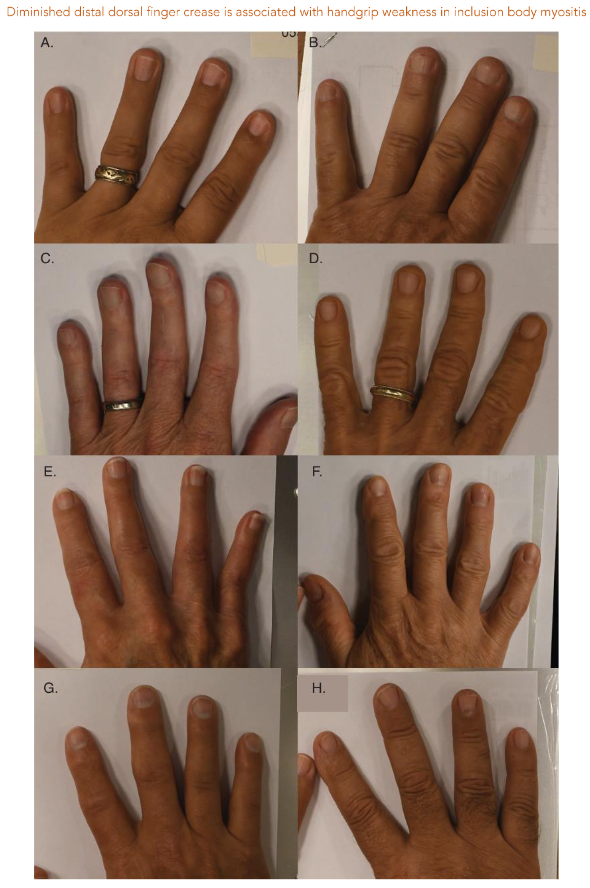
Results
Loss of finger creases and dominant grip strength: Grip strength in patients with IBM showed mean 20th percentile [IQR 12.27] with loss of finger creases (n=32) versus 31st percentile [IQR 24.42] without loss of finger creases (p=0.008). Control strength in patients without IBM is shown in the 10th-111th percentile. Inter-quartile range: IBM: inclusion body myositis.
![Figure 2. Loss of finger creases and dominant grip strength: Grip strength in patients with IBM showed mean 20th percentile [IQR 12.27] with loss of finger creases (n=32) versus 31st percentile [IQR 24.42] without loss of finger creases (p=0.008).](/pdf-to-wp-converter/uploads/images/diminished-dorsal-finger-creases-myositis-figure-2.png)
Discussion
Our findings show that loss of distal dorsal finger creases is present in a significant proportion of patients with IBM (40%) than control patients without (15%). Additionally, we show that loss of distal finger creases is associated with reduction in grip strength (20th percentile vs 31st percentile; p=0.008). We hypothesize that the presence of reduced distal finger creases may be a helpful clinical sign in identifying patients with IBM at time of their presentation. The presence of reduced distal finger creases is helpful in distinguishing IBM from other disorders such as ALS which frequently causes distal hand weakness but not finger flexion weakness.
We expect several factors may be involved in this difference, including the relative sparing of deep finger flexors and the rapidity of symptoms in ALS compared to the slowly progressive weakness often seen in patients with IBM at time of their presentation. The presence of finger creases in 60% of our IBM cohort is suspected to be related to the prevalence of finger creases in the general population.
References
- Lloyd TE, Mammen AL, Amato AA, et al. Inclusion body myositis. Neurology. 2014 Jul 29;83(5):425-36.
- Bardingham JU, Maat-Scheim ML, van Houwelingen JC, et al. Inclusion body myositis. Clinical features and clinical course of the disease in 64 patients. J Neurol. 2005 Dec;252(12):1448-54.
- Phillips BA, Cula LA, Thirukkothai GW, et al. Patterns of muscle involvement in inclusion body myositis: clinical and imaging study. Muscle Nerve. 2013;48(1):9-16.
- Abdelhakim R, Mohamed KA, Egejidy A, et al. Muscle sonography in inclusion body myositis. Muscle Nerve. 2013;48(1):9-16.