

Learning Difficulties, Burnout, and Digital Addiction in Students
Perceived learning difficulties, school burnout and digital addiction of students in grades 6 to 12
Ene Varik-Maasik1*, Riin Seema1
- Ene Varik-Maasik Tallinn University, School of Educational Sciences
- Riin Seema Tallinn University, School of Educational Sciences
OPEN ACCESS
PUBLISHED: 31 March 2025
CITATION: VARIK-MAASIK, Ene; SEEMA, Riin. Perceived learning difficulties, school burnout and digital addiction of students in grades 6 to 12. Medical Research Archives, [S.l.], v. 13, n. 3, mar. 2025. Available at: <https://esmed.org/MRA/mra/article/view/6436>.
COPYRIGHT: © 2025 European Society of Medicine. This is an open-access article distributed under the terms of the Creative Commons Attribution License, which permits unrestricted use, distribution, and reproduction in any medium, provided the original author and source are credited.
DOI: https://doi.org/10.18103/mra.v13i3.6436
ISSN 2375-1924
Abstract
Research on learning difficulties has generally focused on diagnosed learning difficulties and related aspects. The aim of this study is to find out how students in grades 6–12 perceive learning difficulties related to digital addiction and school burnout. This paper used data collected from 8107 students in Estonia, who participated in the Student Survey 2022. The study utilized a Perceived Learning Difficulties Scale to collect data. Results showed that students with higher perceived learning difficulties also reported higher levels of digital addiction and school burnout.
Keywords
learning difficulties, school burnout, digital addiction, students
Introduction
Since 2010, Estonian schools have been required to provide a quality education in a digital setting. With inclusion, at least 80% of learning takes place in mainstream classrooms. This means that included learning can also include partial learning in a special class. While after the restoration of Estonia’s independence in the 1990s and 2000s, students with special needs, often including those with learning difficulties, were placed in special classes or schools, today they remain predominantly in mainstream classes in regular students. Students learning difficulties are primarily targeted by general support measures in the class and school environment. Students’ academic self-concept and ability are closely related to perceived learning difficulties.
Students with reading difficulties find it difficult to read texts at the same pace as their peers and may not be able to comprehend the content of what they read due to low reading skills. In school, children with a learning difficulty may find it difficult to comprehend educational texts, which can contain complex concepts and facts that are difficult for students to relate to their own lives and prior knowledge. Most students with reading difficulties can fluently read the text but struggle to interpret and comprehend the information.
Academic self-concept is positively correlated with students’ academic performance. Students with a low academic self-concept are more likely to perceive themselves as having learning difficulties. However, there has been little research on students’ own perceptions of their learning difficulties, which is the focus of this research.
Burnout has been defined as a psychosocial condition characterized by mental and emotional fatigue, cynicism, lack of motivation and a sense of underachievement. School-related burnout can also be defined as a sense of school-related overload, more specifically as school-related exhaustion, which can eventually lead to burnout.
Methods and procedure
Tallinn University’s Centre for Educational Innovation (CEI) has been conducting research on students’ attitudes towards learning and school life, perceptions of teaching methods, learning skills, learning difficulties and need for additional support in learning; wellbeing and mental health; bullying; digital use and addiction; and in Estonian school life. From 7 January to 28 February 2022, CEI conducted the Student Survey 2022. Participation in the survey was optional for schools, and all Estonian schools were encouraged to participate in grades 6–12. The survey was conducted using the Qualisys survey environment.
The students were sampled as follows: males (n = 3624, 44.3%), females (n = 4560, 55.7%), prefer not to say (n = 13, 0.1%). The total number of students surveyed was 8107.
Data analysis
The data were analysed using the IBM SPSS Statistics 26 program. Principal Component Analysis (PCA) was used to identify the data to identify dimensionality. The value and effect size were calculated using Levene’s test of equality of error variances to identify defined differences between subgroups. The internal reliability of this scale was also high (α = 0.86).
Students’ perception of learning difficulties
Figure 1. The distribution of students according to the composite score of perceived learning difficulties.
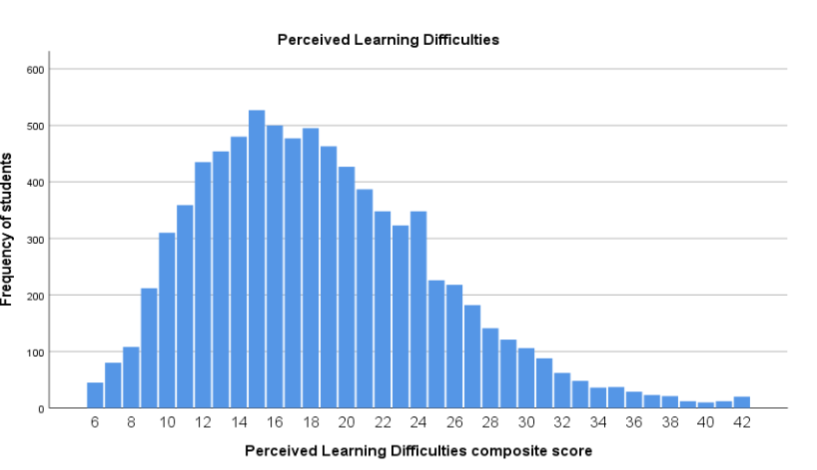
The arithmetic mean of the composite score of the six-factor learning difficulties scale was 6.37. The minimum composite score was 0 and the maximum was 42 (Figure 1).
We also studied that 13.7% of students scored below the average, while 10.4% of students scored above the average.
Supplementary Material. Perceived Learning Difficulties Scale
Please rate how often you have had difficulties in learning during this academic year: Scale: never, rarely, somewhat rarely, so-so, somewhat often, often, very often.
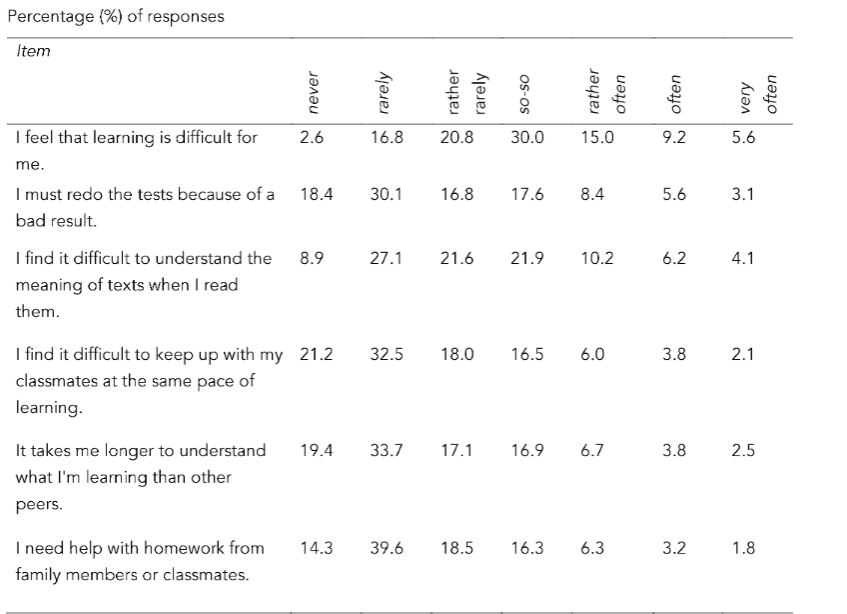
Students’ perceptions of learning difficulties were found across grades 7 and 10. Similar results were found for students in different grades in different subjects.
Gender differences in perceptions of learning difficulties
The results of the univariate analyses of variance and Levene’s test show that there are statistically significant gender differences in the perception of learning difficulties between students in different grades (F = 5.973; p < .0002). The lowest composite score for each student could be and the maximum sum of scores could be 42. The arithmetic mean of the composite scores for the classes ranged between 17.85 and 19.08 points, so the average difference in scores was less than two points.
| Gender | N | Mean | Standard Deviation | Minimum | Maximum |
|---|---|---|---|---|---|
| Male | 3624 | 17.61 | 3.90 | 6 | 30 |
| Female | 4560 | 18.47 | 3.88 | 7 | 30 |
| Prefer not to say | 13 | 18.08 | 3.83 | 12 | 24 |
Correlation matrix
Table 3. Correlation matrix between students’ perceptions of learning difficulties, digital addiction and school-related burnout.
| Digital addiction | Learning difficulties | School-related burnout | |
|---|---|---|---|
| Digital addiction | 1 | 0.323** | 0.409** |
| Learning difficulties | 0.323** | 1 | 0.509** |
| School-related burnout | 0.409** | 0.509** | 1 |
Students with higher perceived learning difficulties scores also had higher digital addiction scores. They often confessed to feeling bored and annoyed without a digital device, feeling the need to use it constantly, keeping an eye on the digital device even while chatting with someone.
Discussion
The aim of this study was to find out how students in grades 6-12 perceive learning difficulties and how they relate to digital addiction and school burnout. The results showed that students with higher perceived learning difficulties also reported higher levels of digital addiction and school burnout.
It is known that environmental factors influence the development and depth of learning difficulties. Inadequate help and support can, in turn, lead to accumulating stress and mental health problems. If this goes unnoticed, students who perceive difficulties are at high risk of school-related burnout and other mental health problems.
A detailed study could focus on the causal relationships between school-related burnout and digital addiction. This study has good and consistent results, but further research is needed to explore the connections between perceived learning difficulties and digital addiction.
References
- Aktan O. Determination of educational needs of students with learning disability. Int J Contemp Educ Res. 2020;7(1):149-164. doi:10.30935/ijcer.6 38362
- Alesk M, Rappo E, Pepi A. Depression, anxiety at school and self-esteem in children with learning disabilities. J Psychol Abnorm Child. 2014; 3(3):1-8. doi:10.4172/2329-9525.1000125
- Barton D. Literacy: An Introduction to the New Literacy Studies. London: Whurr Publishers, 2000.
- ID: ICD: Mental and Behavioural Disorders. Clinical Descriptions and Diagnostic Guidelines. Tartu: University of Tartu Publishing House; 1999.