


Magnesium Supplementation: Impact on Sleep Quality in Adults
Effectiveness of Magnesium Supplementation on Sleep Quality and Mood for Adults with Poor Sleep Quality: A Randomized Double-Blind Placebo-Controlled Crossover Pilot Trial
Introduction
About one-third of the general population experience insomnia symptoms, which are associated with increased risk for physical and mental health issues.¹˒² Because the common interventions of over-the-counter and prescription drugs often have side effects, limited efficacy, and may result in dependency,³ research is needed examining the effectiveness of alternative interventions to improve sleep quality and related mood outcomes for adults with poor sleep quality.
Magnesium supplementation is purported to improve sleep; however, as an over-the-counter sleep aid, limited randomized controlled trial evidence exists to support this assertion.⁴˒⁶
As one of the most abundant minerals in the body, magnesium functions as a cofactor in numerous enzymatic reactions and may influence sleep by modulating the glutamatergic and gamma-aminobutyric acid ergic systems by decreasing nervous system excitability.⁷ Additionally, magnesium can inhibit N-methyl-D-aspartate receptors, which promotes muscle relaxation through the suppression of intracellular calcium concentration in muscle cells. Animal research has found that magnesium deficiency leads to reduced plasma melatonin levels, a hormone that promotes sleep. Moreover, magnesium supplementation lowers serum cortisol levels, a stress hormone, thereby calming the central nervous system and potentially improving sleep quality.⁸˒⁹ Thus, because plasma magnesium levels are lower in sleep deprived people, magnesium supplementation may improve sleep quality.¹⁰ Observational studies have found that magnesium helps maintain a normal circadian rhythm, reduce daytime sleepiness, and improve sleep quality.¹¹˒¹²
Magnesium is inexpensive and available as an over-the-counter sleep aid; however, its effectiveness and safety must be investigated. Furthermore, limitations of the magnesium and sleep research include focus on clinical sleep disorder and special populations, combining of magnesium with other complexes, and a lack of randomized controlled trials with both subjective and objective sleep measures.¹²˒¹³ In short, research on the effectiveness of magnesium supplementation for improving sleep quality in adults with nonclinical insomnia symptoms is required using both objective and subjective assessments within a controlled trial design.
The purpose of this randomized placebo-controlled double-blind crossover pilot trial was to examine the effectiveness of nano magnesium chloride supplementation on sleep quality, daytime activity, and mood of adults with nonclinical insomnia symptoms using both subjective and objective measures. The primary outcome was sleep quality. The secondary outcomes were daytime activity, mood, anxiety, pain effected by sleep, and perceived stress.
Methods and Materials
Participants
Participants were 31 nonobese adults (M age = 46.01, SD = 8.47; range = 27 to 55 years; M BMI = 25.23) who reported nonclinical insomnia symptoms based on the Insomnia Severity Index (M = 13.10, SD = 4.10).¹⁴
Exclusion Criteria
Participants were excluded if they had severe insomnia or absence of insomnia (based on the Insomnia Severity Index ≥ 22 or < 8); (2) history of a disorder affecting sleep quality; (3) events that could cause severe stress within 2 weeks of baseline; (4) use of medication that could influence sleep patterns within 1 month of baseline; (5) current use of any hormone therapy; (6) binge drinking; (7) smoking; (8) high caffeine intake of ≥ 600 mg/d; (9) work schedule that caused irregular sleep patterns; (10) history of travel to a different time zone within 1 month of study; (11) low or high body mass index (BMI ≤ 18 kg/m² or ≥ 30 kg/m²); (12) pregnant, trying to conceive, or breastfeeding; (13) taking sleep supplements or medication, (14) unwilling to abstain from other magnesium product use for two weeks leading up to trial initiation and during the trial, and (14) individuals deemed incompatible with the study protocol.
Procedures
Based on the prescreen questionnaire, eligible participants signed an Institutional Review Board approved informed consent (Sterling IRB) prior to enrolling in the study. Participants completed psychometrically validated self-report questionnaires at Day 0 (Pre) and post each two-week condition; and they also completed a Daily Diary to assess adherence and adverse events, and wore an Oura Ring to objectively determine sleep quality/quantity and daytime activity. Throughout the trial, current lifestyle behaviors were maintained, with no new structured exercise programs, diets, or health interventions initiated. The adherence rate was 100%.
Study design:
This study was approved by Sterling Institutional Review Board (10721) in compliance with the Declaration of Helsinki standards for ethical principles regarding human participant research and registered with ISRCTN registry (ISRCTN70584524). The Consolidated Standards of Reporting Trials (CONSORT) was used to report this trial (www.upgradedformulas.com).
This study was conducted in a double-blind, parallel treatment, stratified random, placebo-controlled manner. The independent variable was the Upgraded Formulas Upgraded Magnesium nutritional supplement. The dependent variables were sleep quality, daytime activity, mood, anxiety, pain effected by sleep, and perceived stress. Sample size power calculation indicated that 30 participants were needed to achieve a power of 80% and alpha < .05 (https://clincalc.com/stats/samplesize.aspx).
Intervention:
Using a randomized double-blind placebo-controlled crossover pilot trial, the participants were randomized to either the Magnesium Condition (1 g/d) or Placebo Control condition for 2 weeks. Following a two-week washout period, the participants engaged in the alternate condition. The Magnesium (i.e., Upgraded Formulas) was a nano magnesium chloride that is free from artificial flavors, fillers, colors, and stabilizers. Participants were instructed to take 4 capsules 30 minutes or less before bed with 12 oz of water. The Placebo was sucrose.
Blinding:
To ensure that all subjects and researchers were unaware of the treatment assignments, the supplement/placebo bottles were labelled as either A or B by an independent party. The research team was blinded to the content of the bottles. At the conclusion of the study, immediately following the last assessment, the research team was unblinded. The participants were then unblinded.
Supplement Information and Adherence:
Participants were instructed to take the capsules 30 minutes prior to nighttime sleep. The participants provided the number of pills remaining in their bottles as an indicator of their adherence. The participants also received a daily text reminder to take their supplement.
Measures
The following psychometrically validated self-report measures were completed at baseline and post each conditions:
Insomnia Severity Index:
The Insomnia Severity Index is a 7-item self-report questionnaire assessing the nature, severity, and impact of insomnia.¹⁴ The dimensions evaluated are: severity of sleep onset, sleep maintenance, and early morning awakening problems, sleep dissatisfaction, interference of sleep difficulties with daytime functioning, noticeability of sleep problems by others, and distress caused by the sleep difficulties. A 5-point Likert scale is used to rate each item (e.g., 0 = no problem; 4 = very severe problem), yielding a total score ranging from 0 to 28. The total score is interpreted as follows: absence of insomnia (0–7); sub-threshold insomnia (8–14); moderate insomnia (15–21); and severe insomnia (22–28).
Pittsburgh Sleep Quality Index.
The Pittsburgh Sleep Quality Index is a standardized, self-administered questionnaire that evaluates retrospective sleep quality and disturbances.¹⁵ The Pittsburgh Sleep Quality Index consists of 19 items forming the following seven subscales: (1) sleep quality, (2) sleep latency, (3) sleep duration, (4) sleep efficiency, (5) sleep disturbance, (6) sleep medication, and (7) daily dysfunction. Each item has a score that is summed to yield a global score ranging from 0 to 21. Higher scores indicate poorer sleep quality.
Restorative Sleep Questionnaire:
The Restorative Sleep Questionnaire is a validated 11-item questionnaire that assesses restorative sleep by asking respondents to rate on a 5-point scale feelings of tiredness, mood, and energy.¹⁶ The Restorative Sleep Questionnaire has good psychometric properties and is able to distinguish between healthy controls, patients with primary insomnia, and insomnia patients with isolated nonrestorative sleep complaints.
Profile of Mood States (POMS) Questionnaire:
The POMS-40 was used to assess the mood states of tension, anger, esteem vigor, fatigue, depression, and confusion.¹⁷ A composite score was computed by summing each of the individual scores for tension, depression, anxiety, fatigue, and confusion, with vigor and esteem scores subtracted to indicate patients’ total mood disturbance. Each item of the POMS was scored on a 5-point Likert scale ranging from 0 (not at all) to 4 (extremely) with lower scores indicating an improved mood. This scale has good to excellent reliability and validity.
Flinders Fatigue Scale:
The Flinders Fatigue Scale is a 7-item scale that measures various characteristics of fatigue (e.g. frequency, severity) experienced over the past 2 weeks.¹⁸ The items tap into commonly reported themes of how problematic fatigue is, the consequences of fatigue, frequency, severity, and insomnia patients’ perception of fatigue’s association with sleep. Six items are presented in Likert format, with responses ranging from 0 (not at all) to 4 (extremely). Item 5 measures the time of day when fatigue is experienced and uses a multiple-item checklist. Respondents can indicate more than one response for item 5, and it is scored as the sum of all times of the day indicated by the respondent. One item explicitly asks for respondents’ impression of whether they attribute their fatigue to their sleep. Total fatigue is calculated as the sum of all individual items. Total fatigue scores range from 0 to 31, with higher scores indicating greater fatigue. A clear description of the term “fatigue” is provided in the initial instructions to the scale.
Perceived Stress Scale:
The Perceived Stress Scale-4 measures the degree to which individuals appraise situations in their lives as stressful.¹⁹ Specifically, the scale evaluates the degree to which individuals believe their life has been unpredictable, uncontrollable, and overloaded during the previous two weeks. The items are general in nature rather than focusing on specific events or experiences. The scale consisted of four items, and each item was scored on a 5-point Likert scale ranging from 0 (“never”) to 4 (“very often”) with higher scores indicating more perceived stress. This scale has excellent psychometric properties.²⁰
Pain and Sleep Questionnaire-3:
The three-item Pain and Sleep Questionnaire measured the impact of pain on quality of sleep and includes the following three items: “1. How often have you had trouble falling asleep because of pain?”, “2. How often have you been awakened by pain during the night?”, and “3. How often have you been awakened by pain in the morning?”.²¹ The possible answers range from 0 indicating “never” to 100 representing “always”. This questionnaire has excellent psychometric properties.²²
Trait Anxiety Inventory:
The Trait Anxiety Inventory (20-items) was used to measure general feelings of anxiety including general states of calmness, confidence, and security.²³ Higher scores indicate more severe anxiety levels. Each item was assessed on a 4-point Likert-type scale (from 0 to 3 points).
Daily measures were:
Oura Ring:
The Oura Ring is a multisensory device that quantifies daily physical activity, night-time sleep duration, and estimates sleep stages, including REM (https://ouraring.com/). The ring also measures motion and body temperature. The Oura Ring uses physiological signals (a combination of motion, heart rate, heart rate variability, and pulse wave variability amplitude) in combination with sophisticated machine learning-based methods to calculate deep, light and rapid-eye-movement (REM) sleep in addition to sleep/wake states. Rings are waterproof, made in ceramic, and come with a dedicated mobile App. They come in different sizes (US standard ring sizes 6–13) and weigh about 15 g with a battery life of about 3 days. The ring automatically connects via Bluetooth and transfers data to a mobile platform via the dedicated app. The Oura Ring has high validity in the assessment of nocturnal heart rate, heart rate variability, movement and sleep outcomes in healthy adults in the natural environment.²⁴˒²⁵
The following items from the Oura Ring were assessed: sleep duration, time awake during the night, light sleep, sleep latency, sleep efficiency (i.e., time spent asleep compared to time spent awake while in bed), readiness (i.e., indication of how ready people are to take on the day), activity balance (i.e., activity level over the past 14 days, with the past 2–5 being weighted slightly more), readiness score balance (i.e., recovery status).
Daily diary:
The daily diary assessed adverse events and adherence.
Statistical Analysis:
Data were analyzed for normality by examining skewness and kurtosis scores and using Shapiro-Wilk test and Q-Q plot. Outliers were characterized as data points that exceeded three interquartile ranges beyond 25th and 75th percentiles. However, no extreme outliers were observed. Descriptive statistics were expressed in Mean (SD). Paired sample t-tests (delta scores) were used to analyze time and condition differences for the self-report measures (p‘s ≤ .05). For the Oura Ring data 2 (Condition: Magnesium × Placebo) × 3 (Time: Week 1, Week, 2,) repeated measures analysis of variance (ANOVA) were used to analyze the Oura Ring data. Multiple comparisons were corrected using Sidak Adjustment. Post hoc tests were paired-sample t-tests where applicable. The data were analyzed using EXCEL and Statistical Product and Service Solutions (SPSS) version 28.
Results
Self-reported Outcomes
For sleep quality, significant improvements following the Magnesium Condition compared to the Placebo Condition were evidenced for the Pittsburgh Sleep Quality Index, t(30) = -1.96, p = 0.05. For the Insomnia Severity Index and Restorative Sleep Questionnaire, nonsignificant improvements were evidenced for the Magnesium Condition compared to the Placebo Condition (See Table 1).
Significant improvements for the Tension (t(30) = -1.96, p = 0.05), Anger (t(30) = -3.02, p = 0.01), and Depression (t(30) = -2.67, p = 0.01) Subscales and the POMS Total (t(30) = -1.93, p = 0.05) for the Magnesium Condition compared to the Placebo Condition were found. The Magnesium Condition had larger improvements in general feelings of perceived stress, (i.e., degree to which situations are appraised as stressful), anxiety, daytime fatigue (i.e., extent that person felt fatigued (tired, weary, exhausted), and the impact of pain on sleep compared to the Placebo Condition, albeit nonsignificant.
Objective Sleep and Activity Outcomes
For sleep duration, significant main effects for Condition (F(1,192) = 28170.00, p < .001) and Interaction (F(2,384) = 4.35, p = .01) were evidenced, but no significant main effect for Time (F(2,384) = 0.54, p = .59) was found. The Magnesium Condition had a longer sleep duration compared to the Placebo Condition at Week 1 (see Table 2).
Table 1:
Insomnia Severity Index, Pittsburgh Sleep Quality Index, Profile of Mood States (POMS), Restorative Sleep Questionnaire, Trait Anxiety, Perceived Stress Scale, Flinder’s Fatigue Scale, and Sleep and Pain Questionnaire Mean and Standard Deviation (SD) Change Scores and Pair-Sample t-tests on Delta Scores
| Measure | Magnesium Condition Mean (SD) | Placebo Condition Mean (SD) | t-test (df = 30) |
|---|---|---|---|
| Insomnia Severity Index | 3.99 (5.20) | 3.32 (4.69) | t = -0.34, p = 0.74 |
| Pittsburgh Sleep Quality Index* | -2.68 (3.23) | -1.74 (2.53) | t = -1.96, p = 0.05 |
| Restorative Sleep Questionnaire | 87.17 (98.49) | 92.2 (121.14) | t = -0.21, p = 0.84 |
| POMS: Tension (anxiety, uneasy)* | 3.04 (4.25) | 1.42 (4.04) | t = -1.96, p = 0.05 |
| POMS: Anger (hostility, furious)* | 1.86 (3.03) | 0.50 (2.80) | t = -3.02, p = 0.01 |
| POMS: Fatigue (inertia, exhaustion) | -2.74 (3.45) | -1.71 (3.78) | t = -1.45, p = 0.16 |
| POMS: Depression (dejection, hopeless)* | -2.08 (3.16) | -0.61 (2.72) | t = -2.67, p = 0.01 |
| POMS: Esteem (confidence) | 1.55 (3.00) | 0.73 (2.54) | t = 1.6, p = 0.12 |
| POMS: Vigor (activity, energetic) | 1.08 (3.63) | 1.06 (2.59) | t = 0.02, p = 0.99 |
| POMS Confusion (bewildered, muddled) | -1.43 (2.58) | -1.06 (2.31) | t = -0.68, p = 0.50 |
| POMS Total* | -7.55 (11.21) | -3.61 (9.31) | t = -1.93, p = 0.05 |
| Anxiety | -5.44 (10.90) | -4.39 (8.40) | t = -0.5, p = 0.62 |
| Perceived Stress Scale | -2.09 (2.60) | -1.59 (2.83) | t = -1.03, p = 0.31 |
| Flinder’s Fatigue Scale | -5.14 (5.47) | -3.91 (5.40) | t = -1.28, p = 0.21 |
| Pain and Sleep Questionnaire | -14.69 (33.52) | -17.01 (32.30) | t = 1.23, p = 0.23 |
* = Magnesium Condition was significantly improved compared to Placebo Condition.
Note: Higher scores for the Insomnia Severity Index, Pittsburgh Sleep Quality Index, POMS, Trait Anxiety, and Flinder’s Fatigue Scale indicate a larger improvement. Lower scores for the Pain and Sleep Questionnaire and Restorative Sleep Questionnaire indicate a larger improvement.
Table 2
Oura Ring Mean and Standard Deviation (SD) Sleep and Activity Scores by Condition and Time
| Measure | Baseline Mean (SD) | Magnesium Week 1 Mean (SD) | Magnesium Week 2 Mean (SD) | Placebo Week 1 Mean (SD) | Placebo Week 2 Mean (SD) |
|---|---|---|---|---|---|
| Sleep duration (Minutes) | 48.23 (22.53) | 54.11 (24.98)+ | 52.78 (27.10)# | 50.42 (25.02) | 53.23 (24.89)# |
| Time awake (Minutes) | 55.33 (27.28) | 54.71 (26.44) | 56.83 (27.39) | 53.29 (23.85) | 54.34 (24.43) |
| Light Sleep (Minutes) | 213.28 (53.68) | 225.88 (48.99)+ | 201.26 (42.55)#† | 225.07 (51.02) | 235.78 (55.27) |
| REM Sleep (Minutes) | 119.04 (36.03) | 113.05 (30.97) | 115.72 (35.54) | 116.37 (37.76) | 118.68 (32.07) |
| Sleep Latency (Minutes) | 9.25 (6.49) | 9.65 (6.12) | 9.15 (6.33) | 8.66 (5.40) | 9.62 (6.23) |
| Sleep Efficiency | 88.24 (5.20) | 88.73 (4.86) | 88.17 (4.94)+ | 89.19 (4.43) | 89.03 (4.38)+ |
| Readiness Score | 79.89 (7.50) | 82.45 (6.74)†† | 81.01 (6.83)†* | 78.84 (7.02)+ | 79.08 (7.89)# |
| Readiness Score Activity Balance | 83.13 (8.69) | 84.84 (10.55)† | 86.06 (8.36)#† | 79.22 (11.99)+ | 80.99 (10.02)* |
| Heart Rate Variability Readiness Score | 78.03 (11.73) | 79.95 (13.03)† | 76.92 (14.91)*† | 71.26 (19.98)+ | 74.67 (19.02)# |
* = significant worsening from Baseline
- indicates a significant difference between Baseline and Week 1
indicates a significant difference between Baseline and Week 2
† indicates a significant difference from Week 1 to Week 2
For time awake during the night, significant main effects for Condition (F(1,192) = 28170, p < .001) and Interaction (F(2,384) = 4.35, p = .01), but not for Time (F(2,384) = 0.54, p = .59) were evidenced. Time awake during the night was less for the Magnesium Condition compared to the Placebo Condition.
For light sleep, significant main effects for Condition (F(1,192) = 9843.16, p < .001) and an Interaction (F(2,384) = 7.69, p = .001), but no significant main effect for Time (F(2,384) = 1.58, p = .21) were found. Light sleep increased for the Placebo Condition and decreased for the Magnesium Condition.
For REM sleep, significant main effects for Condition (F(1,192) = 5270.23, p < .001), but not for Time (F(2,384) = 0.18, p = .84) or Interaction (F(2,384) = .42, p = .65) were found.
For sleep latency, a significant main effect for Condition F(1,192) = 1091.27, p < .001 was evidenced. Sleep latency improved for the Magnesium Condition compared to Placebo Condition, albeit nonsignificant.
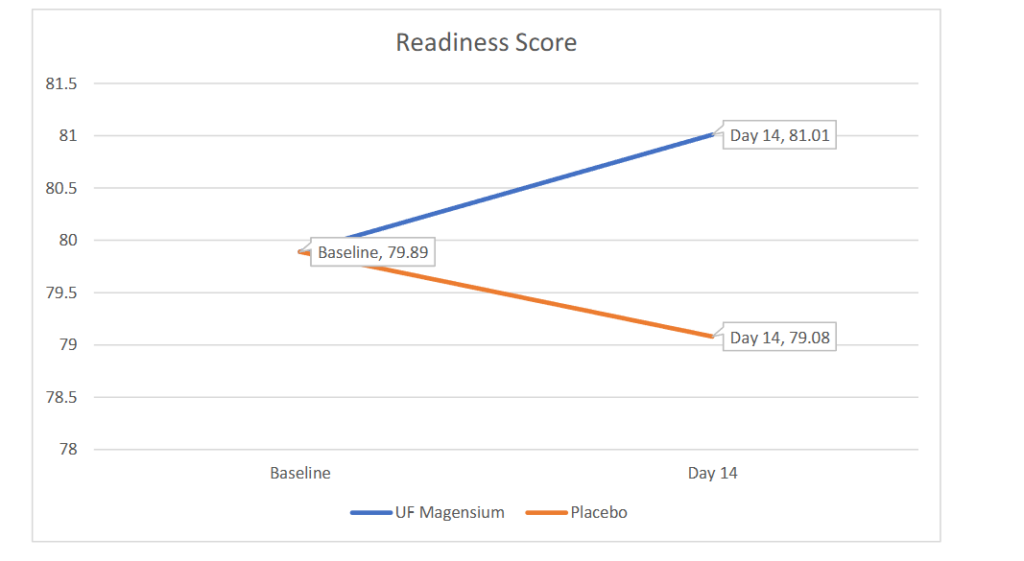
For sleep efficiency, significant main effects for Condition (F(1,192) = 28170, p < .001) and Interaction (F(2,384) = 4.35, p = .01), but no significant Time main effect (F(2,384) = 0.54, p = .59) were found. Magnesium Condition Sleep Efficiency was significantly better than the Placebo Condition. For the Readiness Score significant main effect for Condition (F(1,366) = 121695.48, p < .001) and Interaction (F(2,732) = 7.04, p = .001) were found indicating the Readiness improved significantly for the Magnesium Condition compared to the Placebo Condition (see Figure 1).
Figure 1: Oura Ring Readiness Scores by Condition (Significant Improvement in Magnesium Compared to Placebo Condition)
For Activity Balance a significant main effect for Time (F(2,732) = 5.00, p = .007) and Condition (F(1,366) = 68073.29, p < .001) as well as a significant Interaction (F(2,732) = 10.35, p < .001) were found. Significant improvements were found in Readiness Score Activity Balance for the Magnesium Condition compared to the Placebo Condition.
For the Heart Rate Variability Readiness Score, significant Condition (F(1,366) = 22065.39, p < .001) Time (F(2,732) = 6.59, p = .001), and Interaction (F(2,732) = 7.34, p = .001) were evidenced. Magnesium Condition had a significant improvement and less of a decrease compared to Placebo Condition.
Discussion
The purpose of this randomized placebo-controlled double-blind pilot trial was to examine the effectiveness of magnesium supplementation on sleep quality and mood for adults with nonclinical insomnia symptoms (i.e., occasional sleeplessness) using both subjective and objective measures. The results of this study demonstrated that supplementation with magnesium is safe and resulted in significant improvements in several sleep quality, daytime activity, and mood outcomes compared to placebo. Study findings, limitations, and future research directions are discussed below.
For self-reported sleep quality, the Magnesium Condition compared to the Placebo Condition had significantly improved sleep quality as assessed by the Pittsburgh Sleep Quality Index. Nonsignificant improvements (i.e., trending in the right direction) were evidenced for the Magnesium Condition compared to the Placebo Condition for insomnia symptoms and restorative sleep (i.e., refreshing quality of sleep). Our findings contribute to the growing body of evidence on the positive effects of magnesium supplementation on sleep quality.²⁶ Future research in diverse and larger samples are encouraged to elucidate the effects of these positive trending results.
For mood, significant improvements for the Tension, Anger, and Depression Subscales and the POMS Total for the Magnesium Condition compared to the Placebo Condition were found. The Magnesium Condition also had larger improvements in general feelings of perceived stress, (i.e., degree to which situations are appraised as stressful), anxiety, daytime fatigue (i.e., tired, weary, exhausted), and the impact of pain on sleep compared to the Placebo Condition, albeit nonsignificant. These findings are consistent with research showing the mood enhancing effects of magnesium supplementation, in particular with depression and anxiety symptoms.²⁶˒²⁸
For the objective sleep results, deep sleep improved over time for the Magnesium Condition, and worsened for the Placebo Condition as indicated by less light sleep. Deep sleep is the most restorative and rejuvenating sleep stage. During deep sleep breathing is slow, heartbeat is regular, and muscles are relaxed; and it is the period where the body heals itself (e.g., replaces cells, builds muscle tissue, and heals wounds). Deep sleep encompasses between 0 to 35% of total sleep, and the average adult spends 15 to 20% of their total sleep time in deep sleep.
Regarding cognition, deep sleep contributes to thinking, creativity, and memory consolidation and restoration, specifically procedural and declarative memory. This deep sleep stage allows the brain to rest and recover, which assists with improving cognitive function, concentration, and alertness. And during deep sleep the brain processes and integrates new information, which can improve memory retention and learning. We found that magnesium supplementation improved deep sleep, which provides an explanation for previous findings that magnesium supplementation improved cognitive abilities compared to placebo.²⁹
For activity outcomes, the participants had significant improvements in daytime activity measures. First, daily physical activity, (i.e., Activity Daily Movement) which is an assessment of walking/steps per day, increased for the Magnesium Condition compared to a decrease for the Placebo Condition. Second, the Magnesium Condition had significant improvements in Readiness compared to the Placebo Condition. The Readiness Score consists of eight contributors (body temperature, sleep, heart rate variability, sleep balance, previous day activity, activity balance, resting heart rate, and recover index) that blend with one another to provide an indication of how ready people are “to take on the day”. In other words, it is an indicator of how “ready” the body is to engage in activity; and it is based on the previous day’s resting heart rate, heart rate variability balance, body temperature, and previous night’s sleep quality.³⁰
Finally, the Magnesium Condition had significant improvements in Readiness Activity Balance compared to the Placebo Condition. Readiness Activity Balance is the level to which the participant reached maximum activity capacity without overtraining. A higher score is associated with balanced low, moderate, and high intensity activities. These activity results support previous research findings of a bidirectional relationship between improved sleep quality and increased daytime activity.²⁸˒²⁹ Insufficient sleep is linked to reduced energy, productivity, and physical activity as well as increased feeling of fatigue.³¹˒³²
Research is showing the importance of magnesium for sleep and adding to the growing research finding the positive effects of magnesium supplementation on sleep quality in both clinical and nonclinical populations. For example, low magnesium levels can negatively influence sleep and accelerates aggravate cellular DNA damage via telomere attrition.³¹˒³³
The strengths of the study include a double-blind placebo-controlled trial with both self-report and objective assessments in people’s natural sleep environment. Future studies with larger sample size and longer assessment periods in both clinical and nonclinical sleep populations are encouraged so that more definitive conclusions can be made regarding the potential for this specific magnesium supplement to positively impact sleep and activity health. In summary, the results of this study demonstrate that supplementation with magnesium is safe and resulted in significant improvements in sleep quality, activity, and mood in adults with nonclinical poor sleep quality.
Conclusion
This randomized, placebo-controlled, double-blind pilot trial investigated the impact of magnesium supplementation on sleep quality and mood in adults with nonclinical insomnia symptoms. Results indicated that magnesium supplementation is safe and significantly improved sleep quality, mood, and daytime activity. Participants in the Magnesium Condition showed marked improvements in sleep quality and mood, with trends suggesting benefits for insomnia symptoms and restorative sleep. Objective measures revealed better deep sleep in the Magnesium Condition, enhancing cognitive and physical restoration. Additionally, increased daily physical activity and readiness scores were observed. Despite limitations, such as small sample size and short duration, the study highlights magnesium’s potential for improving sleep and overall well-being. Future research with larger, diverse samples and extended assessment periods is recommended.
Declarations
Disclosure of potential conflicts of interest:
The authors declare no conflicts of interest.
Acknowledgment Statement:
The authors thank Jacksonville University for providing support to complete this study. All individuals have consented to approval.
Funding Statement:
Trial was funded in part by Upgraded Formulas®.
Non-financial interests:
None to declare.
Availability of data and materials:
Data and/or statistical analyses are available upon request on a case-by-case basis for noncommercial scientific inquiry and/or educational use as long as Institutional Review Board restrictions and research agreement terms are not violated.
Informed consent:
Informed consent was obtained from all individual participants included in the study.
Compliance with ethical standards:
The authors have no potential conflicts of interest. The study involves human participants and ethical approval and informed consent was obtained (Sterling IRB approval 10721).
Ethical approval:
“All procedures performed in studies involving human participants were in accordance with the ethical standards of the institutional and/or national research committee and with the 1964 Helsinki declaration and its later amendments or comparable ethical standards.”
Ethical Committee Permission:
Sterling IRB approval 10721.
Clinical Trials Registry:
ISRCTN70584524.
References
1. Kocevska D, Lysen TS, Dotinga A. Sleep characteristics across the lifespan in 1.1 million people from the Netherlands, United Kingdom and United States: A systematic review and meta-analysis. Nat Hum Behav. 2021;5(1):113-122. doi: 10.1038/s41562-020-00965-x.
2. Adjaye-Gbewonyo D, Ng AE, Black LI. Sleep difficulties in adults: United States, 2020. NCHS Data Brief, no 436. Hyattsville, MD: National Center for Health Statistics. 2022. DOI: https://dx.doi.org/10.15620/ cdc:117490.
3. Yue JL, Chang XW, Zheng JW, et al. Efficacy and tolerability of pharmacological treatments for insomnia in adults: A systematic review and network meta-analysis. Sleep Med Rev. 2023;68:101746. doi: 10.1016/j.smrv.2023.101746.
4. Abbasi B, Kimiagar M, Sadeghniiat K, et al. The effect of magnesium supplementation on primary insomnia in elderly: A double-blind placebo-controlled clinical trial. J Res Med Sci. 2012;17(12):1161-1169.
5. Arab A, Rafie N, Amani R, & Shirani F. The role of magnesium in sleep health: A systematic review of available literature. Biol Trace Elem Res. 2023;201(1), 121–128.
https://doi.org/10.1007/s12011-022-03162-1.
6. Cao Y, Zhen S, Taylor A, Appleton S, Atlantis E, Shi Z. Magnesium intake and sleep disorder symptoms: Findings from the Jiangsu Nutrition Study of Chinese adults at five-year follow-up. Nutrients. 2018;10(10), 1354.
https://doi.org/10.3390/nu10101354.
7. Watanabe M, et al.. GABA and GABA receptors in the central nervous system and other organs. Int Rev Cytol. 2002;213:1–47.
8. Held K, et al. Oral Mg(2+) supplementation reverses age-related neuroendocrine and sleep EEG changes in humans. Pharmacopsychiatry. 2002;35(4):135–143.
9. Billyard AJ, et al.. Dietary magnesium deficiency decreases plasma melatonin in rats. Magnes Res. 2006;19(3):157–161
10. Chan V, Lo K. Efficacy of dietary supplements on improving sleep quality: A systematic review and meta-analysis. Postgrad Med J. 2022;98(1158): 285-293. doi:10.1136/postgradmedj-2020-139319.
11. Dhillon VS, Deo P, Thomas P, Fenech M. Low magnesium in conjunction with high homocysteine and less sleep accelerates telomere attrition in healthy elderly Australians. Int J Mol Sci. 2023;24(2):982. DOI: 10.3390/ijms24020982.
12. Djokic G, Vojvodic P, Korcok D, et al. The effects of magnesium – melatonin – vit B complex supplementation in treatment of insomnia. Open Access Maced J Med Sci. 2019;7(18):3101-3105. doi:10.3889/oamjms.2019.771.
13. Gallagher C, Austin V, Dunlop KA, et al. Effects of supplementing zinc magnesium aspartate on sleep quality and submaximal weightlifting performance, following two consecutive nights of partial sleep deprivation. Nutrients. 2024;13;16 (2):251. doi: 10.3390/nu16020251.
14. Bastien CH, Vallieres A, Morin CM. Validation of the Insomnia Severity Index as an outcome measure for insomnia research. Sleep Med. 2001;2(4):297-307.
15. Buysse DJ, Ancoli-Israel S, Edinger JD, Lichstein KL, Morin CM. Recommendations for a standard research assessment of insomnia. Sleep. 2006;29(9):1155-73. doi: 10.1093/sleep/29.9.1155.
16. Drake CL, Hays RD, Morlock R, et al. Development and evaluation of a measure to assess restorative sleep. J Clin Sleep Med. 2014;10 (7):733-41, 41A-41E. doi: 10.5664/jcsm.3860.
17. McNair DJ, Lorr M, Droppleman LF. Manual for the Profile of Mood States. San Diego, CA: Educational and Industrial Testing Services; 1971.
18. Gradisar M, Lack L, Richards H, et al. The Flinders Fatigue Scale: Preliminary psychometric properties and clinical sensitivity of a new scale for measuring daytime fatigue associated with insomnia. J Clin Sleep Med. 2007;3(7):722-8. PMCID: PMC2556916.
19. Cohen S, Kamarck T, Mermelstein R. A global measure of perceived stress. J Health Soc Behav. 1983;24(4):385-96. PMID: 6668417.
20. Du L, Guizhen Y, Wang W, et al. Developing the modified 4-item version of perceived stress scale for functional dyspepsia. BMC Gastroenterol. 2023; 29;23(1):97. doi: 10.1186/s12876-023-02728-0.
21. Ayearst L, Harsanyi Z, Michalko KJ. The Pain and Sleep Questionnaire three-item index (PSQ-3): a reliable and valid measure of the impact of pain on sleep in chronic nonmalignant pain of various etiologies. Pain Res Manag. 2012;17(4):281-90.
22. Mikkonen J, Leinonen V, Luomajoki H, et al. Cross-cultural adaptation, reliability, and psychophysical validation of the pain and sleep questionnaire three-item index in Finnish. J Clin Med. 2021; 23;10(21):4887. doi: 10.3390/jcm10214887.
23. Spielberger CD, Gorsuch RL, Lushene RE, Vagg PR, Jacobs GA. Manual for the State-Trait Anxiety Inventory. Palo Alto, CA: Consulting Psychologists Press; 1983.
24. Mehrabadi MA, Azimi I, Sarhaddi F, et al. Sleep tracking of a commercially available smart ring and smartwatch against medical-grade actigraphy in everyday settings: Instrument validation study. JMIR Mhealth Uhealth. 2020;8(10):e20465. doi:10.2196/20465.
25. de Zambotti M, Rosas L, Colrain IM, Baker FC. The sleep of the ring: Comparison of the ŌURA sleep tracker against polysomnography. Behav Sleep Med. 2019;17(2):124-136.
doi:10.1080/15402002.2017.1300587.
26. Rawji A, et al. Examining the Effects of Supplemental Magnesium on Self-Reported Anxiety and Sleep Quality: A Systematic Review. Cureus. 2024 Apr 29;16(4):e59317. doi: 10.7759/cureus.59317.
27. Wang H, Jin M, Xie M, et al. Protective role of antioxidant supplementation for depression and anxiety: A meta-analysis of randomized clinical trials. J Affect Disord. 2023 Feb 15;323:264-279. doi:10.1016/j.jad.2022.11.072.
28. Saba, S., Nehrir, B., & Faizi, F. (2022). Effect of short-term magnesium supplementation on anxiety, depression and sleep quality in patients after open-heart surgery. Magnesium Res, 35(2), 62–70. https://doi.org/10.1684/mrh.2022.0503
29. Dahat P, Toriola S, Satnarine T, et al. Correlation of various sleep patterns on different types of memory retention: A systematic review. Cureus. 2023; 22;15(7):e42294.
doi: 10.7759/cureus.42294.
30. Mead MP, Baron K, Sorby M, & Irish LA. Daily associations between sleep and physical activity. Int J Behav Med. 2019; 26(5), 562–568. https://doi.org/10.1007/s12529-019-09810-6.
31. Herring MP, Monroe DC, Kline CE, O’Connor PJ, MacDonncha C. Sleep quality moderates the association between physical activity frequency and feelings of energy and fatigue in adolescents. Eur Child Adolesc Psychiatry. 2018;27(11):1425-1432. doi:10.1007/s00787-018-1134-z.
32. Dhillon, VS, Deo P, Thomas P, Fenech M. Low magnesium in conjunction with high homocysteine and less sleep accelerates telomere attrition in healthy elderly Australian. Int J Mol Sci. 2023; 4;24(2):982. doi: 10.3390/ijms24020982.
33. Mah J, Pitre T. Oral magnesium supplementation for insomnia in older adults: a systematic review & meta-analysis. BMC Complement Med Ther. 2021;21(1):125. doi:10.1186/s12906-021-03297-z.
Most read articles by the same author(s)
- Heather A. Hausenblas, PhD, Tarah Lynch, MS, Shaylee Beefus, Tiffany Braverman, Stephanie Hooper, MPH, Effectiveness of a proprietary Dichrostachys glomerata extract (DYG-400®) on Adult’s Sleep Quality and Activity: A Pilot Trial , Medical Research Archives: Vol 12 No 4 (2024): April issue, Vol.12, Issue 4