

Activated Charcoal Dentifrices: Analysis and Findings
Activated charcoal-based dentifrices: Spectroscopy and Thermal analysis
Isis A.V.P. Poiate, Bianca B. Souza, Mônica C. Andrade, Edgard Poiate Jr
OPEN ACCESS
PUBLISHED 31 August 2025
CITATION Poiate IAVP, Souza BB., et al., 2025. Activated charcoal-based dentifrices: Spectroscopy and Thermal analysis. Medical Research Archives, [online] 13(8). https://doi.org/10.18103/mra.v13i8.6903
COPYRIGHT © 2025 European Society of Medicine. This is an open-access article distributed under the terms of the Creative Commons Attribution License, which permits unrestricted use, distribution, and reproduction in any medium, provided the original author and source are credited.
DOI https://doi.org/10.18103/mra.v13i8.6903
ISSN 2375-1924
ABSTRACT
Different types of dentifrices with the whitening proposal have been launched in the market. However, often the characteristics disclosed by the manufacturers are not compatible with the reality of the products.
Objectives: To characterize activated charcoal-based dentifrices using infrared spectroscopy and thermal analysis, thermogravimetric analysis and derived thermogravimetry, seeking a solid basis to understand the implications of their components in their characteristics and performance.
Material and Methods: Seven different brands of activated charcoal-based dentifrices were analyzed besides two conventional dentifrices (control), with an operator blinded to the sample brand using triplicate samples, via infrared spectroscopy in a spectrophotometer with Fourier transform. The range of the spectra was comprised between 700 and 4000 cm-1, using 4 cm-1 resolution, with a number of accumulations of 32 scans per spectrum. The samples were also submitted to thermal analysis, thermogravimetric analysis, derived thermogravimetry and differential scanning calorimetry in air atmosphere, between room temperature and 900° C, at the heating rate of 10° C/min.
Results: The study showed that all dentifrices in the form of paste or gel present inorganic abrasives in their formulation. Dentifrices in the form of powder are almost entirely composed of carbonaceous components, but not always compatible with AC. Twin Lotus Herbaliste dentifrices, My Magic Mud Bleaching, Groomarang Teeth Whitening Powder and Carvvo, did not present fluoride in their composition.
Conclusions: Activated charcoal dentifrices in paste or gel form have equivalent or higher abrasiveness than conventional dentifrices, thus, associated with mechanical stress at the enamel-cement junction may contribute to the development of non-carious cervical lesions. Carvvo dentifrice powder suggested lower adsorption power and higher concentration of inorganic substances than Groomarang. It is proposed to carry out laboratory and clinical research to deepen the knowledge about the activated charcoal dentifrices.
Keywords: Activated charcoal. Infrared analysis. Thermal analysis. Whitening dentifrices.
THE EUROPEAN SOCIETY OF MEDICINE
Medical Research Archives, Volume 13 Issue 8
RESEARCH ARTICLE
Introduction
The benefits of using dentifrices go beyond dental hygiene because they commonly carry in their formulation ingredients with therapeutic and cosmetic functions. With this, dentifrices with a whitening proposal represent for the population an alternative of low cost and easy access in the search for whiter smiles. This type of product has been gaining more and more space in the market, thus impelling, the search of the manufacturers for new formulations.
However, bleaching dentifrices are generally associated with abrasives, peroxides, enzymes and blue dyes. Recently, a new type of whitening dentifrice has drawn the attention of the population: the activated charcoal-based dentifrices. They commonly have black coloration, due to the activated charcoal (AC) present in their formulation, besides, they are marketed in the form of paste, or gel or powder.
Activated charcoal is a high carbon substance produced from the dehydration and carbonization of raw materials such as peat, core and shell of nuts, wood, coconut shells, coffee beans, seeds and fruit peels, followed by its activation. The method used in its preparation and the precursor material are the primary determinants of its characteristics and final properties. Its structure is highly porous with an extensive surface area. With this in mind activated charcoal is a versatile adsorbent for the removal of various types of pollutants, such as dyes, drugs, poisons, among others. This material is the most commonly used high-performance adsorbent for adsorption processes of organic compounds.
Considering the speed of innovations brought by the cosmetic industry to the consumer market and the impact that new products can have on consumers’ lives, numerous analyzes are necessary to confirm the identity/composition and quality of the product. In this context, a method of analysis well known and used in the industries is the infrared spectroscopy. The infrared spectroscopy (IRS) analysis is based on the detection of the vibrations of the atoms of the molecules that make up the sample, the infrared spectrum is obtained during the passage of the IRS radiation by the sample and is considered one of its most physicochemical properties characteristics, having extensive application in the identification of its compounds.
Another widely used methodology for basic materials research is Thermal Analysis (TA), which corresponds to a set of techniques that unveil the chemical or physical properties of a substance and/or its reaction products, while the sample is exposed to a temperature-controlled programming. The methods via IRS and TA have become indispensable for the scientific investigation, as well as for control of the composition and quality of the materials present in the products by the industries. Since no studies on the behavior of activated charcoal-based dentifrices were found to date, the purpose of this study was to characterize them, comparing them with conventional dentifrices, in order to analyze their raw materials, their characteristics and properties. In this way we intend to unravel the possible behaviors of this new product, serving as a fundamental basis for new investigations, laboratory researches and clinics about this new dentifrice.
Material and Methods
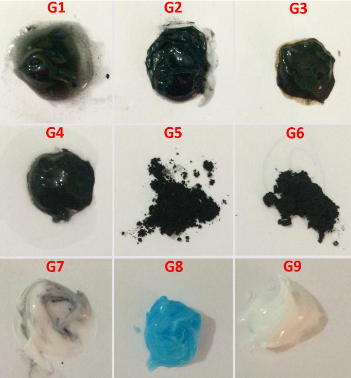
Seven different activated charcoal-based dentifrices were evaluated: Beverly Hills Formula (G1), Curaprox Black is White (G2), Twin Lotus Active Charcoal Toothpaste Herbaliste Triple Action (G3), My Magic Mud Whitening (G4), Groomarang Activated Teeth Whitening Powder (G5), Carvvo (powder) (G6), Colgate Total 12 Carbon (G7). Moreover, the toothpaste control Colgate total 12 whitening (G8) and Colgate Total 12 Clean Mint (G9). Table 1 shows the composition described by the manufacturer of each of the evaluated dentifrices, and Figure 1 shows the dentifrices sample.
The infrared spectroscopy and thermal analysis were carried out with an operator blinded to the sample brand using triplicate samples. The statistical tool used for data analysis was Microsoft Excel 2019.
Table 1: Description of the dentifrices used in the research.
| Group | Dentifrice | Manufacturer | Composition* | Lot |
|---|---|---|---|---|
| G1 | Beverlly Hills Perfect White/Black | Beverlly Hills Formula | Aqua, Sorbitol, Hydrated Silica, Glycerin, Pentasodium Triphosphate, Tetrasodiun Pyrophosphate, Sodium Lauryl Sulphate, Aroma, PEG-32, Cellulose Gum, Sodium Fluoride, Cocomidopropyl Betaine, Sodium Saccharin, Charcoal Powder, Limonene. | 5470 |
| G2 | Curaprox Black Is White | Curaprox | Aqua, Sorbitol, Hydrated Silica, Glycerin, Charcoal Powder, Bentonite, Aroma, Decyl Glycoside, Sodium Monofluorophosphate, Cocomidopropyl Betaine, Tocopherol, Mica, Xanthan, Hydroxyapatite (Nano), Titanium Dioxide, Microcrystalline Cellulose, Maltodextrin, Potassium Acesulfame, Sodium Benzoate, Potassium Chloride, Potassium Sorbate, Methyl Lactate, Methyl Diisopropyl Propionamide, Ethyl Mentane Carboxamide, Sucrose, Zea Mays Starch, Stearic Acid, Cetearyl Alcohol, Citrus Limon Peel Oil, Citric Acid, Lactoperoxidase, Glucose Oxidase, Amyloglucosidase, Potassium Thiocynate, Tin Oxide, Hydrogenated Lecithin, Limon, Ci 75815, Ci 77289. | 72MHD |
| G3 | Twin Lotus Hebaliste | Twin Lotus | Sorbitol, Silica, Water, Glycerin, CocamidopropylBetaine, Guava, Clove, Flavour Transatak (Herbal Combination), Sodium Lauroyl Sarcosinate, Charcoal Powder, Clove Oil, Menthol, Cellulose Gum, Xanthan Gum, Sodium Saccharin, Disodium EDTA, Titanium Dioxide. | 6916119 |
| G4 | My Magic Mud Wintergreen | My Magic Mud | Distilled Water, Diatomaceous Earth, Non-GMO, Xylitol, Bentonite Clay, Organic Coconut Oil, Activated Coconut Shell Charcoal, Wintergreen Oil, Citric Acid, Grapefruit Seed Extract, Sweet Orange Organic Oil, Potassium Sorbate, Rosemary Oil, Organic Stevia, Organic Tea Tree Oil, Organic Vanilla Extract, Xanthan Gum | BE19 |
| G5 | Groomarang Activated Teeth Whitening Powder | Groomarang | Charcoal Powder, mentha Piperita Oil, Aqua, Maltodextrin, Piperita Leaf Extract, Pure Orange. | 2150 |
| G6 | Carvvo | CI-77266, Kaolin Clay, CitrusAurantiun, Dulcis Oil, Aroma. | 30201669440118 | |
| G7 | Colgate Total 12 Charcoal Deep Clean | Colgate | Water, Sorbitol, Hydrated Silica, PVM/MA Copolymer, Sodium Lauryl Sulfate, Flavor, Carrageenan, Sodium Hydroxide, CI 77891, Triclosan, Sodium Saccharin, Sodium Fluoride, Mica, Charcoal Powder. | 16355TH11 F1 |
| G8 | Colgate Total 12 Whitening | Colgate | Hidrated Silica, Water, Sorbitol, PVM/MA Copolymer, Sodium Lauryl Sulfate, Flavor, Carrageenan, Sodium Hydroxide, Sodium Fluoride, Trichlosan, Sodiun Saccharin, CI-77891, CI-77019 (Mica), CI-42090, Limonene, Cinnamal, Eugenl, Sodium Fluoride. | 8007 |
| G9 | Colgate Total 12 Clean Mint | Colgate | Sodium Fluoride (1450 ppm Fluoride), Triclosan 0.3%, Water, Sorbitol, Hydrated Silica, Sodium Lauryl Sulfate, PVM / MA Copolymer, Flavor, Carrageenan, Sodium Hydroxide, Sodium Saccharin, Titanium Dioxide, Dipentene | 7355BR121D |
Infrared Spectroscopy
The infrared spectra were collected on a Fourier transform spectrophotometer (IV-TF) (Frontier model, Perkin-Elmer, USA). The spectra were generated with infrared light at a wavelength ranging from 700 to 4000 cm-1 using 4 cm-1 resolution with a number of accumulations of 32 scans, for each spectrum. The instrument was equipped with the universal accessory containing an attenuated total reflection crystal, ATR (MIRacle ATR, Pike Technologies, USA). The program used was Spectrum, version 10.4.2, 2014 (Perkin Elmer, USA). Three readings were performed for each sample before the thermal analysis and one more reading of the residue resulting from the thermal analysis.
Thermal Analysis
The thermal analysis of the samples were carried out in an air atmosphere between ambient temperature and 900 °C, at the heating rate of 10° C/min, obtaining, simultaneously, Thermogravimetric Analysis (TGA), Differential Scanning Calorimetry (DSC) and Derived Thermogravimetry (DTG). The initial weight of the samples was from 3 to 6 mg, and the analyzes were performed on the Simultaneous Thermal Analyzer (STA 6000, PerkinElmer, USA) with the Pyris program (Perkin Elmer).
Results
The infrared analysis formed spectra that were recorded in graphs of absorbance intensity (in %) versus wavelength (in cm-1). The thermal analysis (TA) resulted in thermal decomposition curves of the samples which were recorded in mass graphs (%) versus temperature (°C). However, for better visualization of the events in the mass loss, the Derived Thermogravimetry (DTG) curves were considered. The results of TA and IRS (before burning) are presented in Tables 2 and 3, respectively.
Table 2: Results of the thermal analysis from DTG.
| Dentifrice Group | DTG peak (°C) | Total mass loss (%) | Final temperature of degradation (°C) |
|---|---|---|---|
| G1 | 74, 115, 305, 345, 462 | 79 | 495 |
| G2 | 81, 114, 248, 308, 326, 421, 536 | 87 | 603 |
| G3 | 112, 269, 310, 415, 543 | 74 | 587 |
| G4 | 104, 247, 315. 602 | 68 | 657 |
| G5 | 66, 692 | 91 | 847 |
| G6 | 57, 630 | 71 | 737 |
| G7 | 110, 157, 168, 220, 305, 325, 428 | 77 | 468 |
| G8 | 84, 117, 222, 287, 320, 421 | 77 | 447 |
| G9 | 83, 112, 218, 297, 333, 434 | 80 | 467 |
Table 3: Results of Infrared Analysis (before burning).
| Dentifrice Group | Peak 1 (cm-1) | Peak 2 (cm-1) | Peak 3 (cm-1) | Peak 4 (cm-1) | Peak 5 (cm-1) |
|---|---|---|---|---|---|
| G1 | 3367.77 | 1645.13 | 1424.01 | 1080.05 | 788.50 |
| G2 | 3351.53 | 1646.50 | 1420.92 | 1081.41 | 1043.98 |
| G3 | 3387.81 | 1080.11 | 794.27 | – | – |
| G4 | 3379.77 | 1642.36 | 1063.18 | 791.31 | – |
| G5 | 3361.76 | 1019.33 | – | – | – |
| G6 | 1570.01 | 1046.84 | 948.42 | 798.89 | – |
| G7 | 3368.95 | 1644.18 | 1419.80 | 1082.00 | 780.00 |
| G8 | 3379.91 | 1650.72 | 1426.64 | 1080.19 | 791.58 |
| G9 | 3363.00 | 1640.00 | 1438.00 | 1072.00 | 769.00 |
Discussion
The infrared spectroscopy and thermal analysis are used to investigate chemical, physical and information on, for example, the purity of a sample, its identity, reactivity, stability. When a sample undergoes thermal change, physical and/or chemical changes occur at the specific temperatures characteristic of the components forming the sample. However, thermal analysis provide indirect data; thus, they are generally associated with spectroscopic methods. Thus, in this study, the samples of activated charcoal-based dentifrices and conventional dentifrices were submitted to TA and IRS, aiming at the fundamental study of their characteristics. As advantages of these characterization techniques, it is essential to obtain a great variety of information in a single graph, besides the analysis is done with a small amount of material and without previous preparation of the samples.
The manufacturers justify the use of activated charcoal (AC) in the dentifrices for their physical and chemical properties that make it a universal adsorbent, in addition to its mechanical removal of pigments through abrasion, but without damaging the dental structure. Above all, there are different types and qualities of AC, since the way it is manufactured and its raw material are the primary determinants of its properties. In the dentifrices, the AC is in different granulometric distributions, is produced with different raw materials and is found in various concentrations. In view of these facts, the detailed specifications of the AC present in the dentifrices, as well as their concentration, would be relevant. This type of whitening dentifrice usually has black coloration, justified by the manufacturers, by the presence of the AC in its composition. Among the dentifrices evaluated in the present study, all showed black coloration, except for Colgate Total 12 Carbon which shows white color with light gray areas, suggesting a lower amount of AC in this dentifrice. Another critical factor is the association of AC with other ingredients, which may influence its properties and behavior during brushing.
Experimental analyses conducted by Ghajari et al. (2021) showed that several charcoal-containing toothpastes resulted in statistically significant changes to the enamel surface after brushing simulations. However, the differences in abrasiveness were not substantial when compared across different commercial brands, indicating that the formulation and distribution of charcoal particles influence the outcomes more than the mere presence of charcoal.
The thermal analysis simultaneously generated results of the Thermogravimetric Analysis (TGA), Differential Scanning Calorimetry (DSC) and Derived Thermogravimetry (DTG). TGA is used to measure mass variations of the sample according to the change in temperature or time. The derivative of the mass loss curve, DTG, better records the events occurring associated with mass loss during temperature variation. The heat flux curve, DSC, also showed events associated with mass loss, which allowed to focus the discussion on the derivative of thermogravimetric analysis (DTG). The derivative of thermogravimetric analysis curves formed in the analysis of the studied groups presented a considerably different decomposition pattern, mainly in the aspects of the number of peaks formed and the percentage of residual mass at 900° C. None of the dentifrices had a 100% mass loss, suggesting the presence of substances that do not degrade at 900° C, inorganic substances, such as aluminosilicates, quartz, amorphous silica, which are abrasives commonly used in the dentifrices, besides the presence of the commonly formed ashes by AC, usually composed of copper, iron, chlorides, among other residues.
During thermal analysis, the dentifrices were heated to 900° C and the amount of residual mass formed was 9 (Group 5) to 32% (Group 4) of the total mass of the dentifrices, corresponding to inorganic material that did not degrade. It can also be observed that the dentifrices presented several peaks of degradation temperatures (Table 2), equivalent to the decomposition of the different ingredients that compose them (Table 1). According to Anusavice (2005), dentifrices in the form of powder are composed almost entirely of 90 to 98% abrasive and in the case of dentifrices in the form of AC powder, a smaller variety of volatile compounds was observed, which was confirmed by the smallest amount of DTG peaks formed during TA. Only two peaks in Groomarang Activated Teeth Whitening Powder (G5) and Carvvo (G6), which presented the highest final degradation temperatures, 847 and 737° C, respectively. In the dentifrices in the form of paste or gel, four peaks were formed in the analysis of My Magic Mud Whitening (G4), five peaks in the Beverly Hills Formula (G1) and Twin Lotus Herbaliste (G3), six peaks in Colgate Total 12 Clean Mint (G9 – control) and Colgate Total 12 Whitening (G8 – control), seven peaks in Colgate Total 12 Carbon (G7) and Curaprox Black is White (G2).
The loss of mass between the samples in the form of powder was noticed by the significant difference, Carvvo (G6) presented 29% of residual mass, and the Groomarang Activated Teeth Whitening Powder (G5) only 9%. These values indicate a significant difference in the quantity of inorganic material. The Carvvo dentifrice did not describe AC as its components, but rather CI-77266 (Table 1), which, like AC, is an inert carbonaceous substance. However, this type of carbon has properties and a different manufacturing method than AC. Moreover, unlike AC, it does not stand out due to the adsorption capacity, but because of its great pigmentation power and the ability to, in combination with the rubbers, substantially increase the mechanical strength of these materials. It has trace amounts of various inorganic elements such as copper, manganese, iron, calcium, arsenic, lead, potassium, chromium, selenium and zinc. The presence of CI-77266 was evidenced in the thermal analysis, since despite the high temperature of final degradation, at 737° C, only 71% of its total mass was degraded, confirming the presence of large amounts of inorganic material, probably due to the presence of CI-77266 and clay in its composition.
The Groomarang Powder (G5) dentifrice presented the lowest percentage of residual mass, only 9% corresponding to the AC ash, which is justified by the absence of inorganic ingredients in its composition. Despite this, this dentifrice is almost entirely made up of AC powder, which can act as an abrasive. In the dentifrices, the abrasives are essential as auxiliaries of the mechanical removal of the biofilm. However, they can act to generate cleaning, polishing or even surface wear, and can, therefore, be considered an aggressive abrasive or not the dental structure.
In this context, a recent systematic review conducted by Montero Tomás et al. (2023) concluded that although toothpastes containing activated charcoal are popular due to claims of natural whitening, their actual effectiveness is limited, and their abrasive potential remains a concern. In addition to the risk of compromising enamel integrity, especially with prolonged use of abrasive agents, such as activated charcoal, have also been associated with the formation of non-carious cervical lesions (NCCLs). Finite element studies conducted by Poiate et al. (2009) demonstrated that excessive mechanical stress at the enamel-cement junction can exceed the enamel’s tensile strength, promoting the formation of microfractures. These findings reinforce the theory that the combination of abrasive toothpastes and occlusal stress may contribute to the development of NCCLs. Poiate et al. (2023) evaluate the displacement and stress distribution in the cervical region of a mandibular central incisor tooth within wedge-shaped lesion (simulating abfraction lesion) with a static load from 12.1 to 42.1N applied in incisal buccal slope at 15º in relation to the tooth’s long axis in a experimental setup by means of Laser Speckle (LS) and 3D Finite Element Analysis (FEA). The LS presents higher displacement in the wedge-shaped lesion than the FEA, but both had an excellent agreement in the displacement direction, thus both methods bring important results of the stress and displacement that are fundamental in planning preventive and restorative approach in NCCLs.
Regarding activated charcoal, no scientific research was found to show the abrasive potential of this material on the dental surface proving its safety and effectiveness for use as toothpaste. However, McCarty, et al. (2015) evaluated the abrasive effect of AC powder on acrylic resin models. For this, they made three models of acrylic resin of the same size, structure and composition for the test, applying then 2,000 brushing movements. One model was brushed with material from a AC capsule mixed with 1 mL of water, another one with a pea-sized dose of whitening toothpaste with 1 mL of water and the third model was brushed with 1 mL of water. They then compared the surface of each of the models. It was observed that AC was more abrasive than a bleaching toothpaste in acrylic resins.
In contrast, Yaghini et al. (2023) did not find a significant increase in enamel surface roughness after simulated brushing with charcoal-based toothpastes, suggesting that under controlled conditions, these products may not be as harmful as previously believed. However, variability in formulation and the brushing force applied in real-life conditions may lead to different outcomes. It is described in Curaprox Black is White (G2) composition provided by the manufacturer, with different inorganic components such as hydrated silica, mica, titanium dioxide, potassium chloride and clay. However, it presented only 13% residual mass. This data shows that despite having various inorganic components, they are present in small quantity. On the other hand, My Magic Mud Whitening (G4) dentifrice presented a higher residual mass formation, 32%. This dentifrice, according to the manufacturer’s description, is composed of clay, diatomaceous earth and potassium sorbate, which are inorganic components that probably resisted the burning up to 900 °C, demonstrating that there is a great concentration of inorganic components in this dentifrice when compared to the others analyzed. The Twin Lotus Herbaliste (G3) dentifrice, after thermal analysis, resulted in 26% residual mass indicating the presence of inorganic components such as silica and titanium dioxide.
All Colgate® brand dentifrices (G7-G9) analyzed have silica, sodium hydroxide, titanium dioxide and mica in their composition, with the mass loss (20 to 23%), and the final degradation temperature (447 to 468° C) were close, therefore, the behavior of the dentifrices of this manufacturer with or without AC was very similar. However, the Colgate Total 12 Clean Mint (G9) dentifrice showed a lower amount of inorganic components, as it resulted in a lower residual mass of the three. Moreover, the amount of AC in Colgate Total 12 Carbon (G7) was shown to be very small, making it difficult to say if AC could play a significant role in the performance of this dentifrice.
Infrared spectroscopy (Table 3) detected the vibrational levels of the chemical bonds of the molecules composing the samples and generated peaks at the characteristic absorbance spectra. Each peak corresponds to the recording of the energy absorbed by the chemical bonds of the molecules forming the sample. Also, by identifying the mode of vibration associated with each peak, the chemical binding in the sample is identified. Peaks at 1080-1160 and 810 cm-1 are characteristic of Si-O-Si vibrational stretches, the siloxane group, found on silica. The peak between 1160 and 1080 cm-1 is related to the asymmetric stretching between Si-O-Si bonds. The peak at 810 cm-1 is related to the symmetrical stretching of the Si-O-Si bonds. The dentifrices that formed the peak corresponding to the siloxane group present the silica in their composition (Table 1), except for My Magic Mud Whitening (G4), however, it is composed of diatomaceous earth, which is an inert powder based on silicon dioxide, which justifies the observed peaks. Among the dentifrices that presented this peak, the Colgate Total 12 Clean Mint (G9) presented lower intensity when compared to the others, suggesting that it has a smaller amount of silica in its composition. Only Groomarang Powder (G5) and Carvvo (G6) (powdered dentifrices) did not present peaks with values close to those mentioned. Clay is often found in activated charcoal-based dentifrices, mainly bentonite clay, which in addition to being used in dentifrices is widely used in oil drilling, ceramic industry, as cargo in polymers, and so forth. The characteristic peak of the clay in the infrared spectrum is around 1033 cm-1 which were observed in the analysis of the dentifrices Curaprox Black is white (G2), My Magic Mud Whitening (G4) and Carvvo (G6).
Broad and intense bands with peaks around 3300 cm-1 in the IRS are formed by stretching O-H and peaks around 1080-1049 cm-1 by stretching C-O. These peaks, identified in the infrared analysis of all dentifrices, except for Carvvo (G6) are characteristic of polysaccharides such as xanthan, xylitol, cellulose gum, maltodextrin, among others that are present in the composition of all dentifrices evaluated, except for Carvvo (powder). Many consumers have sought natural products and are free of toxic ingredients. Within this philosophy, some manufacturers have produced fluoride-free toothpaste. Among the dentifrices evaluated in this study, the Twin Lotus Herbaliste, My Magic Mud Whitening, Groomarang and Carvvo did not present fluoride in their composition. This fact was corroborated by the absence of the peak corresponding to the fluorides, around 1400 cm-1. This peak was found only in the Beverly Hills Formula, Curaprox Black is White and Colgate® dentifrices with similar intensities.
Comparing the different dentifrices of the manufacturer Colgate® analyzed in the research, Colgate Total 12 Clean Mint (conventional), Colgate Total 12 Whitening and Colgate Total 12 Carbon (with AC in the formula), it was found that all obtained similar wavelength absorbances, but presented different intensities at approximately 1644 and 1424 cm-1. The absorbance band at 1644 cm-1 is due to O-H bond vibrations, hydroxyls, or aromatic ring vibrations, typical of carbonaceous materials and the peak at approximately 1424 cm-1 is by flexions of the alkyl groups, C-H, also typical of carbonaceous materials, existing in AC.
Comparing the pastes and gels of the analyzed dentifrices, what is observed in this research is, in part, contradictory to the one proposed by the manufacturers of these activated charcoal-based dentifrices. In other words, on the one hand, materials with AC are proposed as a whitening agent through adsorption of pigments and mechanical removal without attacking the dental structure and, contradictorily, these dentifrices are also composed of a significant amount of silica and other inorganic salts (abrasives), evidenced in the amount of residual mass formed and in the peaks of the infrared analysis. This fact leads to the reflection of what would be the real effect of the activated charcoal in these dentifrices since it acts in conjunction with other abrasives.
The activated charcoal is basically formed by a graphite base, and its edges and vertices can contain different elements such as oxygen, hydrogen and nitrogen, which form the functional groups and inorganic components that compose the ashes, all of them have significant participation in the adsorption processes. AC Activated charcoal ashes are generally formed by inorganic oxides, in addition to Na, K, Mg, Ca, Fe and Al sulfates, phosphates, chlorides, carbonates and silicates. The ash content of the AC may be low (0.1-1%) or reach values above 20%. The infrared spectroscopy analysis of the residual mass formed after thermal analysis of all dentifrices in the form of paste or gel showed peaks corresponding to the siloxane group, justified by the presence of silica that did not degrade to 900° C. Groomarang Powder dentifrice although not containing silica in its formulation showed intense peaks at 1062 and 797 cm-1, which were not present before burning. This can be explained by the fact that phosphates and silicates are components commonly found ashes of AC.
Conclusions
The study concludes that:
- Activated-action dentifrices, whether in paste or gel form, have equivalent or higher abrasiveness than conventional dentifrices. This can be predicted by evaluating the formulations provided by manufacturers, as their formulations contain the same abrasives commonly found in conventional toothpastes, in addition to the activation mechanism, whose abrasive power is still unknown. Thermal analysis results also show variation in compositions due to different types of thermal events in the thermogravimetric derivative curve for each dentifrices.
- Carvvo (powder) dentifrice suggests lower adsorption power and higher concentration of inorganic substances when compared to Groomarang Activated Teeth Whitening Powder, since Carvvo presented CI-77266 in its composition instead of activated charcoal, besides containing clay.
- The combination of abrasive toothpastes, especially with prolonged use of abrasive agents, such as activated charcoal, associated with mechanical stress at the enamel-cement junction may compromising enamel integrity and contribute to the development of non-carious cervical lesions (NCCLs).
- It was evident the need for new laboratory and clinical researches to investigate the behavior of activated charcoal-based dentifrices in the dental structure, as well as for manufacturers to provide the specifications (raw material, granulometry, concentration, and so forth.) of activated charcoal present in their products.
Conflict of Interest Statement:
None.
Funding Statement:
None.
Acknowledgements:
The authors are grateful to the CAPES (Coordenação de Aperfeiçoamento de Pessoal de Nível Superior) by the Productivity Scholarship in Desenvolvimento Tecnológico e Extensão Inovadora do CNPq (310920/2016- and to the FAPERJ (Fundação de Amparo à Pesquisa do Estado do Rio de Janeiro) by the program Jovem Cientista de Nosso Estado da FAPERJ (E-26/203.247/2016).
References:
- Hara AT, Turssi CP. Baking soda as an abrasive in toothpastes: Mechanism of action and safety and effectiveness considerations. J Am Dent Assoc. 2017; 148(11):27-33. doi: 10.1016/j.adaj.2017.09.007.
- Ashe S, Agasti S, Lakkoji S, et al. Novel chromogenic bacteria characterized and their probable treatment options using herbal products and reagents to restrict biofilm formation. J Appl Biomed. 2017;15:291-298.
- Kanwal N, Brauer DS, Earl J, Wilson RM, Hill NKRG. In-vitro apatite formation capacity of a bioactive glass containing toothpaste. J Dent. 2018;68:51-58.
- Joiner A. Whitening toothpastes: a review of the literature. J Dent. 2010;38(2):17-24.
- Brooks JK, Bashirelahi N, Reynolds MA. Charcoal and charcoal-based dentifrices: A literature review. J Am Dent Assoc. 2017;148 (9):661-670.
- Bhatnagar A, Sillanpaa M. Utilization of agro-industrial and municipal waste materials as potential adsorbents for water treatment A review. Chem Eng J. 2010;157:277 296.
- Mor S, Chhoden K, Negi P, Ravindr K. Utilization of nano-alumina and Activated charcoal for phosphateremoval from wastewater. Environmental Nanotechnology, Monitoring & Management. 2017;7:15 23.
- Vargas AMM, Cazetta AL, Kumita MH, Silva TS, Almeida VA. Adsorption of methylene blue on activated carbon produced from flamboyant pods (Delonix regia): Study of adsorption isotherms and kinetic models. Chem Eng J. 2011;168:722-730.
- Cooney DO. Activated Charcoal:Antidote, Remedy and Health Aid. 2nd ed. Teach Services; 2016.
- Blanco M, Villarroya I. NIR spectroscopy: a rapid-response analytical tool. Trends Analyt Chem. 2002;21(4).
- European Agency for the Evaluation of Medicinal Products (EMEA). Note for guidance on the use of near infrared spectroscopy by the pharmaceutical industry and the data requirements for new submissions and variations. The European Agency for the Evaluation of Medicinal Products; 2003.
- Siesler HW, Ozaki Y, Kawata S, Heise HM. Near-infrared spectroscopy: principles, instruments, applications. Wiley-VCH; 2002.
- Alcácer L. Textos de apoio a Química-Física. Determinação da Estrutura Molecular. Métodos Espectroscópios. AEIST; 2007.
- Brown ME. Introduction to thermal analysis: techniques and applications. Chapman and Hall; 1988.
- Jamrógiewicz M. Application of the near-infrared spectroscopy in the pharmaceutical technology. J Pharm Biomed Anal. 2012;66:1-10.
- Hatakeyama T, Quinn FX. Thermal analysis: fundamentals and applications to polymer Science. 2nd ed. Wiley; 1999.
- Haines PJ. Thermal Methods of Analysis – Principles, Applications and Problems. 1st ed. Champman and Hall; 1995.
- Curaprox Black is White. Curaprox. Published May, 2015. Accessed January 12, 2017. www.curaprox.com/data/downloads/21427792206Black_Is_White_e.pdf.
- My Magic Mud. Magic Mud. Published November, 2017. Accessed 16 May, 2018. https://blog.mymagicmud.com/the-science
- Ghajari MF, Shamsaei M, Basandeh K, Galouyak MS. Abrasiveness and whitening effect of charcoal-containing whitening toothpastes in permanent teeth. Dent Res J. 2021;18:51.
- Andrade Junior ACC, Andrade MRTC, Machado WAS, Fischer RG. Estudo in vitro da abrasividade de dentifrícios. Rev Odontol Univ São Paulo. 1998;12(3):231-236. doi:10.1590/S0103-06361998000300006
- Xie X, Zhao Y, Qiu P, Lin D, Qian J, Hou H, Pei J. Investigation of the relationship between infrared structure and pyrolysis reactivity of coals with different ranks. Fuel. 2018;216:521-530.
- Anusavice KJ. Phillips Science of dental materials. 11st ed. Elsevier; 2003.
- Wang MJ, Gray CA, Reznek SA, Mahmud K, Kutsovsky Y. KirkOthmer Encyclopedia of Chemical Technology. Volume 4. 5th ed. JohnWiley & Sons; 2004.
- Long CM, Nascarella MA, Valberg PA. Carbon black vs. black carbon and other airborne materials containing elemental carbon: Physical and chemical distinctions. J Environ Manage. Pollut. 2013;181:271-286.
- Sokhi RS, Gray C, Gardiner K, Earwaker LG. PIXE (particle-induced X-ray emission) analysis of carbon black for elemental impurities. Nucl Instrum Methods Phys Res. 1990;49:414-417.
- Monteiro Tomás DB, Pecci-Lloret MP, Guerrero-Gironés J. Effectiveness and abrasiveness of activated charcoal as a whitening agent: A systematic review of in vitro studies. Ann Anat. 2023;245:151998.
- Poiate IAVP, Vasconcellos AB, Poiate Junior E, Dias KRHC. Stress distribution in the cervical region of an upper central incisor in a 3D finite element model. Braz Oral Res. 2009;23(2):161-168.
- Poiate IAVP et al. Abfraction lesion in central incisor tooth: displacement and stress evaluation by laser speckle and finite element analysis. Medical Research Archives. 2023;11(8).
- McCarty B, Letteri N, Singletary J, Primus C. Activated Charcoal as a whitening dentifrice. Oral Health Dent Manag. 2015,14:5.
- Yaghini J, Moghareabed A, Hatam F, Keshani F. Effect of two types of charcoal toothpaste on the enamel surface roughness of permanent teeth. Dent Res J. 2023;20:98.
- Viart N, Niznansky N, Rehspringer JL. Structural Evolution of a Formamide Modified Sol–Spectroscopic Study. J. Sol-Gel Sci. Technol. 1997;8(183).
- Souza GP, Filgueira M, Rosenthal R, Holanda JNF. Caracterização de material compósito diatomáceo natural. Cerâmica [online]. 2003;49(309):40-43. doi: 10.1590/S0366-69132003000100009
- Santos PS. Ciência e Tecnologia de Argilas. 2nd ed. Edgar Blücher; 1989.
- Stuart B. Analytical Techniques in Materials Conservation. John Wiley & Sons; 2007.
- Pavia DL, Lampman GM, Kriz GS. Introdução à espectroscopia. 1st ed. Cengage Learning; 2010.
- Zhang Z, Wang K, Mo B, Li X, Cui X. Preparation and characterization of a reflective and heat insulative coating based on geopolymers. Energy Build 87, 2015;220 5. doi: 10.1016/j.enbuild.2014.11.028
- Roy S, Das P, Sengupta S, Manna S. Calcium impregnated activated charcoal: Optimization and efficiency for the treatment of fluoride containing solution in batch and fixed bed reactor. Process Saf Environ Prot. 2017;109:18-29.
- Snoeyink VL, Weber WJ. The Surface chemistry of active carbon a discussion of structure and surface functional groups. Environ Sci Technol. 1967;1(3):228-234.
- Jankowska H, Swiatkowski A, Choma J. Active carbon. Ellis Horwood; 1991.
- Smísek M, Cerneý S. Active carbon: manufacture, properties and applications. Anal Chem. New York. 1970;42(14):81A-81A.
- Mirzaei BE, Ramazani SA, Shafiee MM. Studies on Glutaraldehyde Crosslinked Chitosan Hydrogel Properties for Drug Delivery Systems. Int J Polym Mater, 2013;62(11):605-611. doi: 10.1080/00914037.2013.769165