


Global Trends in Clinical Psychology Research (1990-2023)
Global Research in Clinical Psychology Domain: A Scientometric Assessment Based on Web of Science
Table 1 and Figure 1 present the chronological distribution of clinical psychology publications produced globally from 1989 to 2023. It can be depicted that the maximum no. of publication have been produced during the year 2021 i.e., 14737 (5.324%), followed by 2019 (14141, 5.109%), and 2020 (13049, 4.714%). The lowest number of publications was produced in 1989, i.e., 3713 (1.341%). Though fluctuations in the data have been observed throughout the time frame, the noticeable no. of publications drop after the year 2019 could be attributed to several potential factors such as many research activities being disrupted due to lockdowns, which affected data collection, participant recruitment, and overall research progress.
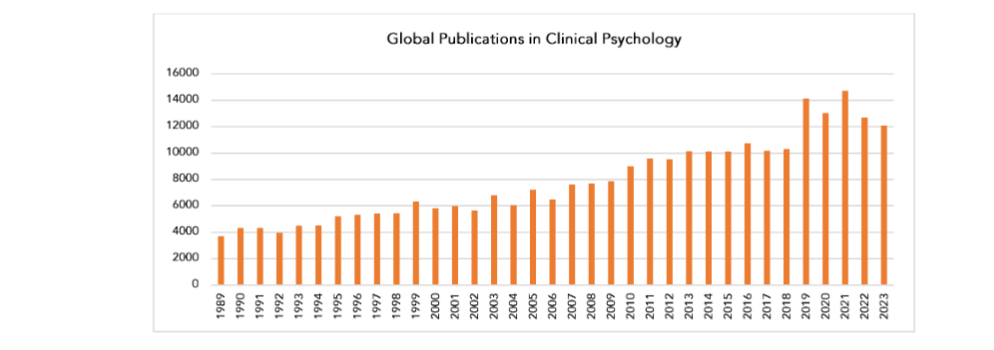
Figure 1: Chronological Distribution of the Global publications in Clinical Psychology
Funding and research priorities shifted to address the pandemic, which may have diverted attention and resources away from clinical psychology research. The peer review and publication process itself may have experienced delays due to the increased volume of submissions related to COVID-19 and the adjustments made by journals and publishers to handle the crisis.
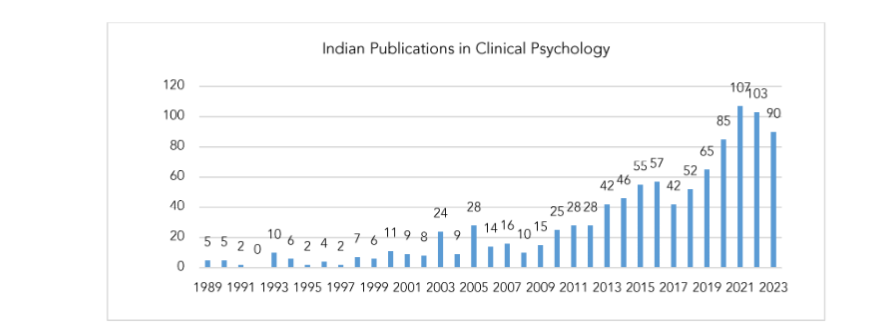
Figure 1.1: Chronological Distribution of the Indian Publications in Clinical Psychology
The chronological distribution of the Indian publications is visible in figure 1.1. The maximum no. of papers produced in the year 2021 (107 papers), followed by 2022 (103), and 2023 (90), with least number of publications in 1991 (2 publications). No publications have been produced during 1992 from India in the field of clinical psychology reason being that Web of Science may not have comprehensive coverage of all journals, especially older ones. Some journals from 1992 might not be included in their database or might not have been indexed at that time.
Table 1 and Figure 1.3 represent the relative growth rate and doubling time of the global publications in clinical psychology. It can be depicted that the Relative Growth Rate of publications has decreased from 0.772 in 1990 to 0.045 in 2023.
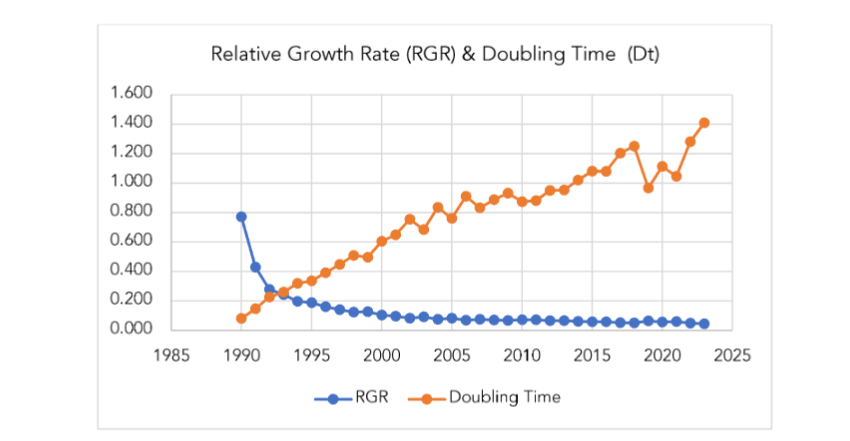
Figure 1.3: Relative Growth Rate and Doubling time of publications
On the other hand the Doubling time for the publications has been increased from 0.082 in 1990 to 1.410 in 2023. Both the RGR and Doubling time show fluctuations in between. The mean RGR is least during the time-frame 2019-2023 i.e., 0.056 and maximum during 1989-1992 i.e., 0.345. The mean doubling time for the publications is maximum during the years 2019 to 2023 i.e., 1.163 while it is minimum during the years 1989 to 1992 i.e., 0.143. This also depicts that the RGR is inversely proportional to the doubling time.
Table 2: Type of Publications
| Sr. no. | Type of Publications | Publication count | % of Count |
|---|---|---|---|
| 1 | Article | 194310 | 70.199 |
| 2 | Meeting Abstract | 33218 | 12.001 |
| 3 | Book Review | 16062 | 5.803 |
| 4 | Review Article | 12309 | 4.447 |
| 5 | Editorial Material | 12165 | 4.395 |
| 6 | Proceeding Paper | 6694 | 2.418 |
| 7 | Letter | 4036 | 1.458 |
| 8 | Note | 1206 | 0.436 |
| 9 | Biographical-Item | 545 | 0.197 |
| 10 | Book Chapters | 407 | 0.147 |
| 11 | News Item | 221 | 0.080 |
| 12 | Item About an Individual | 109 | 0.039 |
| 13 | Bibliography | 88 | 0.032 |
| 14 | Software Review | 43 | 0.016 |
| 15 | Retracted Publication | 40 | 0.014 |
| Others (13) |
Table 2 and figure 2 represents the type of publications produced in the clinical psychology domain. A total of 28 document types have been recorded including articles, book reviews, abstracts, review papers, editorials, proceeding papers, letters, notes, biographical items, book chapters, news items, retracted publications, and many more.
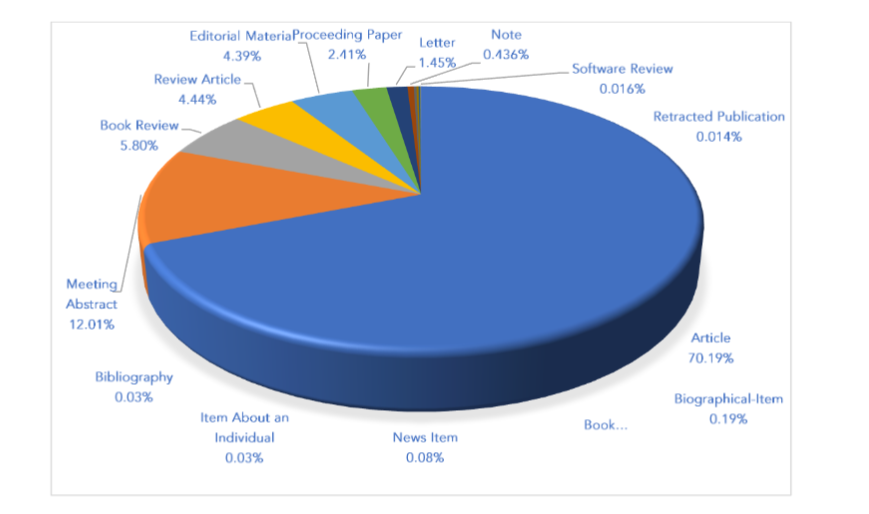
Figure 2: Type of publications
The maximum no. of publications has been produced in the form of articles i.e., 194310 (70.199%), followed by meeting abstracts i.e., 33218 (12.001%), and book reviews (16062, 5.803).
Table 3: Top Authors of Clinical Psychology
| Rank | Top Authors | Affiliation | Country | Publications | % | h-index |
|---|---|---|---|---|---|---|
| 1 | Zvolensky Michael J | University of Houston | USA | 465 | 0.168 | 71 |
| 2 | Traussnig Bernhard | Voestalpine AG | Austria | 443 | 0.16 | 38 |
| 3 | Petermann Franz | University of Bremen | Germany | 398 | 0.144 | 53 |
| 4 | Brahler Elmar | University of Leipzig | Germany | 374 | 0.135 | 82 |
| 5 | Treasure J | King’s College London | England | 344 | 0.124 | 99 |
| 6 | Joiner TE | Florida State University | USA | 342 | 0.124 | 97 |
| 7 | Rief Winfried | Philipps University Marburg | Germany | 330 | 0.119 | 80 |
| 8 | Schmidt Norman B | Florida State University | USA | 317 | 0.115 | 69 |
| 9 | Bulik Cynthia M | University of North Carolina | USA | 316 | 0.114 | 78 |
| 10 | Crosby Ross D | Sanford University | USA | 287 | 0.104 | 90 |
The top ten writers globally who have contributed the most papers in clinical psychology are shown in Table 3. Zvolensky Michael J from the University of Houston, USA has produced the maximum number of publications i.e., 465 (0.168%, Rank 1) having an h-index value equivalent to 71, followed by Strauss Bernhard from Voestalpine AG, Austria (443 publications, 0.16%, Rank 2) having h-index -38, and Petermann Franz from University of Bremen, Germany having 398 publications (0.144%, Rank 3) having an h-index equal to 53. Brahler Elmar from the University of Leipzig, Germany, possesses Rank 4 contributing (374 publications, 0.135%) and has an h-index value of 83, is found to be the highly cited award recipient from the year 2019–2023, in the subject categories Psychology, Psychiatry, Public, Environmental & Occupational Health and Oncology with 34,860 total citations. Rief Winfried from Philipps University Marburg, Germany (Rank 7, 330 publications, 0.199% publications) also got a highly cited researcher award from the year 2021–2023 in subject categories Psychology, Psychiatry, Neurosciences & Neurology, and Pharmacology & Pharmacy with 30,197 total citations and h-index equal to 80.
Table 3.1: Top Indian Authors
| Indian Rank | Global Rank | Author Name | Affiliation | Papers | % | h-Index |
|---|---|---|---|---|---|---|
| 1 | 72 | Andrade Chittaranjan | National Institute of Mental Health & Neurosciences | 159 | 15.61% | 35 |
| 2 | 6381 | Ghosh, Abhishek | Post Graduate Institute of Medical Education & Research (PGIMER), Chandigarh | 21 | 2.06% | 16 |
| 3 | 11111 | Basu, Debasish | Post Graduate Institute of Medical Education & Research (PGIMER), Chandigarh | 14 | 1.37% | 20 |
| 4 | 11306 | Dhikav, Vikas | ICMR – National Institute for Implementation Research on Non-Communicable Diseases (NIIRNCD) | 14 | 1.37% | 13 |
| 5 | 12025 | Sarkar, Siddharth | All India Institute of Medical Sciences (AIIMS) New Delhi | 14 | 1.37% | 21 |
| 6 | 14402 | Kumar, Devarta | National Institute of Mental Health & Neurosciences – India | 12 | 1.17% | 9 |
| 7 | 14537 | Mattoo, Surendra K | Post Graduate Institute of Medical Education & Research (PGIMER), Chandigarh | 12 | 1.17% | 22 |
| 8 | 14853 | Sagar, Rajesh | All India Institute of Medical Sciences (AIIMS) New Delhi | 12 | 1.17% | 67 |
| 9 | 18728 | Janardhan Reddy, Y. C. | National Institute of Mental Health & Neurosciences – India | 10 | 0.98% | 42 |
| 10 | 19063 | Telles, Shirley | National Institute of Mental Health & Neurosciences – India | 10 | 0.98% | 29 |
Table 3.1 lists the leading Indian authors who have made the maximum contributions to clinical psychology, along with their rankings both domestically and globally. Rank 1 is possessed by Andrade Chittaranjan (Global rank 72, h-index 35), affiliated with the National Institute of Mental Health & Neurosciences, contributing 159 papers, i.e., 15.61% of the Indian publications followed by Ghosh, Abhishek with rank 2, (Global rank 6381, h-index 16), and Basu, Debasish with rank 3, (Global rank 11111, h-index 20) from Post Graduate Institute of Medical Education & Research (PGIMER), Chandigarh, contributing 21 i.e., 2.06% and 14 i.e., 1.37% publications respectively. Among the top 10 Indian authors 4 authors are affiliated to National Institute of Mental Health & Neurosciences, 3 are affiliated to PGIMER, Chandigarh, 2 are affiliated to AIIMS, New Delhi and 1 is affiliated to ICMR – National Institute for Implementation Research on Non-Communicable Diseases (NIIRNCD).
Table 4: Top International Affiliations of Clinical Psychology
| Rank | Affiliations | Country | Publications | % |
|---|---|---|---|---|
| 1 | University of California System | USA | 11362 | 4.188 |
| 2 | University of London | England | 8777 | 3.235 |
| 3 | US Department of Veterans Affairs | USA | 8092 | 2.983 |
| 4 | Harvard University | USA | 7970 | 2.938 |
| 5 | Veterans Health Administration VHA | USA | 7928 | 2.922 |
| 6 | Pennsylvania Commonwealth System of Higher Education (PCSHE) | USA | 6685 | 2.464 |
| 7 | State University System of Florida | USA | 6600 | 2.433 |
| 8 | University System of Ohio | USA | 6562 | 2.419 |
| 9 | King’s College London | England | 5102 | 1.881 |
| 10 | University of Texas System | USA | 4925 | 1.815 |
Table 4 depicts the top most productive international affiliations of clinical psychology. Rank 1 is occupied by University of California System, USA contributing 11362 i.e., 4.18% publications, Rank 2 by University of London, England, with 8777, 3.23% papers and rank 3 by US Department of Veterans Affairs, USA with 8092, i.e., 2.98% publications. Rank 4 is occupied by Harvard University, USA with 7970, i.e., 2.93% publications and rank 5 is occupied by Veterans Health Administration, USA with 7928, i.e., 2.92% publications. Among top 10 most productive affiliations of the world 8 affiliations belong to USA and remaining 2 from England.
The US institutions dominate clinical psychology research due to significant funding, high-quality education, state-of-the-art research facilities, interdisciplinary collaboration, access to prestigious journals and conferences, diverse research opportunities, strong professional networks, and historical leadership. The US also encourages collaboration across disciplines, leading to more comprehensive research outcomes. The US has also been a leader in the development of psychology, with many foundational theories and practices originating from American researchers.
Table 4.1: Top Indian Affiliations
| Indian Rank | World rank | Name of the Affiliation | State | Publications | % |
|---|---|---|---|---|---|
| 1 | 507 | National Institute of Mental Health & Neurosciences | Karnataka | 249 | 24.45 |
| 2 | 1193 | All India Institute of Medical Sciences | Delhi | 63 | 6.18 |
| 3 | 1751 | Post Graduate Institute of Medical Education & Research | Chandigarh | 35 | 3.43 |
| 4 | 1920 | Indian Institute of Technology System | West Bengal | 31 | 3.04 |
| 5 | 2256 | University of Delhi | Delhi | 24 | 2.35 |
| 6 | 2296 | Manipal Academy of Higher Education | Karnataka | 23 | 2.25 |
| 7 | 2514 | National Drug Dependence Treatment Centre | Uttar Pradesh | 20 | 1.96 |
| 8 | 2602 | Tata Institute of Social Sciences | Maharashtra | 19 | 1.86 |
| 9 | 2636 | Christian Medical College Hospital | Tamil Nadu | 18 | 1.76 |
| 10 | 3087 | Banaras Hindu University | Uttar Pradesh | 14 | 1.37 |
Table 4.1 lists the top affiliations of India contributing maximum research in clinical psychology domain. It can be clearly depicted that the researchers from the National Institute of Mental Health and Neurosciences, Karnataka contributes maximum papers i.e., 249 publications (0.24.45% of the Indian publications), world rank 507. This can conclude to the fact that it is a leading center for mental health research, education, and clinical services in India. Its significant contribution to clinical psychology research is attributed to its specialized focus on mental health and neuroscience, comprehensive facilities, interdisciplinary approach, high volume of clinical cases, government support, advanced training programs, collaborations with national and international research organizations, universities, and healthcare institutions, and a focus on relevant issues in the Indian context. Rank 2 is occupied by All India Institute of Medical Sciences, Delhi with 63 publications i.e., 6.18%, and Rank 3 is occupied by Post Graduate Institute of Medical Education Research, Chandigarh, with 35 publications i.e., 3.43%.
Table 5: Top Journals of Clinical Psychology
| Rank | Journal Titles | Publisher | Publications | % | (JCI) |
|---|---|---|---|---|---|
| 1 | Archives of Clinical Neuropsychology | Oxford University Press, United Kingdom | 11059 | 3.995 | 0.83 |
| 2 | Journal of Clinical Psychiatry | Physicians Postgraduate Press, United Kingdom | 10832 | 3.913 | 1.15 |
| 3 | Psychological Medicine | Cambridge University Press, United Kingdom | 8557 | 3.091 | 2.36 |
| 4 | International Psychogeriatrics | Cambridge University Press, United Kingdom | 7503 | 2.711 | 1.38 |
| 5 | Addictive Behaviors | Pergamon-Elsevier Science Ltd, Netherlands | 6887 | 2.488 | 1.34 |
| 6 | International Journal of Behavioral Medicine | Springer, USA | 6515 | 2.354 | 0.71 |
| 7 | Clinical Neuropsychologist | Taylor & Francis Inc, United Kingdom | 5887 | 2.127 | 1.11 |
| 8 | Behaviour Research and Therapy | Pergamon-Elsevier Science Ltd, Netherlands | 4981 | 1.799 | 1.5 |
| 9 | Archives of Sexual Behavior | Springer, USA | 4869 | 1.759 | 1.31 |
| 10 | Journal of Clinical and Experimental Neuropsychology | Taylor & Francis Inc, U.K | 4822 | 1.742 | 0.61 |
JCI = Journal Citation Indicator, recorded from Web of Science.
Table 5 enlists the top journals in which most research has been published related to clinical psychology topics. Rank 1 is occupied by Archives of Clinical Neuropsychology (JCI = 0.83), published by Oxford University Press, United Kingdom with 11059 i.e., 3.99% publications, rank 2 is occupied by Journal of Clinical Psychiatry (JCI = 1.15), published from Physicians Postgraduate Press, United Kingdom, with 10832 i.e., 3.91% publications, and rank 3 is occupied by Psychological Medicine (JCI = 2.36), published by Cambridge University Press, United Kingdom with 8557 i.e., 3.09% publications. Among the top 10 journals 6 of the journals are published in the UK, 2 from the USA, and the remaining 2 from the Netherlands.
Table 6: Top Countries Contributing Maximum Research in Clinical Psychology
| Rank | Countries/Regions | Publications | % |
|---|---|---|---|
| 1 | USA | 137585 | 49.706 |
| 2 | England | 25739 | 9.299 |
| 3 | Germany | 20097 | 7.260 |
| 4 | Canada | 17900 | 6.467 |
| 5 | Australia | 15039 | 5.433 |
| 6 | Netherlands | 10377 | 3.749 |
| 7 | Spain | 5950 | 2.150 |
| 8 | Peoples R China | 5009 | 1.810 |
| 9 | Italy | 4880 | 1.763 |
| 10 | Israel | 3932 | 1.421 |
| India | 1018 | 0.368 |
Table 6 enlists the top nations contributing maximum publications in the clinical psychology domain. The USA holds rank 1 contributing 137585 papers i.e., 49.70% of the total, rank 2 is occupied by England contributing 25739 i.e., 9.29% of the total papers, rank 3 is occupied by Germany with 20097 papers, i.e., 7.26%. These nations are followed by Canada and Australia with 17900 (6.46%) and 15039 (5.43%) publications. Due to their robust academic institutions, significant financing, historical roots, multidisciplinary collaboration, worldwide influence, and strong public backing, the United States, England, and Germany are the top three nations in the world for clinical psychology research. Prominent research and academic institutions in these nations, like the University of Oxford, Stanford, and Harvard, offer strong academic settings for training and research. A significant amount of funding is provided for psychological research by organizations like the Deutsche Forschungsgemeinschaft (DFG) in Germany, the Medical Research Council (MRC) in the United Kingdom, and the National Institutes of Health (NIH) in the United States. In these nations, interdisciplinary cooperation enables clinical psychology to interact with other disciplines, such as neuroscience, medicine, and social sciences, producing more thorough and significant research results. Strong professional networks are offered by associations such as the American Psychological Association (APA), the British Psychological Society (BPS), and the German Psychological Society (DGPs), which encourage research, establish ethical guidelines, and assist in the communication of results.
Table 6.1: Top Collaborating Countries with India
| Rank | Country | Collaborated Publications | % |
|---|---|---|---|
| 1 | USA | 203 | 19.941 |
| 2 | England | 125 | 12.279 |
| 3 | Australia | 59 | 5.796 |
| 4 | Canada | 49 | 4.813 |
| 5 | Netherlands | 40 | 3.929 |
| 6 | Peoples R China | 39 | 3.831 |
| 7 | Italy | 36 | 3.536 |
| 8 | Brazil | 35 | 3.438 |
| 9 | Switzerland | 34 | 3.34 |
| 10 | Germany | 31 | 3.045 |
Table 6.1 depicts the top collaborating countries with India for contributing publications of clinical psychology. Maximum collaborated publications with India are from the USA i.e., 203 publications (19.94%), followed by England, 125 publications i.e., 12.27%, and Australia with 59 (5.79% publications). By partnering with organizations in these nations, Indian researchers gain access to state-of-the-art techniques, resources, and knowledge that improve the caliber and significance of their work. The fact that English is widely spoken among scholars in these nations makes communication and cooperation easier. Mental health conditions including depression, anxiety, and trauma are typically of interest to researchers from these nations, and through cooperative endeavors, they address these problems from several angles and provide appropriate interventions.
Table 7: Most Cited Papers of Clinical Psychology
| Rank | Publication Title | Authors | Journal | Citations | Year |
|---|---|---|---|---|---|
| 1 | The Mini-International Neuropsychiatric Interview (MINI): The development and validation of a structured diagnostic psychiatric interview for DSM-IV and ICD-10 | Sheehan, DV et al. | Journal of Clinical Psychiatry | 18366 | 1998 |
| 2 | The structure of negative emotional states – comparison of the depression anxiety stress scales (DASS) with the beck depression and anxiety inventories | Lovibond, PF; Lovibond, SH | Behaviour Research and Therapy | 8053 | 1995 |
| 3 | Clinical-significance – a statistical approach to defining meaningful change in psychotherapy-research | Jacobson, NS; Truax, P | Journal of Consulting and Clinical Psychology | 7535 | 1991 |
| 4 | Short screening scales to monitor population prevalences and trends in non-specific psychological distress | Kessler, RC et al. | Psychological Medicine | 6741 | 2002 |
| 5 | Measuring emotion – the self-assessment mannequin and the semantic differential | Bradley, MM; Lang, PJ | Journal of Behavior Therapy and Experimental Psychiatry | 5814 | 1994 |
| 6 | Factor structure of the Barratt Impulsiveness Scale | Patton, JH; Stanford, MS; Barratt, ES | Journal of Clinical Psychology | 5749 | 1995 |
| 7 | Development of a new resilience scale: The Connor-Davidson Resilience Scale (CD-RISC) | Connor, KM; Davidson, JRT | Depression and Anxiety | 5655 | 2003 |
| 8 | The Pain Catastrophizing Scale: Development and validation | Sullivan, MJL; Bishop, SR; Pivik, J | Psychological Assessment | 5575 | 1995 |
| 9 | Multidimensional assessment of emotion regulation and dysregulation: Development, factor structure, and initial validation of the difficulties in emotion regulation scale | Gratz, KL; Roemer, L | Journal of Psychopathology and Behavioral Assessment | 5072 | 2004 |
| 10 | Development of the World Health Organization WHOQOL-BREF quality of life assessment | Harper, A; Power, M | Psychological Medicine | 4876 | 1998 |
Table 7 presents the top most cited papers during the period of study in the clinical psychology domain. The most cited paper is entitled as “The Mini-International Neuropsychiatric Interview (MINI)…” (1998) by Sheehan, DV et al is published in the Journal of Clinical Psychiatry have 18366 citations. This indicates that it has provided significant information or a well accepted approach, as evidenced by the fact that researchers often cite the publication in their own research. It is followed by “The structure of negative emotional states…” (1995) by Lovibond, PF and Lovibond, SH published in Behaviour Research and Therapy have 8053 citations and “Clinical-significance – a statistical approach…” (1991) by Jacobson, NS and Truax, P published in Journal of Consulting and Clinical Psychology have 7535 citations. Papers with groundbreaking findings, novel methodologies, or significant advancements are often used as foundational references for subsequent research. The paper’s broad applicability, collaboration, and high-quality research enhance its credibility and attracts more citations. Additionally, papers with cross-cultural or global relevance are more likely to be cited by a diverse range of researchers worldwide.
Table 8: Top Research Areas of Clinical Psychology
| Sr. no. | Subject categories | Publications | % |
|---|---|---|---|
| 1 | Psychology | 276800 | 100.000 |
| 2 | Psychiatry | 92189 | 33.305 |
| 3 | Neurosciences Neurology | 24283 | 8.773 |
| 4 | Substance Abuse | 17479 | 6.315 |
| 5 | Family Studies | 16899 | 6.105 |
| 6 | Social Sciences Other Topics | 14365 | 5.190 |
| 7 | Geriatrics Gerontology | 7503 | 2.711 |
| 8 | Nutrition Dietetics | 5714 | 2.064 |
| 9 | Criminology Penology | 4324 | 1.562 |
| 10 | Pharmacology Pharmacy | 4052 | 1.464 |
| 11 | Rehabilitation | 3732 | 1.348 |
| 12 | Public Environmental Occupational Health | 2763 | 0.998 |
| 13 | Obstetrics Gynecology | 1969 | 0.711 |
| 14 | Health Care Sciences Services | 1694 | 0.612 |
| 15 | Education Educational Research | 1295 | 0.468 |
| 16 | Pediatrics | 1135 | 0.410 |
| 17 | Biomedical Social Sciences | 724 | 0.262 |
| 18 | Medical Informatics | 563 | 0.203 |
| 19 | Behavioral Sciences | 412 | 0.149 |
| 20 | Science Technology Other Topics | 130 | 0.047 |
| 21 | Music | 61 | 0.022 |
| 22 | Toxicology | 10 | 0.004 |
Table 8 enlists the subject categories that illustrate the broad scope and interdisciplinary connections of clinical psychology research, highlighting its relevance to a wide range of scientific and applied fields. Maximum publications relate to psychology i.e., 276800 (100%) because this broad category encompasses research that spans various psychological disciplines, including the whole clinical psychology along with others like cognitive, developmental and social psychology. This category is followed by psychiatry with 92189 publications i.e., 33.30%. This field of research focuses on mental health disorders: their diagnosis, treatment, and prevention. Psychiatry and clinical psychology often intersect, particularly in research about mental health issues and therapeutic approaches. Next comes the Neurosciences and Neurology with 24283 publications, i.e., 8.77% which frequently focuses on the biological causes of psychiatric illnesses. Research in this field may include examinations using neuroimaging, evaluations using neuropsychology, and the effects of neurological disorders on mental health.
Table 9: Top International Funding Agencies
| Rank | Funding Agencies | Country | Funded publications | % |
|---|---|---|---|---|
| 1 | United States Department of Health Human Services | USA | 31062 | 11.222 |
| 2 | National Institutes of Health | USA | 30198 | 10.910 |
| 3 | National Institute of Mental Health | USA | 11419 | 4.125 |
| 4 | National Institute on Drug Abuse | USA | 7178 | 2.593 |
| 5 | National Institute on Alcohol Abuse Alcoholism | USA | 3398 | 1.228 |
| 6 | National Institute of Child Health Human Development | USA | 2829 | 1.022 |
| 7 | UK Research Innovation | UK | 2469 | 0.892 |
| 8 | National Institute on Aging | USA | 2231 | 0.806 |
| 9 | Medical Research Council | UK | 1859 | 0.672 |
| 10 | Canadian Institutes of Health Research | Canada | 1843 | 0.666 |
Table 9 represents the world’s top funding agencies that provide funds to carry out research work in the clinical psychology domain. United States Department of Health Human Services USA has funded the maximum number of publications i.e., 31062 (11.22%) and holds rank 1, followed by the National Institutes of Health, USA with 30198 (10.91%) funded publications, and the National Institute of Mental Health, USA with 11419 (4.12%) funded publications. Among the top 10 funding agencies, 7 are from the USA and 2 & 1 from the UK and Canada, respectively.
Table 9.1: Top Indian Funding Agencies
| Rank | Top Funding Agencies in India | Funding count | % |
|---|---|---|---|
| 1 | National Council on Science and Technology | 32 | 3.14 |
| 2 | Indian Council of Medical Research | 17 | 1.66 |
| 3 | Ministry of Health and Welfare | 9 | 0.88 |
| 4 | Department of Science Technology India | 9 | 0.88 |
| 5 | University Grants Commission India | 7 | 0.68 |
| 6 | Department of Biotechnology | 7 | 0.68 |
| 7 | All India Institute of Medical Sciences New Delhi | 4 | 0.39 |
| 8 | Indian Statistical Institute | 2 | 0.19 |
| 9 | Ramanujan Fellowship | 2 | 0.19 |
| 10 | Council of Scientific and Industrial Research | 2 | 0.19 |
Table 9.1 represents the top funding agencies of India for clinical psychologists based on WoS data. National Council on Science and Technology holds rank 1, funding 32 publications i.e., 3.14% of the Indian publications, followed by the Indian Council of Medical Research which funded 17 publications (1.66%), and the Ministry of Health and Welfare with 9 funded publications i.e., 0.88%.
Table 10: Top Keywords
| Rank | Citation Topics Meso | Count | % | Citation Topics Micro | Count | % |
|---|---|---|---|---|---|---|
| 1 | Psychiatry & Psychology | 50294 | 18.17 | Ptsd | 14018 | 5.064 |
| 2 | Psychiatry | 45723 | 16.518 | Eating Disorders | 13460 | 4.863 |
| 3 | Nutrition & Dietetics | 17212 | 6.218 | Psychotherapy | 11473 | 4.145 |
| 4 | Substance Abuse | 11858 | 4.284 | Parenting | 10569 | 3.818 |
| 5 | Neuroscanning | 11036 | 3.987 | Depression | 8818 | 3.186 |
| 6 | Autism & Development Disorders | 10591 | 3.826 | Schizophrenia | 6709 | 2.424 |
| 7 | Social Psychology | 8154 | 2.946 | Methadone | 6286 | 2.271 |
| 8 | Neurodegenerative Diseases | 7098 | 2.564 | Dementia | 6091 | 2.201 |
| 9 | Palliative Care | 4966 | 1.794 | Mindfulness | 6007 | 2.170 |
| 10 | Gender & Sexuality Studies | 4338 | 1.567 | Autism | 5424 | 1.960 |
Table 10 shows the most popular keywords that were found through a combination of focused analysis of the individual elements such as particular publications, contributors, or their citations and an intermediate analysis of the patterns and trends in relation to broader groupings like communities, institutions, or other subfields. This analysis provided in-depth insights into the use and impact of individual research contributions. Understanding the complete range of research influence and citation patterns requires both levels of analysis, which provide insights at various granularities. While analyzing the broader terms i.e., Meso, the most popular topics found are psychiatry and psychology which relate to 50294 (18.17%) of the publications, followed by psychiatry, nutrition and dietetics, substance abuse, and neuroscanning with 45723 (16.51%), 17212 (6.21%), 11858 (4.28%) and 11036 (3.98%) respectively. While analyzing detailed individual elements i.e., micro, the popular topics found are Ptsd (14018 i.e., 5.06%), eating disorders (13460 i.e., 4.86%), psychotherapy (11473 i.e., 4.14%), parenting (10569 i.e., 3.81%) and depression (8818 i.e., 3.18%). The most often recurring keywords throughout the time suggest a greater amount of research in that specific subject, indicating a greater level of interest in such topics among scholars.
5. Results
- Globally the maximum no. of publications has been produced during the year 2021 i.e., 14737 (5.324%), followed by 2019 (14141, 5.109%), and 2020 (13049, 4.714%). The lowest number of publications was produced in 1989, i.e., 3713 (1.341%). From India the maximum no. of papers produced in the year 2021 (107 papers), followed by 2022 (103), and 2023 (90), with least number of publications in 1991 (2 publications). No publications have been produced during 1992.
- Relative Growth Rate of publications has decreased from 0.772 in 1990 to 0.045 in 2023. Doubling time for the publications has been increased from 0.082 in 1990 to 1.410 in 2023. Both the RGR and Doubling time show fluctuations in between.
- The maximum no. of publications has been produced in the form of articles i.e., 194310 (70.199%), followed by meeting abstracts i.e., 33218 (12.001%), and book reviews (16062, 5.803).
- Globally Zvolensky Michael J from the University of Houston, USA has produced the maximum number of publications i.e., 465 (0.168%) and Andrade Chittaranjan (Global rank 72, h-index 35), affiliated with the National Institute of Mental Health & Neurosciences, contributing 159 papers i.e., 15.61% is the top author from India.
- Internationally Rank 1 is occupied by the University of California System, USA contributing 11362 i.e., 4.18% publications and the National Institute of Mental Health and Neurosciences, Karnataka contributes maximum papers i.e., 249 publications (24.45% of the Indian publications), world rank 507.
- Archives of Clinical Neuropsychology (JCI = 0.83), published by Oxford University Press, United Kingdom with 11059 i.e., 3.99% publications is the topmost journal in terms of publication counts.
- The USA is the topmost country contributing 137585 papers i.e., 49.70% of the total publications and also collaborates maximum publications with India i.e., 203 publications.
- The most cited paper is entitled as “The Mini-International Neuropsychiatric Interview (MINI)… (1998)” by Sheehan, DV et al is published in the Journal of Clinical Psychiatry have 18366 citations.
- Maximum publications relate to psychology i.e., 276800 (100%) followed by psychiatry with 92189 publications i.e., 33.30%. Next comes the Neurosciences and Neurology with 24283 publications i.e., 8.77%.
- Globally United States Department of Health Human Services USA has funded the maximum number of publications i.e., 31062 (11.22%), and National Council on Science and Technology is the topmost from India, funding 32 publications i.e., 3.14% of the publications.
- The most popular topics found are psychiatry and psychology with 50294 (18.17%) of the publications, followed by psychiatry, nutrition and dietetics, substance abuse, and neuroscanning with 45723 (16.51%), 17212 (6.21%), 11858 (4.28%) and 11036 (3.98%) respectively. While analyzing detailed individual elements (micro), the popular topics found are Ptsd (14018, 5.06%), eating disorders (13460, 4.86%), psychotherapy (11473, 4.14%), parenting (10569, 3.81%) and depression (8818, 3.18%).
6. Discussion and Conclusion
The scientometric assessment of global clinical psychology publications, based on Web of Science data, reveals significant trends in the field. Overall, the volume of publications has increased, indicating a growing global interest in mental health issues. Though fluctuations in the data have been observed throughout the time frame, the noticeable no. of publications drop after the year 2019 could be attributed to COVID-19. The Relative Growth Rate of global publications decreased and the doubling time for the publications increased from 1990 to 2023. Countries like the United States, the UK, and Germany dominate the field due to their strong academic institutions and substantial funding. India collaborates the most with the USA, England and Australia. The interdisciplinary nature of the field, with overlap in neuroscience, psychiatry, and public health, has led to more comprehensive research outcomes addressing complex mental health issues. Key research areas, such as psychiatry, neuropsychology, psychopathology, family studies, health psychology, Substance abuse and Rehabilitation continue to drive innovation and inform evidence-based practices for advancing mental health care globally.
In conclusion, this scientometric assessment demonstrates that clinical psychology is a dynamic and evolving field with a broadening scope and increasing global participation. The insights gained from this analysis provide a valuable foundation for guiding future research directions, fostering international collaborations, and addressing the diverse mental health needs of populations worldwide. Similar studies can be conducted in other fields too, to analyze dynamic research trends in terms of publications, authors, institutions, funding agencies, subject research areas, keywords etc.
Conflict of Interest:
None.
Funding Statement:
None.
Acknowledgements:
None.
ORCID ID:
Pooja
ORCID ID: https://orcid.org/0000-0001-7133-1614
E-mail: [email protected]
Prof. Meera
ORCID ID: https://orcid.org/0000-0001-7937-5574
E-mail: [email protected]
References
1. Clinical Psychology. American Psychological Association. Published 2024. https://www.apa.org/ed/graduate/specialize/clinical
2. Kazdin AE. Clinical Psychology: science, practice, and culture. Oxford University Press; 2008. http://ci.nii.ac.jp/ncid/BB16826215
3. Moed HF. Citation analysis in research evaluation.; 2005. doi:10.1007/1-4020-3714-7
4. Zhang J, Rousseau R. The International Comparative Performance of the Medical Sciences in PLOS ONE and Web of Science. PLOS ONE. 2019;14(9).
5. Pomerantz AM. Clinical Psychology: science, practice, and culture. 3rd ed. SAGE Publications; 2013. http://ci.nii.ac.jp/ncid/BB16826215
6. Web of Science, Clarivate. Academia and Government. Published 2024. https://clarivate.com/webofsciencegroup/solutions/web-of-science/
7. Waltman L, Van Eck NJ. A smart local moving algorithm for large-scale modularity-based community detection. The European Physical Journal B. 2013; 86(11). doi:10.1140/epjb/e2013-40829-0
8. Leydesdorff L, Bornmann L. The operationalization of “fields” as WoS subject categories (WCs) in evaluative bibliometrics: The cases of “library and information science” and “science & technology studies.” Journal of the Association for Information Science and Technology. 2015;67(3):707-714. doi:10.1002/asi.23408
9. Aarts AA, Anderson JE, Anderson CJ, et al. Estimating the reproducibility of psychological science. Science. 2015;349(6251). doi:10.1126/ science.aac4716
10. Hamidi A, Khosravi A, Hejazi R, FatemehTorabi N, Abtin A. A scientometric approach to psychological research during the COVID-19 pandemic. Current Psychology. 2023;43(1):155-164. doi:10.1007/s12144-023-04264-2
11. Wang F, Guo J, Yang G. Study on positive psychology from 1999 to 2021: A bibliometric analysis. Frontiers in Psychology. 2023;14. doi:10.3389/fpsyg.2023.1101157
12. Grover S, Gupta B, Bansal M, Ahmed KKM. Covid-19 and Psychology: A Scientometric Assessment of India’s Publications during 2020-21. International Journal of Medicine and Public Health. 2022;12 (1):01-07. doi:10.5530/ijmedph.2022.1.1
13. Hulloli PB. Research on subject area of psychology in India: Scientometric study. International Journal of Education and Psychological Research. 10:76-79. https://www.researchgate.net/profile/Praveen-Hulloli/publication/358604738_Research_on_Subject_area_of_Psychology_in_India_Scientometric_Study/links/620b3493afa8884cabe4a58c/Research-on-Subject-area-of-Psychology-in-India-Scientometric-Study.pdf
14. Hulloli PB. Research on Psychology in India and South Africa A comparative scientometric study. Library Philosophy and Practice (E-journal). Published online 2021. https://digitalcommons.unl.edu/libphilprac/5828
15. Liu S, Oakland T. The emergence and evolution of school psychology literature: A scientometric analysis from 1907 through 2014. School Psychology Quarterly. 2016;31(1):104-121. doi:10.1037/spq0000141
16. Naveed S, Waqas A, Majeed S, Zeshan M, Jahan N, Sheikh MH. Child psychiatry: A scientometric analysis 1980-2016. F1000Research. 2017;6:1293. doi:10.12688/f1000research.12069.1
17. Barlow DH. The Oxford Handbook of Clinical Psychology.; 2014. doi:10.1093/oxfordhb/978019 9328710.001.0001