

Improving Clinical Practice Through Situation Awareness
Situation Awareness—Bridging Neuroscientific and Human Factors/Ergonomics Perspectives and Implications for Clinical Practice
Stavros Piranes
Department of Anaesthetics and Pain Management, Nepean Hospital, Sydney, Australia
OPEN ACCESS
PUBLISHED 30 April 2025
CITATION: Piranes, S. 2025. Situation Awareness—Bridging Neuroscientific and Human Factors/Ergonomics Perspectives and Implications for Clinical Practice. Medical Research Archives, Volume 13 Issue 1. doi: 10.18103/mra.v13i1.645.
Abstract
A key challenge for clinicians is to make sufficient sense of what is happening around them to anticipate what might happen next and take timely action. This review article examines the theoretical basis of Situation Awareness (SA) – defined by Endsley as “the perception of the elements in the environment within a volume of time and space, the comprehension of their meaning, and the projection of their status in the near future.”
Keywords
- Situation Awareness
- Neuroscience
- Human Factors
- Clinical Practice
Introduction and Rationale
A key challenge for clinicians is to make sufficient sense of what is happening around them to anticipate what might happen next and take timely action. This review article examines the theoretical basis of Situation Awareness (SA) – defined by Endsley as “the perception of the elements in the environment within a volume of time and space, the comprehension of their meaning, and the projection of their status in the near future.”
Situation awareness (SA) is an important human factors/ergonomics (HF/E) concept which arguably underlies all other non-technical skills such as perception of risk, communication, teamwork, leadership and managing automation.
This review article seeks to define SA and examine its counter-intuitive plastic and dynamic nature from the perspective of the factors that affect SA in healthcare environments, the differences between the brain processes involved in novice and expert SA, and the implications for clinical practice.
Level I Situation Awareness – The Perception Stage
The serial logic underpinning the model of SA is fundamentally about the brain’s ability to process information, learning and memory. This is fundamentally the foundation of what SA is, and how it is developed.
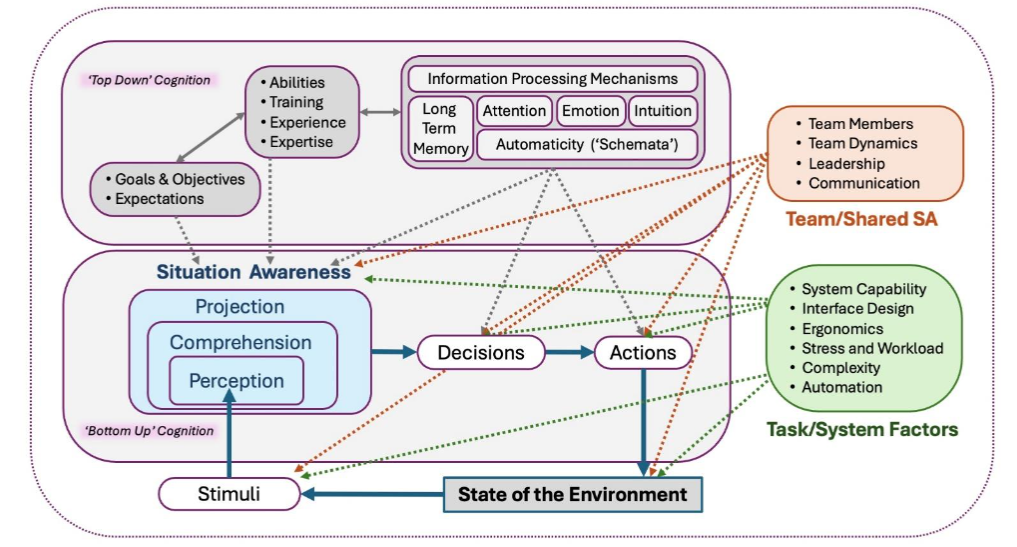
The Dynamics of Situation Awareness
The serial logic underpinning the model of SA is fundamentally about the brain’s ability to process information, learning and memory. This is fundamentally the foundation of what SA is, and how it is developed.
Mental Models and Schemata
The challenge for any brain is to discern meaning from the chaos of information about the self and the world around it in real time with only the limited processing power at its disposal. Through natural selection it appears that early neural networks acquired the ability to filter and ‘chunk’ aggregate information into more consumable packets of activity.
Bayesian Brain
Statistically, the Gabor Box made the famous observation that “all models are wrong, but some are useful.” This is particularly relevant in the context of SA where the brain is constantly trying to make sense of the world around it.
Examples of Clinical Sources of SA Error
| Error Category | Examples of Clinical Sources of SA Error |
|---|---|
| Inadequate Level I Data | 1. Data was not available 2. Data was not available |
| Failure to monitor/observe | 1. Misperception of data 2. Memory loss |
Training Implications
Understanding SA is essential for healthcare professionals to enhance their performance and patient safety. The implications of SA can be extrapolated to other fields.
Conclusion
Situation awareness is fundamental to competent clinical decision making and clinical performance of individual practitioners and healthcare teams. Expert SA is a skill that can be acquired through experience and practice.
Acknowledgments
I would like to thank Kathleen Mosier, Steven Shorrock and Tim Suharto for their invaluable editorial input.
References
- Lu, T., & Su, W. (2014). Giles T. Translation of the 5th Century B.C. Treatise on Art. Artistry, 2014, 4:18.
- van Clauwaert, C., & Von Kriegge (On War). Graham JJ Translation of 1874 Edition. Project Gutenberg. Available at https://www.gutenberg.org/files/1946/1946-0.txt retrieved 20 March 2025.
- Endsley, M.R. Design and evaluation for situation awareness enhancement. In Proceedings of the Human Factors Society 32nd Meeting, Santa Monica, CA: Human Factors Society. 1988: 97-101.
- Endsley, M.R. Situation Awareness. Human Factors. 1995; 37(1): 32-64.