

Incorporating Noise in Audiological Assessments
Why and How we Need to Involve Background Noise in Audiological Assessment
Mark Laureyns 1,2, Melinda Freyaldenhoven Bryan 5 and Federica Di Berardino 3,4
OPEN ACCESS
PUBLISHED: 30 September 2025
CITATION: LAUREYNS, Mark; BRYAN, Melinda Freyaldenhoven; DI BERARDINO, Federica. Why and How we Need to Involve Background Noise in Audiological Assessment. Medical Research Archives, . Available at: <https://esmed.org/MRA/mra/article/view/6941>.
COPYRIGHT: © 2025 European Society of Medicine. This is an open-access article distributed under the terms of the Creative Commons Attribution License, which permits unrestricted use, distribution, and reproduction in any medium, provided the original author and source are credited.
DOI: https://doi.org/10.18103/mra.v13i9.6941
ISSN 2375-1924
ABSTRACT
This paper explores the importance of assessing speech recognition in noise for individuals with sensorineural hearing loss, highlighting its relevance in audiological rehabilitation. Traditional assessments like pure tone and speech audiometry in quiet often fail to address patients’ real-world listening challenges, particularly in noisy environments. Studies using the Client Oriented Scale of Improvement (COSI) in Australia and Belgium reveal that speech in noise is a common rehabilitation goal, though its prioritization varies by region. The MarkeTrak survey further emphasizes that hearing aid users report significantly higher satisfaction in noisy situations compared to non-users. Despite its clinical relevance, speech in noise testing faces implementation barriers. The Acceptable Noise Level (ANL) test and Speech Audiometry in Noise (SPIN) are discussed, with findings showing that the type and spectral characteristics of background noise significantly affect test outcomes. Specifically, speech-weighted noise yields more reliable and representative results. The paper concludes by recommending the inclusion of speech in noise testing in audiological assessments, using speech-weighted noise or babble matched to the long-term spectrum of the speech material, in line with ISO standard on speech audiometry.
Keywords
- Speech recognition
- Sensorineural hearing loss
- Audiological rehabilitation
- Background noise
- Acceptable Noise Level
- Speech Audiometry in Noise
Introduction
When audiologists evaluate the issues experienced by hard of hearing people and the specific goals they identify for rehabilitation with hearing aids or other assistive technology, it is not surprising that functioning in noise is a prevalent concern. This is because sensorineural hearing loss is associated with reduced speech recognition abilities, especially in background noise. However, the most commonly used (many times the only used) audiological assessment procedures completed are pure tone audiometry (the lowest level at which pure tones at different frequencies in quiet are heard) or speech audiometry in quiet. When we conduct assessments in noise using the Acceptable Noise Level test (ANL) test or Speech Audiometry in Noise (SPIN, QuickSIN, etc.), we frequently hear the reaction from patients: “Finally somebody is evaluating what really matters to me, instead of using beeps or words in quiet.”
Functioning in noise and the Client Oriented Scale of Improvement (COSI)
Dillon et al. developed the Client Oriented Scale of Improvement (COSI) and evaluated the specific goals for rehabilitation for 4,421 Australian adult patients. The top 5 goals mentioned were “radio, television at normal volume” (75%), “conversation with one or two in quiet” (47%), “conversation with group in quiet” (32%), “conversation with one or two in noise” (24%) and “conversation with group in noise” (24%). Windle reported comparable results in a study conducted on the COSI goals gathered from records of 995 patients seen in hearing assessment appointments in a NHS audiological department in the UK. Specifically, 46% of the responses related to “television”, 37% “other person in quiet”, 31% “groups in quiet”, and 28% “background noise.” They also looked at the relationship between age and hearing loss and found that for listeners up to 80 years of age, background noise was reported to be a problem for approximately 30% of the subjects. This percentage dropped to 10% for the 90 year old group. Further, when listeners had an average hearing loss of 45 dB HL, their ability to function in background noise fluctuated between 25 -34% and dropped to 20% when their average hearing loss was 50 dB HL and higher.
Likewise, Meyhi et al. evaluated 1801 specific COSI goals expressed by 497 adult patients who presented in hearing clinics in Belgium. The COSI goals were clustered into 5 generic categories and included (1) speech in quiet, (2) speech in noise, (3) radio/television, (4) other, and (5) telephone (see Table 1 below). The main difference between this study and the studies performed by Dillon and Windle is that “radio/television” was not determined to be the most problematic listening situation. Instead, “speech in quiet” was generally the most problematic listening situation (35%) and served as many patients’ primary (37%) and secondary goals (35%). “Speech in noise” was the second most problematic situation (22%). Interestingly, “speech in noise” was a primary goal (31%) for many patients; whereas, it was a secondary goal less often (19% of the time). “Radio/Television” shows an opposite trend where it more prevalent as a secondary goal (21%) and much less important as a primary goal (13%).
| All goals | Primary goal | Secondary goals |
|---|---|---|
| Speech in Quiet | 35% | 37% |
| Speech in Noise | 22% | 31% |
| Radio / Television | 19% | 13% |
| Other | 17% | 17% |
| Telephone | 6% | 1% |
Functioning in noise in the MarkeTrak survey
The latest MarkeTrak survey, a long-running, comprehensive survey series tracking trends, behaviors, and perceptions related to hearing care in the United States, provided a report of satisfaction of users versus non-users of hearing aids in various listening situations. First, it should be noted that individuals with hearing loss that are non-users of hearing aids (N= 1840) reported being satisfied with following conversation in the presence of noise only 25% of the time. This was the lowest ranked listening situations for non-users of hearing aids, followed by conversation in large groups (27% satisfied) and conversations in small groups (38% satisfied). This, further documents that listening in background noise is one of the most challenging listening situations for listeners with hearing loss. Interesting, the listening situations where hearing aid users (N = 1,061) showed the greatest satisfaction over non-users of hearing aids included following conversations in noise (47% more satisfaction for hearing aid users versus non-users), conversations with large groups (45% more satisfaction for hearing aid users versus non-users), and conversations with small groups (40% more satisfaction). As reported by the participants, these more difficult listening situations are more problematic for non-users of hearing aids while hearing aids users are more satisfied with their hearing ability in these difficult listening situations.
The Acceptable Noise Level (ANL) test and Speech Audiometry in Noise
Because listening in noise is one of the most challenging listening situations for listeners with hearing loss, Billings et al. in “Speech in Noise Testing: An Introduction for Audiologists” states that: “Speech in noise testing has been proposed as a useful part of the audiometric test battery dating back to the earliest years of the field of audiology. Many speech in noise tests have been developed and used to varying degrees. However, multiple barriers have prevented speech in noise testing from being used widely in the clinic.” One of the tests they mention in the overview is the Acceptable Noise Level (ANL) test, developed by Nabelek in 1991 and initially intended as a predictor of successful hearing aid use. Freyaldenhoven et al. evaluated the impact of the type of background noise, speech weighted noise versus speech babble noise, on the ANL results and reliability of the ANL test on 30 normal hearing subjects (50% female, average age = 23 years, range: 18 – 25 years and PTA (WHO index) ≤ 20dBHL). The average ANL results were significantly higher (i.e., produced a poorer result) for speech weighted noise (ANL = 15.0 dB) compared to speech babble noise (ANL = 12.9 dB), but they found a high test-retest reliability for both background noise types (correlation coefficient r = 0.81 for speech weighted noise and r = 0.79 for speech babble noise). Likewise, Francart et al. found different results for speech audiometry in noise using sentence material (LIST) for 15 normal hearing subjects (52% female, 18 – 25 years, < 20dBHL), where the signal to noise ratio (SNR) for the 50% score was significantly higher (poorer result) when using multi-talker babble (-1.8 dB SNR) compared to the results using speech weighted noise (-8.4 dB SNR).
These differences may be explained by the fact that the speech babble noise used in the ANL study, a babble of 12 English voices recorded for the SPIN test, Kalikow et al. 1977 was different in spectrum and in modulation compared to the multi-talker babble signal recorded by Auditec of St. Louis, a mixture of 20 English competing talkers used in the speech audiometry in noise study. Another factor, which may have played a role is that the instructions as well as the aspects evaluated are different for the ANL versus the SPIN tests.
Why the background noise needs to be speech weighted.
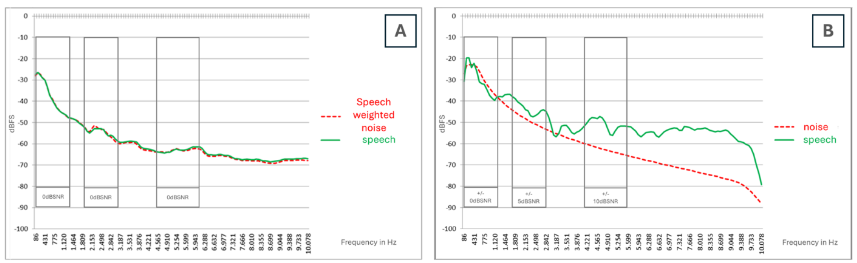
Laureyns et al. evaluated the impact of the masker babble spectrum on the ANL test and demonstrated that if the spectrum of the masking signal has more high frequency energy (high boost) compared to the spectrum of the running speech, ANL results will be higher (poorer) compared to matched noise. Specifically for the Dutch ANL version, when the masker babble spectrum was not matched, the average ANL was 14 dB whereas when the babble spectrum of the masker was matched, the average ANL was 10 dB. One reason for this difference may be that when the long-term spectrum of the noise is not speech weighted, this can result in different signal to noise ratio’s (SNR) in different frequency regions (see Figure 1 below). As displayed in Figure 1 / Graph 1A, the speech weighted noise produces a SNR ratio that is constant for all frequency regions; however, in Figure 1 / Graph 1B, the noise is not speech weighted, which allows for different SNR in different frequency regions (i.e., SNR is +/- 0 dB up to 1000 Hz, increasing to +5 dB SNR at 2000 Hz and to +10 dB SNR after 4000 Hz).
Conclusions
Based on these results, we recommended to include speech in noise testing, such as speech audiometry in noise or the acceptable noise level test, in audiology assessments. The World Health Organization recommends using speech in noise testing for hearing screening purposes. But when doing this, it’s highly advised to use speech weighted babble or noise, matched to the long term spectrum of the speech used for the ANL or SPIN tests. This recommendation can also be found in the ISO standard for speech audiometry (2022), where it is stated in Annex B – Examples of competing sound: that “In many cases, non-modulated noises represent the mean long-term spectrum of the speech material of the speech recognition test. Usually, this kind of noise yields a high test-retest reliability of the speech recognition threshold level.”
References
- Billings CJ, Olsen TM, Charney L, Madsen BM, Holmes CE. Speech-in-Noise Testing: An Introduction for Audiologists. Semin Hear. 2023 Sep 11;45(1):55-82. doi: 10.1055/s-0043-1770155. PMID: 38370518; PMCID: PMC10872656.
- Bronkhorst AW. The cocktail-party problem revisited: early processing and selection of multi-talker speech. Atten Percept Psychophys. 2015 Jul;77(5):1465-87. doi: 10.3758/s13414-015-0882-9. PMID: 25828463; PMCID: PMC4469089.
- Picou EM. Hearing Aid Benefit and Satisfaction Results from the MarkeTrak 2022 Survey: Importance of Features and Hearing Care Professionals. Semin Hear. 2022 Dec 1;43(4):301-316. doi: 10.1055/s-0042-1758375. PMID: 36466566; PMCID: PMC9715311.
- Dillon, H., A. James, and J. Ginis. 1997. “Client Oriented Scale of Improvement (COSI) and Its Relationship to Several Other Measures of Benefit and Satisfaction Provided by Hearing Aids.” Journal of the American Academy of Audiology 8 (1): 27–43.
- Moore DR, Edmondson-Jones M, Dawes P, Fortnum H, McCormack A, Pierzycki RH, Munro KJ. Relation between speech-in-noise threshold, hearing loss and cognition from 40-69 years of age. PLoS One. 2014 Sep 17;9(9):e107720. doi: 10.1371/journal.pone.0107720. PMID: 25229622; PMCID: PMC4168235.
- Windle R. Trends in COSI responses associated with age and degree of hearing loss. Int J Audiol. 2022 May;61(5):416-427. doi: 10.1080/14992027.2021.1937347. Epub 2021 Jun 17. PMID: 34137647.
- Parmar BJ, Rajasingam SL, Bizley JK, Vickers DA. Factors Affecting the Use of Speech Testing in Adult Audiology. Am J Audiol. 2022 Sep;31(3):528-540. doi: 10.1044/2022_AJA-21-00233. Epub 2022 Jun 23. PMID: 35737980; PMCID: PMC7613483.
- Meyhi, Y. , Van Doren P. & Laureyns M. (2020). Evaluatie van het gebruik van de Client Oriented Scale of Improvement (COSI) vragenlijst Vlaanderen – Deel: Classificatie van de doelstellingen in 5 en 16 clusters (Unpublished thesis). Thomas More University College, Department of Audiology, Antwerp.
- Nabelek AK, Tucker FM, Letowski TR. Toleration of background noises: relationship with patterns of hearing aid use by elderly persons. J Speech Hear Res. 1991 Jun;34(3):679-85. PMID: 2072693.
- Nabelek AK, Freyaldenhoven MC, Tampas JW, Burchfiel SB, Muenchen RA. Acceptable noise level as a predictor of hearing aid use. J Am Acad Audiol. 2006 Oct;17(9):626-39. doi: 10.3766/jaaa.17.9.2. PMID: 17039765.
- Freyaldenhoven MC, Smiley DF, Muenchen RA, Konrad TN. Acceptable noise level: reliability measures and comparison to preference for background sounds. J Am Acad Audiol. 2006 Oct;17(9):640-8. doi: 10.3766/jaaa.17.9.3. PMID: 17039766.
- Gordon-Hickey S, Moore RE, Estis JM. The impact of listening condition on background noise acceptance for young adults with normal hearing. J Speech Lang Hear Res. 2012 Oct;55(5):1356-72. doi: 10.1044/1092-4388(2012/11-0140). Epub 2012 Mar 12. PMID: 22411277.
- Francart T, van Wieringen A, Wouters J. Comparison of fluctuating maskers for speech recognition tests. Int J Audiol. 2011 Jan;50(1):2-13. doi: 10.3109/14992027.2010.505582. Epub 2010 Nov 23. PMID: 21091261.
- Jansen S, Luts H, Dejonckere P, van Wieringen A, Wouters J. Efficient hearing screening in noise-exposed listeners using the digit triplet test. Ear Hear. 2013 Nov-Dec;34(6):773-8. doi: 10.1097/AUD.0b013e318297920b. PMID: 23782715.
- Kalikow DN, Stevens KN, Elliott LL. Development of a test of speech intelligibility in noise using sentence materials with controlled word predictability. J Acoust Soc Am. 1977 May;61(5):1337-51. doi: 10.1121/1.381436. PMID: 881487.
- Laureyns M, Pugliese G, Freyaldenhoven Bryan M, Willekens M, Gasbarre AM, Zanetti D, Gilson J, Van Doren P, Di Berardino F. Multicenter Study on the Impact of the Masker Babble Spectrum on the Acceptable Noise Level (ANL) Test. Audiol Res. 2024 Dec 7;14(6):1075-1083. doi: 10.3390/audiolres14060088. PMID: 39727611; PMCID: PMC11673388.
- World Health Organization (2021). Hearing screening: considerations for implementation. 54p. retrieved at: https://www.who.int/publications/i/item/9789240032767
- WHO. World Report on Hearing (2021) 252p. retrieved at: https://www.who.int/publications/i/item/9789240020481
- International Organization for Standardization. (2022). Acoustics — Audiometric test methods Part 3: Speech audiometry (ISO Standard No. 8253-3). https://www.iso.org/standard/74049.html