

Metadichol Enhances CD14 Expression in Stem Cells
Metadichol induces CD14 glycoprotein expression in human embryonic stem cells and fibroblasts
P.R. Raghavan
Nanosrc Inc., PO Box 131, Chappaqua, NY 10514, USA
OPEN ACCESS
Published 31 May 2025
CITATION
Raghavan P.R. 2025. Metadichol induces CD14 glycoprotein expression in human embryonic stem cells and fibroblasts. Medical Research Archives, [online] 13(5). https://doi.org/10.18103/mra.v13i5.4849
Abstract
Cluster of differentiation 14 (CD14) is a glycoprotein central to the immune system that is found primarily on monocytes, macrophages, and other immune cells. Despite its importance, there are no examples in the literature highlighting the ability of metadichol to enhance CD14 expression in human embryonic stem cells (hESCs) remaining underexplored, presenting a unique opportunity for novel therapeutic interventions.
Keywords
CD14, metadichol, human embryonic stem cells, fibroblasts, immune response
Introduction
Cluster differentiation 14 (CD14) is a glycoprotein essential to the immune response that recognizes lipopolysaccharides (LPSs) from bacterial cell walls. This interaction significantly enhances the immune response to bacterial infections, making CD14 a key component in pathogen recognition and immune activation. However, the expression and functional implications of CD14 in human embryonic stem cells (hESCs) remain underexplored, presenting a unique opportunity for novel therapeutic interventions.
Experimental
All work was performed in accordance with the guidelines of the Indian Science Trust, Ltd. (Bangalore, India), and the antibodies used were from Elabscience (Houston, Texas, USA). hESC BGO1V and NHDF cells were obtained from ATCC.
Cell culture
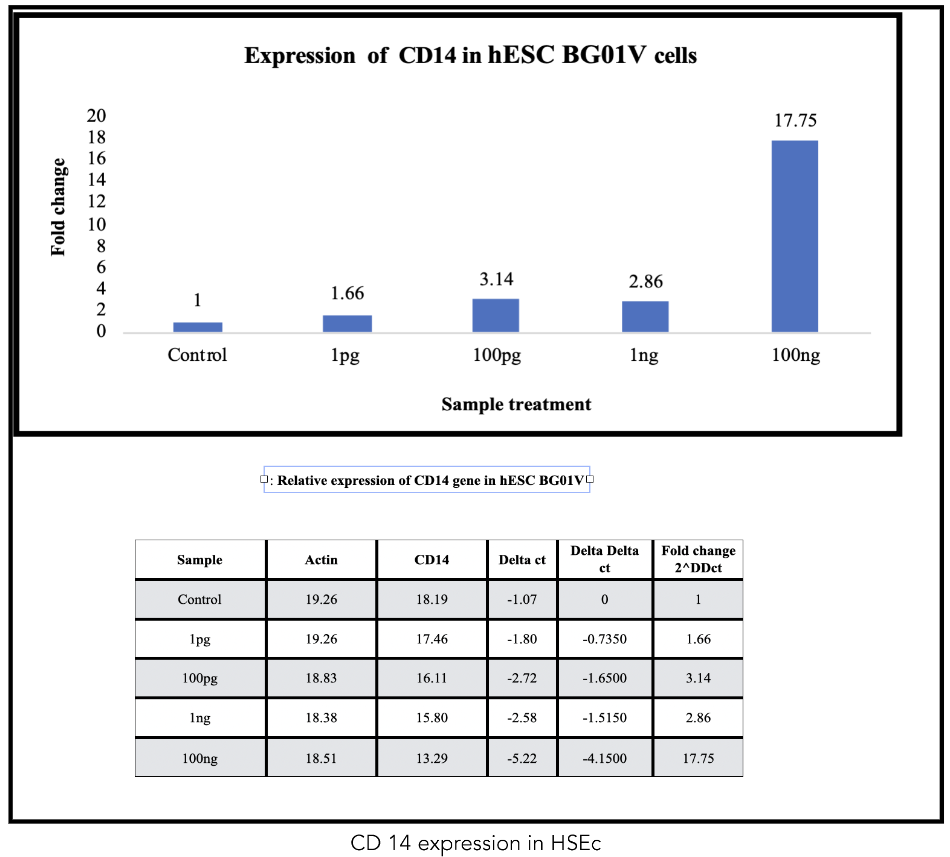
Human embryonic stem cells (hESCs) were maintained in suitable media with 20% fetal bovine serum and 1% antibiotics in a humidified atmosphere at 37°C. The cells were passaged every 3-4 days, and the expression of CD14 was monitored using qRT-PCR and Western blotting.
Quantitative real-time PCR
RNA was extracted using TRIzol (Invitrogen, CA, USA) and cDNA synthesis was carried out using a reverse transcriptase kit (TAKARA, Shiga, Japan) with oligo dT primers according to the manufacturer’s instructions. The reaction volume was set to 20 µL, and cDNA synthesis was performed at 50°C for 30 minutes, followed by RT inactivation at 85°C for 5 minutes in a thermal cycler (Applied Biosystems, Foster City, CA, USA). The cDNA was further used for real-time PCR analysis.
Western blotting
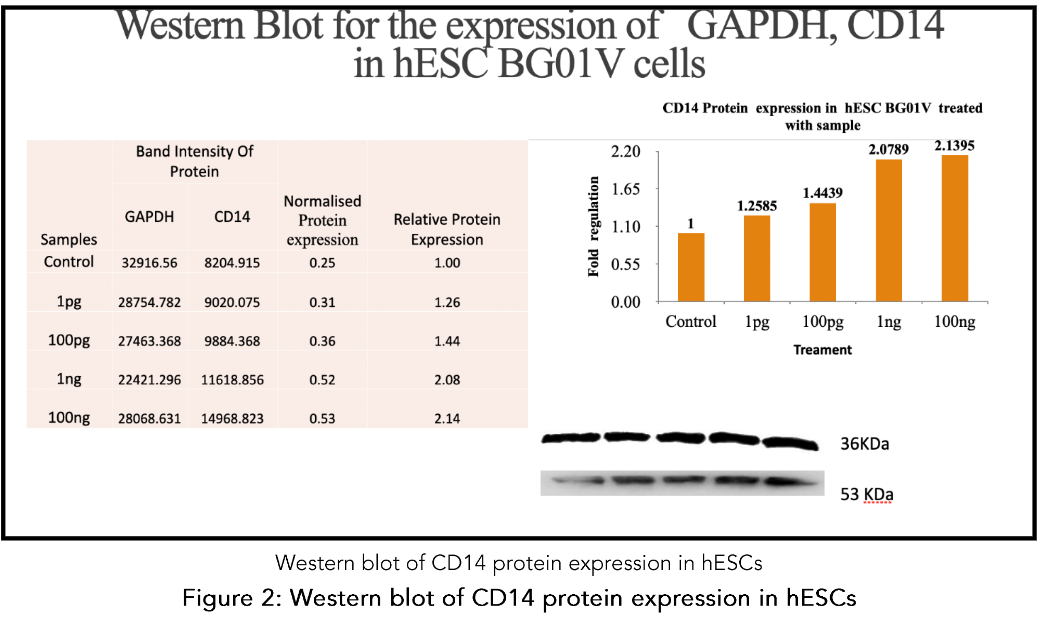
Protein was extracted from hESCs and analyzed using SDS-PAGE followed by Western blotting. The membranes were probed with specific antibodies against CD14 and GAPDH.
Results
The expression of CD14 in hESCs was significantly enhanced by metadichol treatment. The results indicated that metadichol exerts an influence on CD14 expression in hESCs.
Discussion
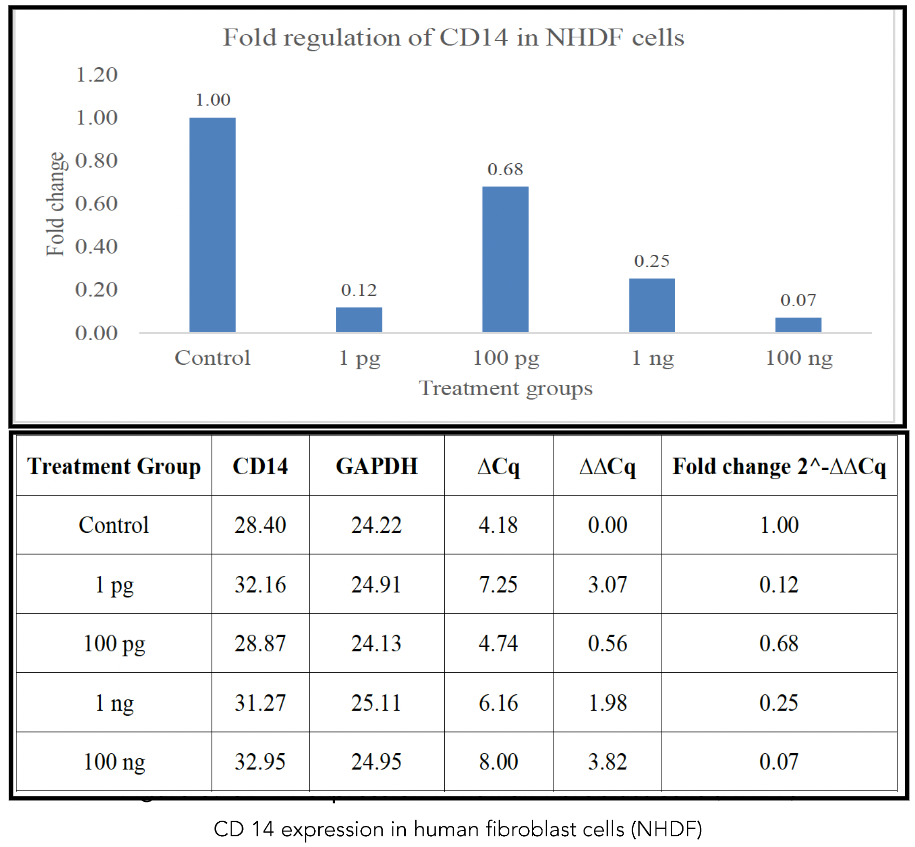
The downregulation of CD14 in fibroblasts by metadichol could imply a reduction in the inflammatory response typically mediated by these cells. Fibroblasts are involved in wound healing and tissue repair, and their role in inflammation is crucial.
Table 1
| Primer | Sequence | Size | Temperature |
|---|---|---|---|
| GAPDH | GTCCTCCTGACTTCAACAGG | 186 | 50 |
| CD-14 | ACGACCTTGTGCTGACCCAG | 119 | 53 |
Table 2
| Fibroblasts (NHDF) | Control | 1 µg | 10 µg | 100 µg |
|---|---|---|---|---|
| PPAR gamma | 1.78 | 2.31 | 7.31 | 30.7 |
| VDR | 1.76 | 2.85 | 9.67 | 31.5 |
Conclusion
The findings from this study indicate that metadichol has the potential to regulate CD14 expression in human embryonic stem cells (hESCs) and fibroblasts, suggesting novel therapeutic strategies for the treatment of inflammatory diseases.
References
1. Tuckov L, Faré M, Iwase T, Takada Y, Tsukada-Hagihara H. Functional analysis of epithelial cells in vivo express and release soluble CD14: a reevaluation of LPS activation of epithelial cells. Infect Immun. 2001; 69(6):3772-3781.
2. Warwick T, Schulz M.H., Günther S, et al. An investigation of the hierarchical regulatory network of the vitamin D-induced transcriptional response uncovers novel regulators and demonstrates total VDR dependency in monocytes. Sci Rep. 2021; 11(1): 6518. doi:10.1038/s41598-021-86032-5.
3. Valdés-López JF, Veilla P, Urquijo-Inclán L, Barrera-Robles L. Function of CD14 expression and differentiation into monocytes or macrophages in promyelocytic cell lines: a novel strategy. Adv Pharm Bull. 2013; 3(2):329-332. doi:10.5681/apb.2013.05.