

NEWS2 Outperforms CURB-65 and SMART-COP in CAP Mortality
Advanced Pneumonia Prognostication: Superior Performance of NEWS2 over CURB-65 and SMART-COP
Aziz Ahmed Barry ¹, Neelam Kumari ¹, Saira Jafri ¹
¹ Jinnah Postgraduate Medical Center
OPEN ACCESS
PUBLISHED: 31 August 2025
CITATION Barry, AA., Kumari, N., et al., 2025. Advanced Pneumonia Prognostication: Superior Performance of NEWS2 over CURB-65 and SMART-COP. Medical Research Archives, [online] 13(8). https://doi.org/10.18103/mra.v13i8.6687
COPYRIGHT © 2025 European Society of Medicine. This is an open-access article distributed under the terms of the Creative Commons Attribution License, which permits unrestricted use, distribution, and reproduction in any medium, provided the original author and source are credited.
DOI: https://doi.org/10.18103/mra.v13i8.6687
ISSN 2375-1924
ABSTRACT
National Early Warning Score 2 has gained popularity in recent years due to its simple and rapid application. Through this study, we aimed to compare NEWS2 with SMART-COP and CURB65 as a predictor of mortality in community acquired pneumonia patients. A total of 116 patients with a mean age of 46.9±20.5 years were taken through non-probability convenience sampling in six months duration in 2020 at Jinnah Postgraduate Medical Centre, Karachi, Pakistan. Patients with pneumonia secondary to aspiration or hospital acquired, COVID19 patients, Koch’s and pulmonary oedema or embolism were all excluded. Forty five (38.8%) mortalities were recorded for which NEWS2 was 97.8% sensitive in predicting it but only 15.5% specific. While CURB65 was 46.7% sensitive and 71.8% specific, making it a poor predictor of true positives. However, SMART-COP showed reasonable sensitivity and specificity of 68.9% and 66.2% respectively, making NEWS2 the most sensitive scoring system among all three for patients with CAP.
Keywords
NEWS2, CURB-65, SMART-COP, pneumonia, mortality
Introduction
Pneumonia is the infection of lower respiratory tract affecting the lung parenchyma involving the alveoli and the bronchioles. The 2019’s study on Global Burden of Diseases, estimates that around 489 million people are affected by pneumonia worldwide. Community acquired pneumonia (CAP) is the infection acquired outside the hospitals’ setting. Making it the fourth highest mortality contributor, globally. Where as Pakistan the all-cause mortality rate for CAP remains as high as 11.0% Despite the recent advances through antibiotics; acute critical care; vaccinations and rapid testing, CAP still has a high mortality and morbidity rate posing it to be a significant challenge for health care professionals.
The ATS/IDS guidelines have been instrumental in helping physicians manage patients with community-acquired pneumonia (CAP), particularly in determining admission criteria. Although severity scoring tools like CURB-65—which includes factors such as confusion, blood urea nitrogen >19 mg/dL, respiratory rate ≥30 breaths/min, systolic blood pressure <90 mmHg or diastolic pressure ≤60 mmHg, and age ≥65 years—and SMART-COP—which considers low systolic blood pressure (<90 mmHg), multilobar involvement on chest X-ray, albumin <3.5 g/dL, respiratory rate ≥30/min, heart rate ≥125 bpm, new confusion, oxygen saturation <90%, and arterial blood pH <7.35—are used to assess pneumonia severity, their application is limited due to their reliance on laboratory tests and time-consuming nature. A retrospective study involving 419 patients reported a sensitivity of 71% for CURB-65, while a Pakistani study found a 64.71% sensitivity for predicting mortality in CAP patients. In contrast, a meta-analysis showed that SMART-COP had a higher sensitivity of 92% for identifying mortality risk in CAP cases.
National Early Warning Score (NEWS) was first published by the Royal College of physicians in year 2012, which was then updated to National Early Warning Score 2 (NEWS2) in 2017 by adding new onset confusion and amended oxygen saturation levels for patients with type II respiratory failure. The final scores were then titrated to find the thresholds and triggers. These scoring systems have gained popularity in the recent years as they are comprising only of clinical parameters, their easy rapid application and non-dependency over lab parameters. This makes them cost efficient. A recent cross-sectional study conducted in Karachi, Pakistan published in the year 2023 showed greater sensitivity of NEWS2 over PSI in CAP patients, making it a better predictor for mortality by labelling high risk patients with greater accuracy.
NEWS2 has not yet been validated against other scoring systems, which are already being used for community acquired pneumonia in Pakistan such as CURB65 and SMART-COP. Hence; through this study we aim to compare NEWS2 with CURB65 and SMART-COP to predict mortality during hospital stay for CAP patients.
Methods
This study was conducted at Jinnah Postgraduate Medical Centre, Karachi after hospital’s IRB’s approval (NO.F.2-81/2020GENL/42870/JPMC) in 2020, conducted over a period of six months from June till November. It’s a cross-sectional study conducted after taking informed and written consent from all the patients (or their next-of-kin) included in the study.
116 patients were included in this study, aged 12 years and above diagnosed with community acquired pneumonia on clinical grounds and radiological basis. Sample size was calculated by using the formula n = (Zα/2) 2 *Var (AUC) / d 2 taking AUC as 0.71. The decision for admission was dependent upon ATS/IDSA CAP severity criteria fulfilling at least one minor criteria for admission, while the ICU admission was dependent upon meeting three minor or one major criterion. Patients with pneumonia secondary to aspiration or hospital acquired, COVID-19, Koch’s and pulmonary oedema or embolism were all excluded. Hospital mortality was the primary outcome. Three scores NEWS2, CURB65 and SMART-COP were applied onto the patient characteristics to calculate the severity scores. The severity scores for both the NEWS2 and SMART-COP were categorized into low risk with score <5 and high risk with a score ≥5. As for CURB65 a score of <3 was considered low and a score of ≥3 was considered as high risk.
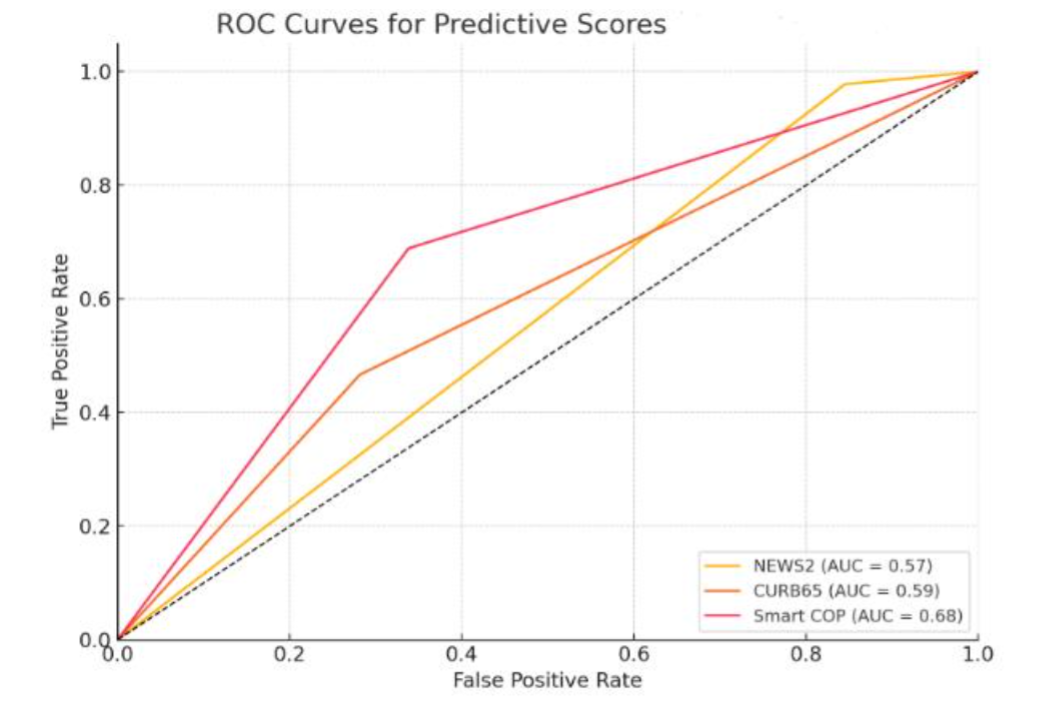
For statistical analysis IBM SPSS version 22.0 was used. Receiver operating characteristic (ROC) curve was utilised to estimate the area under the curve for sensitivity and specificity of each scoring system to predict the primary outcome. To check numeric variables’ normality Kolmogorov-Smirnov test was applied. For non-parametric variables comparisons use Wilcoxon Mann Whitney test and were presented as median, frequencies and percentages. After stratification McNemar test was applied on same variables to cross validate NEWS2 with other two scoring systems. In hospital mortality was taken as the gold standard and its sensitivity/specificity against the scoring systems was analysed. To assess the factors affecting the primary outcome, logistic regression was applied. The p≤0.05 was considered statically significant.
Results
A total of 116 patients were included in this study, with a mean age of 46.9±20.5 years. Out of these; 45 (35.3%) were females and 75 (64.7%) were males. Total of 45 (38.8%) mortalities were recorded. NEWS2 was able to label 104 (89.7%) patients as high risk and 12 (10.3%) as low risk patients. While Curb65 score revealed 41 (35.3%) as high risk and 75 (64.7%) as low risk patients. SMART-COP had shown 55 (47.4%) patients as high risk and 61 (52.6%) low risk.
| National Early Warning Score 2 (NEWS2) | P-Value | Low Risk (<5) | High Risk (≥5) |
|---|---|---|---|
| NEWS2 [Median (IQR)] | <0.001 | 3.0 (1.25-4.0) | 9 (7.0-10.0) |
| Curb65 [Median (IQR)] | 0.002 | 1.0 (0.25-1.0) | 2.0 (1.0-3.0) |
| o Low risk (<3) | <0.001 | 11 (91.7%) | 64 (61.5%) |
| o High risk (≥3) | 1 (8.2)% | 40 (38.5%) | |
| Smart COP [Median (IQR)] | <0.001 | 2.50 (1.0-3.0) | 5.0 (3.0-5.0) |
| o Low risk (<5) | <0.001 | 11 (91.7%) | 50 (48.1%) |
| o High risk (≥5) | 1 (8.2%) | 54 (51.9%) |
NEWS2 was 97.8% sensitive as it labelled 44 out of 45 patients who expired, as high risk patients. However; it showed low specificity of 15.5% as it labelled only 11 out of 71 survivors as low risk. The sensitivity and specificity of CURB65 as compared to NEWS2 was 46.7% and 71.8% respectively, making it a poor predictor of true positives for predicting in-hospital mortality. While SMART-COP showed a sensitivity of 68.9% and specificity of 66.2%, making it a reasonable scoring system to predict mortality.
| Predictive scores | In-hospital outcome | Sensitivity | Specificity | PPV | NPV |
|---|---|---|---|---|---|
| NEWS2 | High risk (≥5) | 44 (97.8) | 60 (84.5) | 97.8% | 15.5% |
| Low risk (<5) | 1 (2.2) | 11 (15.5) | |||
| Curb65 | High risk (≥3) | 21 (46.7) | 20 (28.2) | 46.7% | 71.8% |
| Low risk (<3) | 24 (53.3) | 51 (71.8) | |||
| Smart COP | High risk (≥5) | 31 (68.9) | 24 (33.8) | 68.9% | 66.2% |
| Low risk (<5) | 14 (31.1) | 47 (66.2) |
The ability to predict mortality in terms of ROC of NEWS2 [AUC: 0.57 (95% CI: 0.48-0.66), p=0.000] was similar to that of CURB65 [AUC: 0.59 (95% CI: 0.50-0.68), p=0.0094], whereas for SMART-COP [AUC: 0.68 (95% CI: 0.595-0.765)]. Logistic regression analyses revealed renal disease (OR=14.5, 95% CI: 1.67-125) and stroke (OR=8.75, 95% CI: 0.99-77.5) as factors leading to mortality.
Discussion
This is the first ever study in Pakistan comparing NEWS2 with CURB65 and SMART-COP for CAP patients in predicting mortality. Through this study it has been established that NEWS2 is a highly sensitive scoring system in predicting in-hospital mortality for community acquired pneumonia as compared to its counterparts, i.e. CURB65 and SMART-COP. However, NEWS2 has shown to have less specificity for the same goal. CURB65 on the other hand had low sensitivity and specificity both, for these patients. But SMART-COP has proven to be an acceptable scoring system with its reasonable sensitivity and specificity. Although, NEWS2 is not an ideal scoring system due to its low specificity, it can still be used due to its ability to pick-up high-risk patients efficiently. Which indirectly predicts mortality. Also, it’s increasing popularity due to its application and non-dependency over the lab parameters.
Because of its high sensitivity, the NEWS2 scoring system is useful in emergency settings, allowing for quick and efficient identification of high-risk patients and early detection of clinical deterioration, which facilitates prompt medical intervention. However, its low specificity in predicting mortality among CAP patients can result in false positives, where stable patients are mistakenly classified as high risk. While this tendency to over-triage may be preferable to under-triage, it can lead to unnecessary use of medical resources.
A six-year retrospective cohort study done in Norway on CAP patients, where nine different scoring systems for pneumonia were analysed including NEWS2 and CURB65. Similar to our study, this study has also shown high sensitivity but low specificity for NEWS2 scoring system as compared to other scores. However; in prediction of all-cause mortality CURB65, SOFA and IDSA/ATS has gained preference over NEWS2 as per this study.
A prospective cohort study published in 2023 involving 260 patients with community-acquired pneumonia (CAP) found that a NEWS2 score of ≥8, when combined with albumin levels below 3 g/dL and blood urea nitrogen (BUN) levels of ≥30 mg/dL, was a more effective predictor of in-hospital mortality. Additionally, this combination was also indicative of disease progression, as it correlated with the need for assisted ventilation and vasopressor support. These findings were supported by a higher area under the curve (AUC) value.
Sbiti-Rohr et al. in their randomised control trial conducted in 6 different tertiary care hospitals of Switzerland, compared NEWS2 with CURB65. Through regression analysis it showed that greater the value of NEWS2 score, greater the chances of not just ICU admissions but also re-admissions and the possibility of empyema in future.
The great benefit of using NEWS2 over the other scoring systems is that it doesn’t require any laboratory investigations like its counterparts. In fact, it can be applied at different intervals during the hospital stay to the same patient to assess the severity of the disease. This makes it easier for nurses to alarm the physician about their patients’ progress. Exactly for this reason, it makes this scoring system not just popular within the developing countries but in the west as well. Although in resource-rich environments, more comprehensive scores maybe feasible.
A meta-analysis done on 36 articles, studying eight different scoring system for community acquired pneumonia showed superiority of SMART-COP over CURB65 and PSI in terms of ICU admission prediction. However; unlike our study there has been no mention of NEWS2 scoring system in it. Another study done, shows similar results of SMART-COP being superior to CURB65 and PSI. However, there was no mention of NEWS2 in this study.
The key highlight of this study owes to its originality. As this is the first ever study conducted in the country comparing NEWS2 to not only one but two scoring systems; CURB65 and SMART-COP for CAP patients.
However, this study does have its limitations, such as that it’s a single centred study. Also the study was conducted at the peak time of COVID-19 pandemic, where the patients presenting to the hospital with respiratory tract symptoms were first evaluated and tested by the COVID-19 team and only after clearance were admitted in the pulmonology ward. Hence; the calculation of these scores for the patients might have been done at different intervals of the hospital course. Another limitation of the study is that NEWS2 is designed more for clinical deterioration rather than long term mortality predictor and we only scored it once at the time of presentation rather than at different stages of clinical stay. With these limitations, in high-pressure environments like emergency department, NEWS2 may still be more appropriate. This study has shown, great impact on predicting mortality by NEWS2 scoring system. The most striking advantage of NEWS2 is the simplicity of this score. We should strive to explore score adjustments or machine-learning-enhanced models that retain the simplicity of NEWS2 but improve specificity.
Conclusion
NEWS2 has proven to be more effective than CURB65 and SMART-COP in predicting mortality, primarily due to its quick and straightforward application in patients with CAP. This is particularly valuable in resource-limited settings, where timely identification of high-risk patients with greater sensitivity is crucial compared to other scoring tools.
Conflict of interest: The authors declare no conflict of interest related to this study.
Funding sources: This study received no financial support from any individual or organization.
Acknowledgements: The authors would like to extend their gratitude to Muniba Mehmood for her thorough review of the article and valuable editing assistance. We also like to thank Mr Intisar Ahmad for his biostatistical work.
References
- Torres A, Cilloniz C. Pneumonia. Nature Reviews Disease Primers. 2021;7(1). doi: https://doi.org/10.1038/s41572-021-00259-0
- Eleana Tsoumani, Carter JA, Stina Salomonsson, Stephens J, Goran Benčina. Clinical, economic, and humanistic burden of community acquired pneumonia in Europe: a systematic literature review. Expert Review of Vaccines. 2023;22(1):876-884. doi: https://doi.org/10.1080/14760584.2023.226178
- Simonetti AF, Garcia-Vidal C, Viasus D, et al. Declining mortality among hospitalized patients with community-acquired pneumonia. Clinical Microbiology and Infection. 2016;22(6):567.e1-567.e7. doi: https://doi.org/10.1016/j.cmi.2016.03.015
- Ansarie M, Kasmani A. Community acquired pneumonia in Pakistan: an analysis on the literature published between 2003 and 2013. JPMA The Journal of the Pakistan Medical Association. 2014;64(12):1405-1409. https://pubmed.ncbi.nlm.nih.gov/25842587/
- Dedrick RM, Guerrero-Bustamante CA, Garlena RA, et al. Engineered Bacteriophages for Treatment of a Patient with a Disseminated drug-resistant Mycobacterium Abscessus. Nature Medicine. 2019;25(5):730-733. doi: https://doi.org/10.1038/s41591-019-0437-z
- Metlay JP, Waterer GW, Long AC, et al. Diagnosis and treatment of adults with community-acquired pneumonia. an official clinical practice guideline of the american thoracic society and infectious diseases society of america. American Journal of Respiratory and Critical Care Medicine. 2019;200(7):e45-e67. doi: https://doi.org/10.1164/rccm.201908-1581st
- Community-Acquired Pneumonia in the Emergency Department (Infectious Disease CME) | EB Medicine. www.ebmedicine.net.
- Mandell LA, Wunderink RG, Anzueto A, et al. Infectious Diseases Society of America/American Thoracic Society Consensus Guidelines on the Management of Community-Acquired Pneumonia in Adults. Clinical Infectious Diseases. 2019;44(Supplement_2):S27-S72. doi: https://doi.org/10.1086/511159
- PAKISTAN CHEST SOCIETY GUIDELINES for the MANAGEMENT of COMMUNITY ACQUIRED PNEUMONIA in ADULTS. Accessed May 26, 2025. https://www.pakistanchestsociety.pk/wp-content/uploads/79_archives.pdf
- Barlow G, Nathwani D, Davey P. The CURB65 pneumonia severity score outperforms generic sepsis and early warning scores in predicting mortality in community-acquired pneumonia. Thorax. 2007;62(3):253-259. doi: https://doi.org/10.1136/thx.2006.067371
- Ahmed N, Jawad N, Jafri S, Raja W. DECAF versus CURB-65 to Foresee Mortality among Patients Presenting with an Acute Exacerbation of Chronic Obstructive Pulmonary Disease. Cureus. Published online January 9, 2020. doi: https://doi.org/10.7759/cureus.6613
- Memon RA, Rashid MA, Avva S, et al. The Use of the SMART-COP Score in Predicting Severity Outcomes Among Patients With Community-Acquired Pneumonia: A Meta-Analysis. Cureus. 2022;14(7). doi: https://doi.org/10.7759/cureus.27248
- Jones M. NEWSDIG: the National Early Warning Score Development and Implementation Group. Clinical Medicine. 2012;12(6):501-503. doi: https://doi.org/10.7861/clinmedicine.12-6-501
- Smith GB, Redfern OC, Pimentel MA, et al. The National Early Warning Score 2 (NEWS2). Clinical Medicine. 2019;19(3):260-260. doi: https://doi.org/10.7861/clinmedicine.19-3-260
- Kumari N, Saifullah N, Jafri S, Ahmed A, Jawad N, Ahmed N. Comparison of NEWS2 and PSI as mortality predictors in patients with community acquired pneumonia. JPMA The Journal of the Pakistan Medical Association. 2024;74(6):1156-1159. doi: https://doi.org/10.47391/JPMA.10031
- Iftikhar S, Bjørn Waagsbø. Assessment of disease severity in hospitalized community-acquired pneumonia by the use of validated scoring systems. BMC Pulmonary Medicine. 2025;25(1). doi: https://doi.org/10.1186/s12890-025-03550-y
- Tajarernmuang P, Sanwirat P, Inchai J, Phinyo P, Limsukon A. The National Early Warning Score 2(NEWS2) to Predict Early Progression to Severe Community-Acquired Pneumonia. Tropical Medicine and Infectious Disease. 2023;8(2):68. doi: https://doi.org/10.3390/tropicalmed8020068
- Sbiti-Rohr D, Kutz A, Christ-Crain M, et al. The National Early Warning Score (NEWS) for outcome prediction in emergency department patients with community-acquired pneumonia: results from a 6-year prospective cohort study. BMJ Open. 2016;6(9):e011021. doi: https://doi.org/10.1136/bmjopen-2015-011021
- Marti C, Garin N, Grosgurin O, et al. Prediction of severe community-acquired pneumonia: a systematic review and meta-analysis. Critical Care. 2012;16(4):R141. doi: https://doi.org/10.1186/cc11447
- Brown SM, Dean NC. Defining and predicting severe community-acquired pneumonia. Current Opinion in Infectious Diseases. 2010;23(2):158-164. doi: https://doi.org/10.1097/qco.0b013e3283368333