

Nurses’ Attitudes Toward Opioids and Death Anxiety
“`html
Correlation of sociodemographic parameters with nurses’ attitudes about opiophobia and thanatophobia
Authors: Iassopou, M.D., Marana Bajić, Grad. Med., Catholic University of Croatia, Zagreb, Croatia; Tanja Angelovska, Ph.D., Special Hospital for Chronic Diseases, New Maj, Croatia; Tassić, M.D., Ph.D., Catholic University of Croatia, Zagreb, Croatia; Jasna Flečko, M.D., University Josip Juraj Strossmayer, Osijek, Croatia; Barbara Ešlić, M.D., Ph.D., Catholic University of Croatia, Zagreb, Croatia; Darko Ropac
ABSTRACT
Pain is one of the most common symptoms encountered by patients with palliative care, and it affects the patient’s quality of life. It is important for the medical staff to understand the importance of the quality of the remaining life of the patient, improve the quality of life, and alleviate suffering.
Quality palliative care is achieved through early recognition, adequate assessment and relief of pain and other physical, emotional and spiritual problems.
Keywords:
palliative care, opiophobia, thanatophobia, nurses’ attitudes, pain management
Introduction
The World Health Organization (WHO) defines palliative care as an approach that improves the quality of life of patients (adults and children) and their families who are facing problems associated with life-threatening illnesses. It prevents and relieves suffering through the early identification, correct assessment and treatment of pain and other problems, whether physical, psychosocial or spiritual.
Quality palliative care is achieved through early recognition, adequate assessment and relief of pain and other physical, emotional and spiritual problems.
Participants and Methods
ETHICS
This study was performed for the purposes of scientific research and was approved by the Ethics Committee of the Hospital. The study included participants who voluntarily agreed to participate. The informed consent was obtained from all participants.
STATISTICAL PROCEDURES
Descriptive methods (descriptive and Spearman’s rank correlation coefficient) and inferential methods (Kolmogorov-Smirnov distribution normality test, chi-square test, t-test) were used in statistical data processing. The significance of the difference was determined at the level of p < 0.05 (95% confidence level).
Results
DESCRIPTIVE STATISTICAL ANALYSIS
The length of service of the participants in the sample varied between one and 41 years. The average length of service for all participants is 17.6 years with an interquartile range of variation of 8.69.
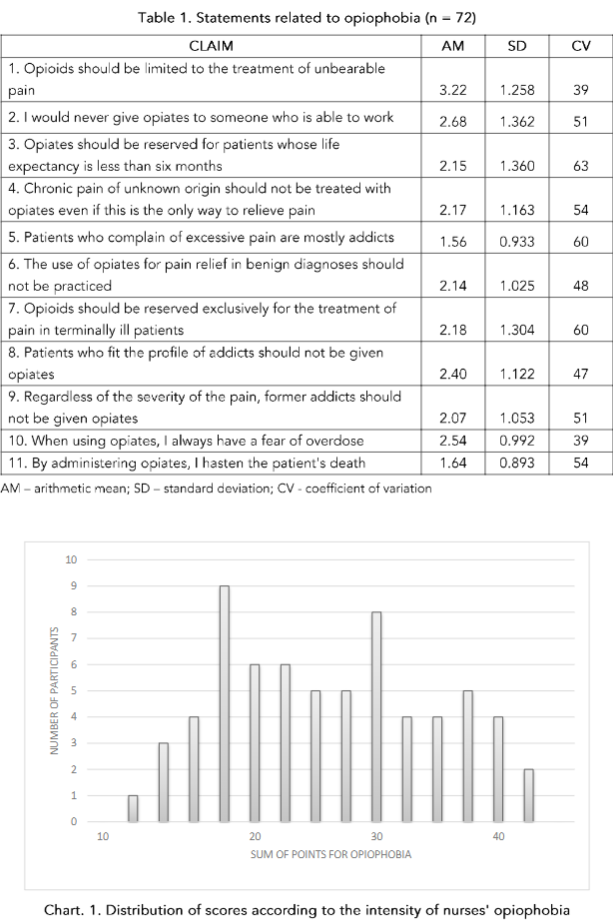
AM = arithmetic mean; SD = standard deviation; CV = coefficient of variation.
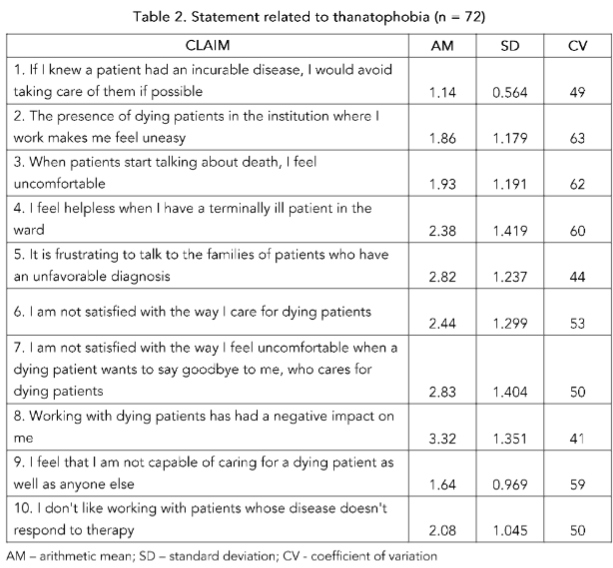
INFERENTIAL STATISTICAL ANALYSIS
The first group of analyses consists of t-tests of differences between arithmetic means. Six t-tests were performed comparing arithmetic means with regard to opiophobia and thanatophobia of participants with regard to their place of work in the hospital.
Discussion
In order to obtain a more relevant result, it was necessary to analyze the relationship between the level of education and the attitudes of participants with a positive attitude towards pain management. This result was attributed to the education and knowledge of participants.
Conflicts of Interest Statement:
The authors have no conflicts of interest to declare.
References
1. WHO. Palliative care: A systematic review of reviews and meta-analysis. Clin Pract Epidemiol Ment Health. 2024;20:1-10. doi:10.2147/145017918385. 724202629428.
2. McCaffrey N, Bradley S, Ratcliffe J, Currow DC. What aspects of quality of life are important from palliative care patients’ perspectives? A systematic review of qualitative research. J Pain Symptom Manage. 2014;52(1):138-228.
“`