Political Astuteness in Tennessee Nurse Practitioners
Political Astuteness in Tennessee Nurse Practitioners: Strategies to Inform
Tracie Gooch, DNP, RN
Lincoln Memorial University
OPEN ACCESS
PUBLISHED: 31 July 2025
CITATION Gooch, T., 2025. Political Astuteness in Tennessee Nurse Practitioners: Strategies to Inform. Medical Research Archives, [online] 13(7). https://doi.org/10.18103/mra.v13i7.6617
COPYRIGHT © 2025 European Society of Medicine. This is an open-access article distributed under the terms of the Creative Commons Attribution License, which permits unrestricted use, distribution, and reproduction in any medium, provided the original author and source are credited.
DOI: https://doi.org/10.18103/mra.v13i7.6617
ISSN 2375-1924
ABSTRACT
Political astuteness among nurse practitioners practicing in states like Tennessee with practice restrictions needs evaluation to promote policy and scope of practice change to increase access to quality healthcare in rural and underserved areas to decrease healthcare disparities in vulnerable populations. There is a scant amount of literature that specifically addresses political astuteness in nurse practitioners. The purpose of this project is to assess and provide strategies to inform nurse practitioners on political astuteness and activity. A cross sectional survey included the administration of an online version of the Political Astuteness Inventory (PAI), compared results with the demographic questions to establish political astuteness strengths and weaknesses. The PAI is a self-assessment tool created by P.E. Clark in 1981 and used in multiple studies that reveals increased political astuteness following policy related educational activities. A Framework for Action provided the conceptual and theoretical framework to integrate the baseline assessment of political astuteness in nurse practitioners in Tennessee to strategize ways to inform nurse practitioners to increase political astuteness and activity.
Keywords: political astuteness, nurse practitioner, research, Tennessee, restrictive states, and political astuteness inventory
Introduction
Political astuteness in the nursing profession is essential to promoting policy change that increases scope of practice, access to care and implementation of evidence-based practice. The state of Tennessee is characterized as a restrictive practice state, which requires Nurse Practitioners (NPs) to have a supervising physician in order to practice and prescribe medications. In addition to being a restrictive practice state, Tennessee has specific legislation that prevents NPs from prescribing buprenorphine for the treatment of addiction. Resistance to change this legislation is a prime example of how NPs in Tennessee need to work together as a profession to increase access to life-saving treatments.
According to the membership directory of the Tennessee Nurse Practitioner Association (TNNPA) there are only 128 members of this professional organization out of approximately 5,776 professionally active NPs in Tennessee. This is only 0.02% of NPs who are currently practicing in Tennessee. Membership and participation in professional or political organizations has shown to increase political participation. A baseline assessment of the political astuteness of NPs in the state of Tennessee through an online Political Astuteness Inventory (PAI) provided a foundation of how to implement political awareness activities that will promote NP understanding and participation in the political arena. Strategies to inform are based on the results from the political astuteness survey when compared to demographic data collected, the collective PAI score of the participants, and evaluation of needs to improve political activity in NPs who practice in Tennessee.
The inspiration for this project revolved around a perceived inability to make a difference in legislation by the primary researcher when contacting the state professional organization regarding medication-assisted treatment (MAT) prescriptive authority. The response of the professional organization to this specific situation revealed a personal knowledge gap in the political process, despite having courses directly addressing this topic. Current literature and standards are utilized to strategize methods for improving political astuteness and activity in Tennessee NPs from the baseline political astuteness assessment.
Review
A comprehensive literature search of Cumulative Index of Nursing and Allied Health Literature (CINAHL), with the key terms: political astuteness, research, nurse practitioner, Tennessee, and restrictive states, and Mednar, a deep federated search that includes the Cochrane Library, Google Scholar, MEDLINE/PubMed, and all the National Institutes of Health (NIH) websites, including the key terms: political astuteness, nurse practitioner, political astuteness inventory, and research reveals a paucity of research specific to nurse practitioner political astuteness. Political astuteness was introduced into community health nursing in the 1980s. The main concept was to measure political astuteness through an individual assessment of political awareness and activity that was created into the Political Astuteness Inventory. The concept of political astuteness has not been well developed in the literature. However, the definition consists of “an awareness and understanding of legislative and political processes and political skills” and “deploying political skills in situations involving diverse and sometimes competing interests and stakeholders, in order to create sufficient alignment of interest and/or consent in order to achieve outcomes.” Similar concepts related to political astuteness include political awareness, political activity, political advocacy, and political self-efficacy. Political awareness is not specifically defined in the literature but has been defined as a category of emotional intelligence that includes the ability to understand underlying motives and agendas and using that data to bring about a desired outcome. Political activity is defined as “activities undertaken voluntarily by a citizen to influence authoritative or generally binding regulations and decisions related to the political system” and falls into four categories that include voting, conventional, party-related and unconventional based on the degree of commitment to the activity. Political self-efficacy is divided into two main aspects: internal efficacy – where an individual believes that personal activities will lead to a desired policy change; and external efficacy – the belief that actions performed by an individual will move through the political process and result in a desired outcome. Political astuteness encompasses all of these aspects to create a skill set and knowledge base that enables individuals to participate in the political arena.
Political astuteness has been studied within the Framework for Action and critical social theory was suggested as a framework to increase political astuteness. The PAI works well with the Framework for Action because the data from the PAI provides an assessment of strengths and weaknesses in political astuteness and the Framework for Action provides structure to enhance the strengths and a pathway for change regarding weaknesses. Critical Social Theory (CST) in the nursing profession is based on the theory that can be viewed as a metatheoretical framework that emphasizes reason, language, rational argument, social critique, and understanding historical evidence to promote emancipation from current paternalistic norms in the nursing profession. The CST can be used to promote objectivity regarding current political astuteness levels in Tennessee NPs, evaluate the political climate regarding changes for scope of practice, confront negative stigma regarding the nursing profession in relation to other health care providers, and encourage liberation for a predominately female profession to encourage preventative health care. Critical Social Theory can be utilized to compare scope of practice traditions in restrictive practice states to unrestricted practice states and provide objective data to legislators, health care providers, and other stakeholders to remove barriers to care, and promote patient autonomy through allowing increased access to health care through the utilization of NPs.
Political Astuteness was assessed in the UK, Australian and New Zealand public sectors. This study revealed that the concept of political astuteness had negative implications, however, the skills that are used in political participation are considered valuable in individuals who considered public managers. This study shows that political astuteness is a skill set that allows individuals to be aware of differing stakeholder values and using that information to bring about a collaborative agreement that is beneficial to all stakeholders. The theoretical definition of political astuteness comes from this study: “deploying political skills in situations involving diverse and sometimes competing interests and stakeholders, in order to create sufficient alignment of interest and/or consent in order to achieve outcomes.” The legal profession posits that legal astuteness is “the ability of a top management team to work with counsel to solve complex problems and to protect and leverage firm resources.” Hartley and colleagues posit that political astuteness is a valuable skill set that should be utilized in public sector to promote unification among diverse stakeholders in various settings. The literature shows that nursing from varying educational levels, along with allied health care professions, benefit from political awareness activities, with Hart having literature specific to nurse practitioners.
An integrative review revealed that the PAI is the most commonly used instrument for evaluation of political astuteness. Additionally, despite the use of the PAI, nursing in the United States seems to be lacking in promoting the skill set to enhance political astuteness in all levels of nursing careers. There is uniformity in the literature that political astuteness is enhanced with education, understanding and participation in political activities. Further research is needed to promote political competence in the nursing profession.
PROBLEM AND PURPOSE
There is a paucity of information regarding political astuteness in NPs in Tennessee. This project assessed the following questions: 1) What is the baseline assessment of political astuteness in Tennessee NPs; 2) How does demographics – age, practice region, and years of practice – impact political astuteness in Tennessee NPs; and 3) How can the results of this assessment and current political astuteness literature be utilized to inform and strategize political activity to increase NP scope of practice in Tennessee and other restrictive practice states?
AIM
The aim of this project is to explore and describe the level of political astuteness in Tennessee NPs and provide strategies to remove barriers to care and increase scope of practice in a restrictive practice state.
OBJECTIVES
- To measure a baseline political astuteness in Tennessee NPs
- To identify demographic strengths and weaknesses from baseline astuteness
- To develop recommendations to promote improved political astuteness in Tennessee NPs
- To explain how political astuteness can promote political activity
- To inform NPs how political astuteness and activity can lead to policy recommendations for increased scope of practice in restrictive states
Political astuteness baseline assessment is essential to determine the level of political understanding and participation in NPs in a restrictive practice state. Once the baseline political astuteness level was determined, evaluation of age, practice regions and experience provided areas of strengths and weaknesses to political astuteness and recommendations to improve political astuteness in a restrictive practice state. Finally, political astuteness levels were assessed to provide recommendations and strategies for Tennessee NPs to increase political astuteness and activity that will lead to increased political efficacy, and patient access to care through removal of barriers in scope of practice and legislation in a restrictive practice state.
Significance
HEALTH RANKINGS
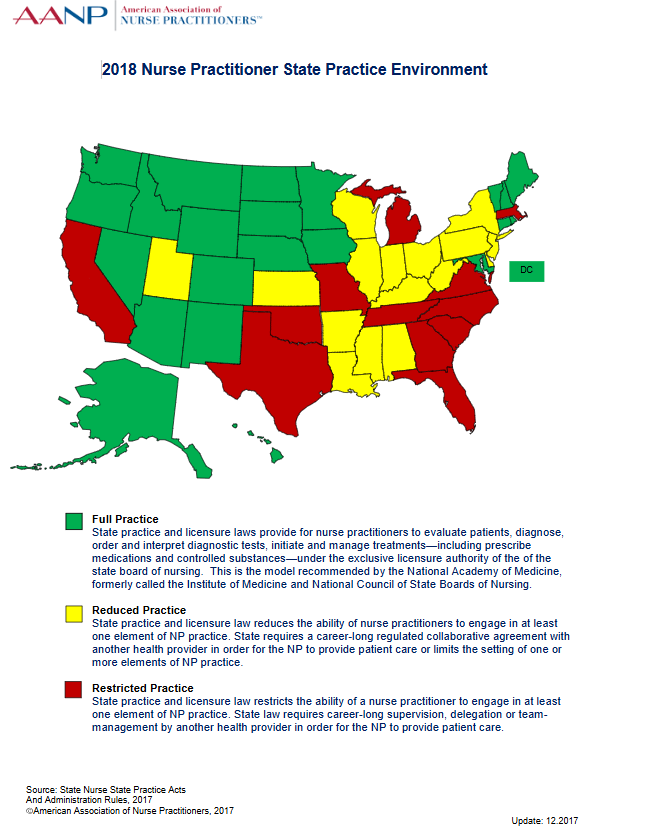
In 2015, the state of Tennessee ranked 43 out of 50 in overall health. America’s Health Rankings 2017 annual report reveals that the rank for Tennessee health had dropped to 45, showing a decrease in health status for Tennesseans. These statistics support a need for increased access to quality health care in the state of Tennessee, which is currently one of only twelve states with restrictive practice regulations for NPs as shown on the Practice Map in Appendix B. Oliver and colleagues describe the statistical significance in improved outcomes with care provided by NPs in full practice states versus states without full practice. Full practice is an “absolute independent practice in which the NP is responsible exclusively to a state board of nursing” while reduced practice is defined as “a collaborative practice agreement with a physician specifying the scope of practice allowed” and restrictive practice is practice that requires “a physician to oversee all care provided by the NP.” Oliver and colleagues conclude that in the four areas of evaluation – potentially avoidable hospitalizations, third-day readmissions after rehabilitation discharge, annual hospitalization of nursing home patients and overall health outcomes – full practice state results were statistically better than the states that were not full practice. The Institute of Medicine states that nurses, and especially NPs, are key to strengthening primary care provisions in the United States through nurses’ health professionalism and expertise in policy. There are roughly 5,776 NPs in the state of Tennessee who could have a positive impact on removing barriers to care through effective utilization of political astuteness and policy expertise.
In the state of Tennessee there is currently specific legislation that prohibits nurse practitioners from prescribing buprenorphine specifically for the treatment of addiction. Access to medication-assisted treatment (MAT) with buprenorphine through utilization of NPs would decrease health care disparities especially in rural areas. The Henry J Kaiser Family Foundation reports that the life expectancy for Tennesseans ranks among the shortest in the US and chronic illnesses – diabetes, asthma, obesity, and heart disease – are among the highest ranks in the US. Utilization of NPs to the fullest educational capacity is key to decreasing the morbidity and mortality related to these statistics in Tennessee.
BARRIERS TO CARE
The Tennessee Nurses Association posted on their website: “The Unmet Demand for Primary Care in Tennessee: The Benefits of Fully Utilizing Nurse Practitioners” that revealed that in 2012 there is a significant access deficiency in most of Tennessean counties. In this report, the barriers to practice include “practice authority regulations, inequitable payment policies for NP-provided care, and interprofessional tensions that impede effective team practices.” Rural counties have decreased access to primary care and increased incidence and prevalence of chronic health conditions such as diabetes, hypertension, and cardiovascular disease, that leads to further decrease in access to care through irresponsible use of health care funds. Increased access to primary care through NPs will decrease health care costs by approximately “$199 million in the short term and $621 million in the long term for Tennesseans with diabetes and hypertension.” Tennessee has a large percentage of unmet primary health care needs as seen on the Federal Health Professional Shortage Areas Primary Care Map Appendix E.
SIGNIFICANCE TO NURSING PRACTICE AND SCIENCE
Political astuteness is a knowledge base and skill set that has to be developed to promote policy change. A baseline assessment of Tennessee NP astuteness has provided a way to understand how the astuteness skills and educational foundations can increase political participation to remove barriers to full practice authority and access to primary care. Political self-efficacy is a key component to political astuteness because an individual has to have confidence that political activity will bring about a desired outcome, and believe that the government is willing to act upon the activities that an individual invests into the system. Participation in professional organizations has shown to increase political activity and bring about desired outcomes through collective confidence in the political arena. With only approximately 0.02% of Tennessee NPs participating in the state professional organization, the political efficacy of Tennessee NPs can be bolstered through evaluating the results of the Political Astuteness Inventory and comparing with strengths and weaknesses to develop strategies to increase political knowledge and skills. With increased political astuteness, NPs will be able to unify to promote policy change based on evidence rather than interprofessional misconceptions, political views, or traditional stigma that can lead to increase access to primary care, and remove practice barriers.
DESIGN
This project consisted of a cross-sectional study of Tennessee Nurse Practitioners (NPs) to determine a baseline assessment of political astuteness for this cohort of nurses. A cross-sectional study design involves participants based on inclusion and exclusion criteria. Individual demographics (independent variable) that has been correlated with political astuteness (dependent variable) which has been evaluated through the administration of the Political Astuteness Inventory (PAI). The PAI has been used in previous studies as a pre and post assessment for political astuteness. This project utilized the PAI as a one-point assessment that is consistent with a cross-sectional study design. The results allowed generalizability to similar cohorts to promote political astuteness and participation. These results in conjunction with the extant literature has provided data for strategy development to improve political astuteness and participation.
THEORETICAL FRAMEWORK
Mason and Talbott produced a political action model for the nursing profession in 1985 called The Framework for Action. The Framework for Action conceptualizes areas where the nursing profession uses politics to enhance policies that promote quality in health systems. The current Framework for action includes 4 “spheres of influence” that include: 1) the workplace and workforce, 2) the government, 3) associations and interest groups, and 4) the community and incorporates health and social policy, health systems and social determinants of health that promote health and decreased health care disparities through nurses. These spheres overlap and influence one another in multiple ways creating a dynamic system that adapts to individual, group or global needs.
The Framework for Action was ideal for this project because it is a systems approach to increasing political activism through recognition of a baseline assessment of the NPs in Tennessee (the workforce and workplace), understanding scope of practice limitations (the government), participation in professional organization (associations and interest groups), and access to quality health care in restrictive practice states (the community) and how these concepts influence health disparities in Tennessee. Political astuteness provides a knowledge base and skill set that is used in all spheres to promote collaboration in the workforce, implementation of evidence-based practice through legislation (government), increase political activity through professional organizations (associations) and decrease health disparities (community). In Figure 1-4 (Appendix C) Mason and colleagues describe: who, where, what, when and why of nursing’s policy influence. This project was designed to obtain a baseline understanding of political astuteness of NPs in order to develop strategies to promote policy change through a learned process to decrease health care disparities.
Method
CROSS-SECTIONAL STUDY
A cross-sectional survey was used in this project to assess a baseline political astuteness level of NPs. Descriptive statistics, demographic information, were collected and correlated with individual political astuteness levels. This method allowed generalization of the results to NPs in restricted practice states. The descriptive statistics were used to generate strategies to inform regarding political astuteness. The baseline assessment is imperative to increase the understanding of political astuteness and activity that can be utilized in a longitudinal study.
SAMPLING AND DATA COLLECTION
This study sample included NPs with a valid Tennessee APRN license, and exclude NP students, Certified Clinical Nurse Specialists (CNSs), Certified Registered Nurse Anesthetists (CRNAs), and Certified Nurse Midwives (CNMs). NP certification was required therefore, if a participant holds dual certification, i.e. a NP that is also a CNS or CNM, was eligible to participate in the survey.
A modified PAI was rendered into an electronic format on Survey Monkey ™ and a link was placed on the Tennessee Nurse Practitioner’s Association (TNNPAs) Facebook ™, Tennessee Nurses Association Facebook ™, Doctors of Nursing Practice online community, and snowball sampling were utilized to increase survey response. The PAI survey was open for participation for six consecutive weeks from May 28, 2018 until July 9, 2018. Reminder postings were done on a two-week interval during the open response time. The week prior to closing, an extra reminder was presented in an attempt to increase response rate. With the approximate NP professionals in Tennessee rounded to 5,000 and a desired margin of error +/- 5%, the number of survey participants that were needed was 357. With a margin of error of +/- 10%, the number of participants would be 95. This design utilized multiple resources accounted for those NPs who are not members or familiar with TNNPA. The sampling questions included demographic, and astuteness questions.
The demographic information was collected to correlate astuteness with age, educational level, gender and regions of Tennessee. The astuteness questions were correlated the demographic information with level of political understanding and involvement. These data provided an overall assessment of how NPs understand and participate in the political arena. The survey consisted of multiple-choice options for the demographic information, and yes/no questions for astuteness. The typical time contribution time was four minutes and three seconds. Statistical consultation was utilized to evaluate results using SPSS. Conclusions were evaluated to ascertain characteristics that may promote political activity advocating increased access to care for Tennessee residents through utilization of NPs to the fullest extent of licensure.
PROJECT ENVIRONMENT SETTING
This project was conducted as an online assessment survey using Survey Monkey ™. Each participant had the option to participate, consent was implied, and current Tennessee licensure was self-reported when a NP chose to participate through answering and submitting the survey.
POLITICAL ASTUTENESS INVENTORY
The Political Astuteness Inventory (PAI) consists of a 40-item questionnaire that was developed by P.E. Clark in 1981 and published in 1984 for use. Each question is scored according to response – each affirmative response earns a score of 1 while negative responses earn a score of 0. Questions are structured to assess political activity, “I am registered to vote” and “I voted in the last two elections”; political awareness, “I was acquainted with the majority of issues on the ballot at the last election”; and general legislative process, “I know the process by which a bill is introduced in my state legislature.” All questions are scored equally resulting in a final score that falls into one of the following four categories: completely politically unaware (0-9), slight awareness of political activity (10-19), beginning political awareness (20-29), politically astute (30-40). These results are interpreted as the higher the score, the greater level of political astuteness an individual possesses. The content validity of the PAI is consistent with other items reported on the Civic Volunteerism Model tool and has internal consistency reliability with Cronbach α 0.818, and 0.8415.
The PAI was adapted for this project as shown in Appendix A that shows the original PAI, the original modification to the PAI for publication in 1984, and the modified PAI for this study with changes noted with red text. The modifications included an electronic format with some questions reworded to provide consistency if the participant chose to continue moving forward through the survey instead of looking back at previous questions, removal of the student cohort from the survey, as this cohort was excluded in this study and adjustments for state and national organization participation.
THEORETICAL AND OPERATIONAL DEFINITIONS
Astuteness is theoretically defined as “deploying political skills in situations involving diverse and sometimes competing interests and stakeholders, in order to create sufficient alignment of interests and/or consent in order to achieve outcomes.” For this project the operational definition of political astuteness consisted of political awareness, political participation and legislative understanding as scored on the PAI.
DATA ANALYSIS/QUALITY ADHERENCE
This project was a quantitative observational cross-sectional study. The data was collected via Survey Monkey ™ and compared to the demographic information for measure of prevalence or rate associated with dichotomous categorical outcomes. Data were evaluated using SPSS to find prevalence between astuteness and demographic information that was obtained. Since this study was a one-time survey of individuals, response bias associated with a pre-post design was eliminated. Additionally, socially accepted response expectations were absent since this project was anonymous and reports were in aggregate form. Strategies to inform were based on extant literature and current evidence that enhances political knowledge and skills that can be utilized to unify NPs to promote policy change in Tennessee.
HUMAN RIGHTS AND PRIVACY
This project did not involve participants from vulnerable populations – prisoners, children, cognitively impaired persons, employees, students, and economically and/or educationally disadvantaged. Demographic information collected did not include ethnic, racial, religious, medical history, or pregnancy related information and did not cause any harm to these participants. The data collected were in aggregate form, thereby protecting the anonymity of participants. Survey Monkey ™ was used because the software is designed to maintain anonymity and prohibits collection of individual identifiers. The survey was voluntary and participants were able to opt out of participation without any consequences at any time. The emailed invitations to participate in the survey thoroughly explained the process of participation, lack of incentive to participate and when data was saved. The IRB application approval was obtained on April 4, 2018. Appendix F includes the Lincoln Memorial University IRB application and Approval.
Results
The total number of respondents was 82 participants. Only completed surveys were considered for statistical analysis to prevent skew of results. Only 66 surveys were completed to include all PAI and demographic questions and only 64 completed demographic questions. Survey Monkey ™ reported 88% completion rate, however, this did not account for skipped questions in the PAI portion of the survey. The overall completion rate was 80.48% for PAI and demographics and 78.05% for demographic data.
| Question # | % Yes | % No | # Yes | # No | #NR |
|---|---|---|---|---|---|
| 1. I am currently registered to vote. | 95.12 | 4.8 | 78 | 4 | 0 |
| 2. I know where my voting precinct is located. | 93.90 | 6.10 | 77 | 5 | 0 |
| 3. I voted in the last general election. | 90.24 | 9.76 | 74 | 8 | 0 |
| 4. I voted in the last two elections. | 87.80 | 12.20 | 72 | 10 | 0 |
| 5. I recognized the names of the major candidates on the ballot in the last election. | 92.59 | 7.41 | 75 | 6 | 1 |
| 6. I was acquainted with the majority of issues on the ballot at the last election. | 87.80 | 12.20 | 72 | 10 | 0 |
| 7. I stay abreast of current health issues. | 98.78 | 1.22 | 81 | 1 | 0 |
| 8. I belong to the state professional nurses’ organization. | 75.31 | 24.69 | 61 | 20 | 1 |
| 9. I participate (committee member, officer, etc.) in that organization. | 22.22 | 77.78 | 18 | 61 | 1 |
| 10. I attended the most recent meeting of my district’s nurses’ organization. | 15.85 | 84.15 | 13 | 69 | 0 |
| 11. I attended the last state or national convention held by my organization. | 34.18 | 65.82 | 27 | 52 | 3 |
| 12. I am aware of at least two issues discussed and the stands taken at that convention. | 65.82 | 34.18 | 52 | 27 | 3 |
| 13. I read literature published by my state nurses’ association, professional magazines, or other literature on a regular basis to stay abreast of current health issues. | 85.71 | 14.29 | 66 | 11 | 5 |
| 14. I know the names of my state senators in Washington, DC. | 89.87 | 10.13 | 71 | 8 | 3 |
| 15. I know the names of my representatives in Washington, DC. | 88.46 | 11.54 | 69 | 9 | 4 |
| 16. I know the name of the state senator from my district. | 89.87 | 10.13 | 71 | 8 | 3 |
| 17. I know the name of the representative from my district. | 84.81 | 15.19 | 67 | 12 | 3 |
| 18. I am acquainted with the voting record of at least one of my senators or representatives in relation to a specific health issue. | 75.95 | 24.05 | 60 | 19 | 3 |
| 19. I am aware of the stand taken by one of my senators or representatives on one current health issue. | 83.33 | 16.67 | 65 | 13 | 4 |
| 20. I know whom to contact for information about health-related policy issues at the state or federal level. | 81.01 | 18.99 | 64 | 15 | 3 |
| 21. I know whether my professional organization employs lobbyists at the state or federal level. | 74.03 | 25.97 | 57 | 20 | 5 |
| 22. I know how to contact that lobbyist. | 48.68 | 51.32 | 37 | 39 | 6 |
| 23. I support my state or national professional organization’s political arm. | 67.53 | 32.47 | 52 | 25 | 5 |
| 24. I actively supported a candidate for the US or state House of Representatives (campaign contribution, campaigning service, wear a button, or other) during the last election. | 22.08 | 77.92 | 17 | 60 | 5 |
| 25. I have written regarding a health issue to one of my state or national representatives in the last year. | 63.16 | 36.84 | 48 | 28 | 6 |
| 26. I am personally acquainted with a senator or representative or a member of his or her staff. | 25.97 | 74.03 | 20 | 57 | 5 |
| 27. I served as a resource person for one of my representatives or member of his or her staff. | 6.49 | 93.51 | 5 | 72 | 5 |
| 28. I know the process by which a bill is introduced in my state legislature. | 81.82 | 18.18 | 63 | 14 | 5 |
| 29. I know which senators or representatives are supportive of nursing. | 71.43 | 28.57 | 55 | 22 | 5 |
| 30. I know which House and Senate committees usually deal with health-related issues. | 72.73 | 27.27 | 56 | 21 | 5 |
| 31. I know the committees on which my representatives hold membership. | 30.67 | 69.33 | 23 | 52 | 7 |
| 32. I know of at least two issues related to my profession that are currently under discussion at the state or federal level. | 93.24 | 6.76 | 69 | 5 | 8 |
| 33. I know of at least two health-related issues that are under discussion at the state or national level. | 93.33 | 6.67 | 70 | 5 | 7 |
| 34. I am aware of the composition of the state board that regulates the practice of my profession. | 64.00 | 36.00 | 48 | 27 | 7 |
| 35. I know the process whereby one becomes a member of the state board that regulates my profession. | 38.67 | 61.33 | 29 | 46 | 7 |
| 36. I attended public hearing related to health issues. | 20.00 | 80.00 | 15 | 60 | 7 |
| 37. I find myself more interested in public issues now than in the past. | 89.33 | 14.67 | 64 | 11 | 7 |
| 38. I have provided testimony at a public hearing on an issue related to health. | 8.00 | 92.00 | 6 | 69 | 7 |
| 39. I know where the local headquarters of my political party is located. | 48.00 | 52.00 | 36 | 39 | 7 |
| 40. I have written a letter to the editor or other piece for the lay press speaking out on a health-related issue. | 16.00 | 84.00 | 12 | 63 | 7 |
Table 2: Aggregate PAI Score
| Statistic | PAI Total Mean |
|---|---|
| PAI Total Mean | 25.8485 |
| 95% Confidence Interval for Mean Lower Bound | 24.1138 |
| Upper Bound | 27.5832 |
| Standard Deviation | 7.05635 |
Table 3: PAI Survey Response Numbers
| Week | Number of Responses |
|---|---|
| 1 May 28, 2018 | 32 (beginning week) |
| 2 June 4, 2018 | 3 |
| 3 June 11, 2018 | 10 |
| 4 June 18, 2018 | 5 |
| 5 June 25, 2018 | 17 |
| 6 July 2, 2018 | 14 |
| 7 July 9, 2018 | 1 (last day) |
Discussion
Restrictive practice states, like Tennessee, limit access to preventative health care. Limiting the scope of practice for NPs creates access barriers that can be changed through unification of NPs in the political arena. In order to be effective in the political arena, a baseline assessment of political astuteness was performed to provide valuable information regarding current astuteness level, areas of strengths and weaknesses, and a foundation for investigating strategies to maximize strengths and limit weaknesses for NPs in Tennessee and promote political astuteness in the nursing profession. Tennessee NPs are at a beginning astuteness level. The PAI revealed strengths to include current knowledge of health issues, voter registration, and awareness of professional and health related issues that are discussed on a local/state or national/federal level. The major weaknesses of Tennessee NPs include limited sharing of professional expertise to representatives, lack of active participation in professional organizations, and scant participation in public hearing educational events.
RESEARCH FINDINGS
This research accomplished the main goal of answering the following research questions: 1) What is the baseline assessment of political astuteness in Tennessee NPs, 2) How do demographics – age, practice region, and years of practice – impact political astuteness in Tennessee NPs, and 3) How can the results of this assessment and current political astuteness literature be utilized to inform and strategize political activity to increase NP scope of practice in restrictive practice states?
POLITICAL ASTUTENESS INVENTORY RESULTS
The aggregate PAI score for Tennessee NPs with this cross sectional survey sample was 25.86, revealing a beginning astuteness level for the sample. There were only two respondents that participated that did not belong to a professional organization with a mean PAI score of 25.50. The overall rounded PAI score for Tennessee NPs is 26. According to the scoring criteria, this reveals that Tennessee NPs are at a beginning level of political astuteness and that while improvement is needed, there is a small gap for NPs to be politically astute and an asset to the nursing profession in the political arena.
DEMOGRAPHIC DATA
The demographic data revealed no statistical significance for the categories compared to the PAI score. The results of this survey were consistent with data collected by Caprara and colleagues who found that demographics, except gender and educational level, had little significance in political activity.
Age
The PAI results revealed that the highest PAI score related to age was 36-40 years of age, while the highest response age group was 46-50. This is consistent with Caprara and colleague’s findings that middle age and older adults are more likely to be politically active than younger or elderly populations.
Gender
The majority of the responses were from female participants which is indicative of the predominance of female NPs in Tennessee. Caprara’s findings were statistically significant in that males scored higher on the Perceived Political Self-Efficacy Scale (P-PSE), however, the comparison of males and females in this study did not show a statistical significance regarding gender. This sample survey may be skewed toward the female gender since there are predominately female NPs in Tennessee, or has equivocal educational level between male and female participants as compared to Caprara’s samples.
Years as Nurse Practitioner
There was no statistical difference in the years in practice for the PAI score. The highest PAI score was in the category of practice years being greater than 16 years. The interesting finding is that those NPs who had been in practice between 5 and 10 years had the lowest PAI score. This category had the highest number of respondents, and may reflect that during this time of practice, NPs are confident in their skills, are increasing the number of patients, professional activities, and have limited time to contribute to political activities.
Practice Area
There was no statistical significance in practice area and the PAI score. The respondents were close in number of responses. The rural area had the most respondents and a PAI score of 25.40. The urban PAI score was highest with a 26.90. This result shows that there is consistency in the political activity despite specific area challenges in practice areas.
Practice Region
This demographic was collected to evaluate if the geographic areas had an impact on political participation. The hypothesis was to evaluate if there was an increased PAI score in relation to the state capitol, the epicenter of political activity. There was no statistical significance in PAI scores in this category. There were more respondents from East Tennessee with a PAI score of 25.13. West Tennessee had the highest PAI score, 27.62, and lowest amount of respondents. Nashville, Tennessee is considered Middle Tennessee and had a PAI score of 25.47 and the lowest number of respondents. These results show that despite geographic location, NPs have a consistent political astuteness and location does not seem to influence political participation.
Highest Degree
Caprara and colleagues suggest that with the P-PSE that males and higher educated individuals scored higher to reveal an increased political self-efficacy. This survey shows that the majority of respondents had obtained a masters level education and scored 25.41 on the PAI. The doctoral level participants did score slightly higher with a PAI score of 25.90 when averaging the DNP/DNS and the PhD categories. This did not reveal a statistical significance and would suggest that NPs are equivocally prepared for political activity in both degree levels. The smaller sample size may not have revealed the same outcomes as Caprara and colleagues.
STRATEGIES TO INFORM
The most revealing aspect of this project was that with the PAI score of 26 there is a considerable amount of astuteness associated with the nursing profession and that an incremental change in the PAI score to 30 will advance the profession to political astuteness levels that will benefit the profession as a whole. The current awareness demonstrates that nursing curricula does emphasize political awareness. The research shows that increased participation in professional organizations increases political astuteness. While all, except 2 participants, were members of professional organizations, only 22% participated as a committee member or officer, district meeting participation was only 15%, and only 34% attending a state or national conference. Leadership in professional organizations should be forward thinking in creating ways to engage members to increase participation that is streamlined into daily activities. The Doctor of Nursing Practice (DNP) degree promotes adaptive leadership skills, effective intraprofessional and interprofessional collaboration, and recognition of the strengths that individuals possess to contribute to the whole profession. Nurses specializing in informatics and technology systems would be ideal candidates to increase awareness of safe, effective use of social media to promote increased participation in organizations.
One area to improve communication within the NP community would be unification of the different NP organizations through the use of social media. Tennessee has many organizations for NPs to participate – American Association of Nurse Practitioners (AANP), Tennessee Nurse Practitioners Association (TNNPA), Northeast Tennessee Nurse Practitioners Association (NETNNPA), American Nurses Association (ANA), Tennessee Nurses Association (TNA), and Middle Tennessee Advanced Practice Nurses (MTANP) – each having avenues for communication. With busy daily schedules, NPs may be overwhelmed with information if there are too many emails or posts. Additionally, an avenue of communication for those NPs who are not members of these organizations should be available. Effective, concise, and intraprofessional collaboration is the key first step to increasing political astuteness.
Positive Attributes
NPs stay abreast of current health issues with almost 99%, followed by being registered to vote (95%), knowledge of voting precinct location (94%), issues related to nursing profession (93%), and awareness of health related issues in the political arena (93%). A unified voice of NP providers should be utilized to educate colleagues, physicians, health care providers, communities and legislators regarding the benefits of increased scope of practice for NPs. This can be achieved through using the strengths found in this survey – lifelong learning activities to maintain current practice standards, voting for legislators that are supportive of nursing practice, and voting to change scope of practice legislation barriers. This baseline survey shows that NPs are aware of the voting process and stay current with evidence based practice issues to promote healthy communities.
Negative Attributes
The lowest percentages of political participation included being a resource person for a representative or staff member 6%, providing testimony at a public hearing regarding a health related issue 8%, and writing a letter to the lay press regarding a health issues 16%. These areas for improved participation could be bolstered through educational efforts in nursing schools, district, and state organizational meetings. In many situations, NPs may be fighting negative stigma regarding the role of NPs in health care, showing political affiliation with a specific political party, and time constraints. Nursing organizations may increase awareness regarding how to contact representatives or staff members – AANP provides an advocacy center – to encourage NPs to provide expert resources for legislators. Nurse Practitioners report an awareness of health related issues in legislation, and should be empowered to share knowledge through writing to the lay press, or speaking at a public hearing.
Recognition that political action may negatively impact a provider should be recognized and support services should be provided to ensure that individual practitioners are able to voice concerns, evidence, and offer solutions to health related community issues. Building collaborative relationships with legislators, political action committees, and community stakeholders are key elements to empowering NPs to providing valuable knowledge in local and state political settings.
Nurse Practitioner Engagement in the Political Arena
Other studies use the PAI as a pre/post test assessment of political astuteness related to an educational intervention and are consistent in the improving political astuteness scores related to political educational exercise and activities. These studies did not present specific PAI scores for before and after the learning activities therefore it is difficult to conclude what an expected PAI score should be. Using the scoring system of the PAI, it can be concluded that Tennessee NPs have attained substantial educational exposure to policy and political activity to be at beginning level of astuteness. However, the PAI score of 26 leaves room for improvement. Since the literature clearly shows that increased exposure to policy related activities increases the PAI scores, then increased exposure to policy and political activity is a necessity to increase Tennessee Nurse Practitioner’s Political Astuteness Inventory scores to achieve political astuteness that is beneficial to the profession as a whole.
The literature reveals that there is a gap in curricula and a lack of defined competencies that encourage greater involvement in the political arena. Policy and political competencies should be developed to ensure nurses with any degree have an increased understanding of how policy and political involvement increases evidence based practice, increased scope of practice, and improved patient outcomes. Competencies should include recognition of political climate, development of talking points that can be discussed with legislators, lobbyists, or institutional stakeholders, writing articles for lay press, and providing expert opinions regarding individual practice areas.
The literature shows that increased participation in professional organizations leads to increased political activity in the specific organizations. This survey shows that most participants are members of a professional organization, however, the active participation in these organizations seems to be limited, especially with district meeting participation. Increasing membership participation revolves around frequency, access, timing, and effective communication of these areas. Individual participation in district professional meetings may be elevated through increased communication through the use of social media, video conferencing, varied frequency of meetings, and meeting topics. District meetings would be an ideal setting to enhance policy and political participation through educational avenues that promote involvement with legislators, lobbyists, and local avenues to promote preventative health, health maintenance and access to care. District meetings would also be an avenue to discuss the role of nurses being expert witnesses and resources for legislatures or staff.
The major limitation of this study is the limited networking abilities of those NPs who are not members of professional organizations. Nursing Informatics could be utilized to ensure there are safe, secure notification systems that are utilized by all NPs who have graduated in the state of Tennessee to ensure collaboration and support for daily practice and policy or political activity. This is especially important for NPs who practice in rural communities with limited support, and for those students who may have taken online classes and have limited networking opportunities. Increasing networking and collaborative opportunities with NPs would also increase opportunities for NP students to find preceptors during their NP clinical requirements for graduation.
Communicating the necessity of active political involvement is the next step to advance the nursing profession to achieve parity with other health care professionals. The standard of promoting the Doctor of Nursing Practice degree as the terminal degree is a beginning step to attain parity, however, active participation in policy and political avenues will further the nursing profession to remove barriers to care. Open lines of communication between NPs is essential to unify the nursing profession and utilize our political voice to enact changes that increase access to care, implementing evidence based practice, and decrease health care disparities in restrictive practice states.
Nurse Practitioners are extremely busy providers. One area that could be utilized to promote policy and political awareness could be the utilization of the political arm of professional organizations to have a representative provide informative luncheons at individual offices. Concise informative sessions would be an ideal avenue to promoting policy and political activity and promote continuity in the nursing profession. This would also provide opportunities to explain positions to other health care providers who may be in the same setting. Increased exposure to political activities and educational opportunities has shown to increase PAI scores.
STRENGTHS AND WEAKNESSES
The strengths of this project included the cross-sectional design that allowed for a one-time baseline assessment of political astuteness in Tennessee NPs. The data provided valuable information regarding the political awareness, participation and understanding of NPs in a restrictive practice state. With a narrow cohort the results were easily generalized to other NPs in restrictive practice states to promote political activity to increase access to health care through utilization of NPs to the fullest capacity. The weaknesses of this study included a dependence on self-report and number of survey responses to attain accurate prevalence information. The project was built on the premise that the Tennessee Board of Nursing had a listserv available to purchase for email notification. However, due to privacy issues, this was no longer available. Additionally, there was an under-representation of participants who were not members of a professional organization, therefore limiting generalizability to this population.
Conclusion
Restrictive practice states, like Tennessee, have shown higher health care mortality and morbidity rates as compared to full practice states. Nurse Practitioners are valuable assets to the increase access to care in areas where health care access is limited. Political activity is essential to remove barriers to care through state legislation. There is a beginning astuteness level in Tennessee NPs that can be enhanced through increased exposure to policy advocacy and political activity through increased and consistent communication within the nursing profession. Nursing Informatics should be utilized to increase confidence, security and safety regarding social media as an avenue for communication. Political Action Committees (PAC) of professional organizations should be utilized to provide increased awareness and understanding of the political processes to increase scope of practice for NPs.
Increased exposure to political activity and increased communication are essential steps in removing barriers to health care access through utilizing NPs to the fullest extent of their abilities. Further research should be performed to ascertain the political astuteness of NPs who are not members of professional organizations. Professional organizations should evaluate the utilization of the current members to the fullest capacity to promote increased mobilization of politically inclined individuals, especially in providing local health related educational venues for the communities that NPs serve. Professional Nursing political action committees should promote policy and political understanding through increasing educational opportunities for NP practices. These steps would increase the voice of Tennessee NPs to remove barriers to safe, quality health care in a restrictive practice state.
References
- State practice environment. American Association of Nurse Practitioners. 2017. Accessed June 17, 2025. https://www.aanp.org/advocacy/state/state-practice-environment.
- Addiction Treatment Act of 2015, § 871, 2015.
- Total number of nurse practitioners. Tennessee Nurse Practitioner Association. Published 2017. Accessed June 17, 2025. Available from: https://tnnpa.com/directory
- Caprara GV, Vecchione M, Capanna C, Mebane M. Perceived political self-efficacy: theory, assessment, and applications. Eur J Soc Psychol. 2009;39(6):1002-1020. doi:10.1002/ejsp.604
- Reichert F. How internal political efficacy translates political knowledge into political participation. Eur J Psychol. 2016;12(2):221-241. doi:10.5964/ejop.v12i2.1095
- Holly C. Scholarly Inquiry and the DNP Capstone. New York, NY: Springer Publishing Company; 2014.
- Clark M. Community Nursing: Health Care for Today and Tomorrow. Reston, VA: Appleton and Lange; 1984.
- Primomo J. Changes in political astuteness after a health systems and policy course. Nurse Educ. 2007;32(6):260-264. doi:10.1097/01.NNE.0000299474.07718.92
- Hartley J, Alford J, Hughes O, Yates S. Leading with Political Astuteness: A Study of Public Managers in Australia, New Zealand and the United Kingdom. Australia and New Zealand School of Government and the Chartered Management Institute, UK; 2013. Accessed June 17, 2025. http://apo.org.au/node/35465
- Political awareness skills. Expert Program Management Published 2018. Accessed June 17, 2025. https://expertprogrammanagement.com/2017/02/political-awareness-skills/
- Hart L. The Political Astuteness of Nurse Practitioners Following a Successful Legislative Journey [master’s thesis]. University of Missouri-Kansas City; 2016. Accessed June 17, 2025. https://hdl.handle.net/10355/49150
- Mueller D. Political astuteness: informing education for advocacy and efficacy. GTSF J Nurs Health Care. 2014;1(2):32-36. doi:10.5176/2345-718X_1.2.32
- Browne AJ. The potential contributions of critical social theory to nursing science. Can J Nurs Res. 2000;32(2):33-55. Accessed June 17, 2025. https://library.lmunet.edu/c.php?g=263007&p=1756631
- Lowenstein H. Advancing legal astuteness skills through inductive learning: an educational approach for MBA students. South J Bus Ethics. 2015;7:71-87.
- Byrd ME, Costello J, Gremel K, et al. Political astuteness of baccalaureate nursing students following an active learning experience in health policy. Public Health Nurs. 2012;29(5):433-443. doi:10.1111/j.1525-1446.2012.01032.x
- Eaton M, DeValpine M, Sandford J, Lee J, Smith K. Be the change: an interprofessional team-based health advocacy summit. Nurse Educ. 2017;42(5):226-230. doi:10.1097/NNE.0000000000000382
- Benton D, Maaitah RA, Gharaibeh M. An integrative review of pursuing policy and political competence. Int Nurs Rev. 2017;64:135-145. doi:10.1111/inr.12275
- Aiming higher: results from a scorecard on health system performance 2015 edition. The Commonwealth Fund. Published December 2015. Accessed June 17, 2025. http://www.commonwealthfund.org/~/media/files/publications/fund-report/2015/dec/2015_scorecard_v5.pdf
- 2017 Annual Report: Tennessee. America’s Health Rankings. Published 2017. Accessed June 17, 2025. https://www.americashealthrankings.org/learn/reports/2017-annual-report/state-summaries-Tennessee
- Oliver GM, Pennington L, Revelle S, Rantz M. Nurse practitioner practice: full scope, better outcomes. Medscape. Published 2014. Accessed June 17, 2025. https://www.medscape.com/viewarticle/832738
- Committee on the Robert Wood Johnson Foundation Initiative on the Future of Nursing, at the Institute of Medicine; Robert Wood Johnson Foundation; Institute of Medicine. The Future of Nursing: Leading Change, Advancing Health. National Academies Press; 2011. Accessed June 17, 2025. https://ebookcentral-proquest-com.lmunet.idm.oclc.org/lib/lmunet/reader.action?docID=3378745&query=
- State health facts. Kaiser Family Foundation. Published Unknown. Accessed September 2, 2018. https://www.kff.org/statedata/?state=TN
- Chang CF, Zhan L, Mirvis DM, Fleming B. The unmet demand for primary care in Tennessee: the benefits of fully utilizing nurse practitioners. Methodist Le Bonheur Center for Healthcare Economics, University of Memphis. August 2015. Accessed June 17, 2025. https://www.tennesseeaonline.org/wp-content/uploads/2017/03/NP-Policy-Report_U-of-Memphis_Exe-Summary_Aug-29-2015.pdf
- Federal Shortage Areas. Tennessee Department of Health. Published unknown. Accessed June 17, 2025. https://www.tn.gov/health/health-program-areas/rural-health/federal-shortage-areas.html
- Mason DJ, Leavitt JK, Chaffee MW. Policy & Politics in Nursing and Health Care. 6th ed. St. Louis, MO: Elsevier; 2014.
APPENDIX
Appendix A: Political Astuteness Inventory
Astuteness Inventory (Developed By Philip E. Clark, RN 1981)
Place a check mark next to those items for which the answer is yes. Then give yourself one point for each yes. After completing the inventory compare your total score with the scoring criteria at the end of the inventory.
- I am registered to vote.
- I know where my voting precinct is located.
- I voted in the last general election.
- I voted in the last two elections.
- I recognized the names of the majority of candidates on the ballot and was acquainted with the majority of issues at the last election.
- I stay abreast of current health issues.
- I belong to the state professional or student organization.
- I participate (committee member, officer, etc.) in that organization.
- I attended the most recent meeting of my district nurses’ association.
- I attended the last state or national convention held by my organization.
- I am aware of at least two issues discussed and the stands taken at that convention.
- I read literature published by my state nurses’ association, professional magazine, or other literature on a regular basis to stay abreast of current health issues.
- I know the names of my senators in Washington, DC.
- I know the names of my representatives in Washington, DC.
- I know the name of the state senator from my district.
- I know the name of the representative from my district.
- I am acquainted with the voting record of at least one of the above in relation to a specific health issue.
- I am aware of the stand taken by at least one of the above on one current health issue.
- I know who to contact for information about health-related issues at the state or federal level.
- I know whether or not my professional organization employs lobbyists at the state or federal level.
- I know how to contact that lobbyist.
- I support my state professional organization’s political action arm.
- I actively supported a senator or representative (campaign contribution, campaigning service, wore a button, or other) during the last election.
- I have written regarding a health issue to one of my state or national representatives in the last year.
- I am personally acquainted with a senator or representative or a member of their staff.
- I serve as a resource person for one of my representatives or their staff.
- I know the process by which a bill is introduced in my state legislature.
- I know which senators or representatives are supportive of nursing.
- I know which house and senate committees usually deal with health-related issues.
- I know the committees on which my representatives hold membership.
- I know of at least two issues related to my profession which are currently under discussion at the state or national level.
- I know of at least two health-related issues which are currently under discussion at the state or national level.
- I am aware of the composition of the state board which regulates the practice of my profession.
- I know the process whereby one becomes a member of the state board which regulates my profession.
- I know what the letters HSA mean.
- I have at least a vague notion of the purposes of HSAs.
- I am a member of an HSA committee.
- I attend public hearings related to health issues.
- I attend public meetings sponsored by the HSA.
- I find myself more interested in political issues now than in the past.
Scoring:
0 to 9 points: totally unaware politically
10 to 19 points: slightly aware of the implications of politics for nursing
20 to 29 points: shows a beginning political astuteness
30 to 40 points: politically astute and an asset to the profession of nursing
Political Astuteness Inventory
Source: Community Assessment Reference Guide for Community Health Nursing (Mary Jo Clark – modified with permission from P.E. Clark, 1984)
- I am registered to vote.
- I know where my voting precinct is located.
- I voted in the last general election.
- I voted in the last two elections.
- I recognized the names of the majority of candidates on the ballot in the last election.
- I was acquainted with the majority of issues on the ballot at the last election.
- I stay abreast of current health issues.
- I belong to the state professional or student nurses’ organization.
- I participate (committee member, officer, etc.) in that organization.
- I attended the most recent meeting of my district’s nurses’ organization.
- I attended the last state or national convention held by my organization.
- I am aware of at least two issues discussed and the stands taken at that convention.
- I read literature published by my state nurses’ association, professional magazines, or other literature on a regular basis to stay abreast of current health issues.
- I know the names of my state senators in Washington, DC.
- I know the names of my representatives in Washington, DC.
- I know the name of the state senator from my district.
- I know the name of the representative from my district.
- I am acquainted with the voting record of at least one of the above in relation to a specific health issue.
- I am aware of the stand taken by at least one of the above on one current health issue.
- I know whom to contact for information about health-related policy issues at the state or federal level.
- I know whether my professional organization employs lobbyists at the state or federal level.
- I know how to contact that lobbyist.
- I support my state or national professional organization’s political arm.
- I actively supported a candidate for the US or state House or Representatives (Assembly) (campaign contribution, campaigning service, wore a button, or other) during the last election.
- I have written regarding a health issue to one of my state or national representatives in the last year.
- I am personally acquainted with a senator or representative or a member of his or her staff.
- I served as a resource person for one of my representatives or a member of his or her staff.
- I know the process by which a bill is introduced in my state legislature.
- I know which senators or representatives are supportive of nursing.
- I know which House and Senate committees usually deal with health-related issues.
- I know the committees on which my representatives hold membership.
- I know of at least two issues related to my profession that are currently under discussion at the state or federal level.
- I know of at least two health-related issues that are under discussion at the state or national level.
- I am aware of the composition of the state board that regulates the practice of my profession.
- I know the process whereby one becomes a member of the state board that regulates my profession.
- I attend public hearings related to health issues.
- I find myself more interested in public issues now than in the past.
- I have provided testimony at a public hearing on an issue related to health.
- I know where the local headquarters of my political party is located.
- I have written a letter to the editor or other piece for the lay press speaking out on a health-related issue.
Scoring:
0 to 9 points: totally unaware politically
10 to 19 points: slightly aware of the implications of politics for nursing
20 to 29 points: shows a beginning political astuteness
30 to 40 points: politically astute and an asset to the profession of nursing
Appendix B Practice Map
Source: State Nurse State Practice Acts And Administration Rules, 2017 American Association of Nurse Practitioners, 2017 Update: 12.2017