

Prevalence of Congenital Heart Disease in Bangladeshi Kids
Prevalence of Congenital Heart Disease of Bangladeshi Children – A Nationwide Survey
Prof. Dr. Mohd. Zahid Hussain1, Dr. Tahmina karim2, Prof. Md. Tariqul Islam3, Dr. Mohammad Shakhawat Alam1, Dr. Diana Islam4, Dr. Md. Mostafizur Rahman Bhuiyan4, Dr. Faizul Haque Ponir4, Dr. Porimal Kumar Das4, Dr. K.M Enayet4, Dr. Heera Nand Yadav4, Dr. Rezaul Hayat4,Dr. Kashid Omar4
- Associate professor Paediatric cardiology, BSMMU Shahbag, Dhaka, Bangladesh
- Assistant professor Paediatric cardiology, BSMMU Shahbag, Dhaka, Bangladesh
OPEN ACCESS
PUBLISHED: 31 March 2024
CITATION: HUSSAIN, Prof. Dr. Mohd. Zahid et al. Prevalence of Congenital heart disease of Bangladeshi Children – A Nationwide survey. Medical Research Archives, [S.l.], v. 13, n. 3, mar. 2025. Available at: <https://esmed.org/MRA/mra/article/view/6327>.
COPYRIGHT: © 2025 European Society of Medicine. This is an open-access article distributed under the terms of the Creative Commons Attribution License, which permits unrestricted use, distribution, and reproduction in any medium, provided the original author and source are credited.
DOI: https://doi.org/10.18103/mra.v13i3.6327.
ISSN 2375-1924
ABSTRACT
Background: Congenital heart disease (CHD) is the most common birth defect in children. The prevalence and pattern of CHD has regional variation worldwide. This variation may be due to different ethnicity and genetics and different environmental exposure. This population-based study was conducted to identify prevalence of Congenital heart disease in Bangladesh. We do not have national data registry for congenital heart disease.
Methods: A total of 6146 children underwent Echocardiographic assessment in this study. 116 cases were found to have congenital heart disease.
Results: The overall prevalence of CHD was 18.9 per 1000 live births. Out of 116 cases (6455.2%) were female & 52 male (44.8%) with a ratio of 1.21: 1.
Conclusion: This is the only conducted data on prevalence of CHD in Bangladesh. Our observation is that, high burden of CHD in this region which reflecting continued increase in the reported birth prevalence of CHD. In our country hospital-based data of incidence of CHD was also found high. ASD was the most common Acyanotic CHD while TOF was the commonest cyanotic CHD.
Keywords
Congenital heart disease, Bangladesh, prevalence, children, echocardiography
Background
Bangladesh is a developing country. The rate of under-five mortality was 25.5% according to UNICEF Demographic data of Bangladesh. Congenital malformation contributes a large percentage in under five mortality, of which congenital heart disease is the most important one. A congenital heart defect (CHD) is defined as a gross structural abnormality of the heart or of the major thoracic vessels. CHD has been reported to occur in 5-8 per 1000 live births. It is by far the most common birth defect & a significant cause of childhood morbidity and mortality. Congenital heart diseases are the most prevalent structural birth defects. Surviving infants often require surgery and interventions and will have a lifetime of disability that impacts a significant burden on families and the healthcare system.
Materials and Methods
This study was conducted to determine the prevalence of congenital heart disease in Bangladesh. The findings of the present study could be applied to current practices in pediatric cardiology and also used for policy making and future research.
INCLUSION CRITERIA INCLUDES —
-
children aged from 0 day to 18 years
-
all healthy and sick children
& EXCLUSION CRITERIA WERE —
Non-Bangladeshi resident &
children and parents unwilling to participate
in the study were excluded.
DATA COLLECTION —
The day before investigation, data collector visited each home where eligible children were available. They selected cases in view of cyanosis, low SPO2%, heart murmur, high-risk neonates, history of CHD in siblings. And they were asked to come on the day of investigation with their Expanded Program on Immunization (EPI) card and they marked them with a marker at finger.
After taking written informed consent at the day of investigation, meticulous history taking and clinical examination were done. Pulse oximetry were checked in both upper and lower limbs. Echocardiography were performed by paediatric cardiologist by GE echocardiography machine model no VIVID IQ, using M4S and 6S probes. Sedation used for those children who needed to be calm at the time of performing echocardiography. Patient were examined in supine and lateral position. And all standard echocardiographic views 2D, Color Doppler Echo.were recorded. Those who were diagnosed as having congenital heart diseases were counted.
| Type of CHD | Frequency (N=116) |
|---|---|
| Acyanotic CHD | 82 |
| VSD | 28 |
| PDA | 24 |
| Valvular PS | 2 |
| CoA | 1 |
| ASD | 27 |
| VSD+PDA+ASD | 1 |
| Cyanotic CHD | 34 |
| TOF | 12 |
| DCM with VSD with PS | 10 |
| ASD with AR | 1 |
| Others | 8 |
Distribution of CHD patients (N=116)
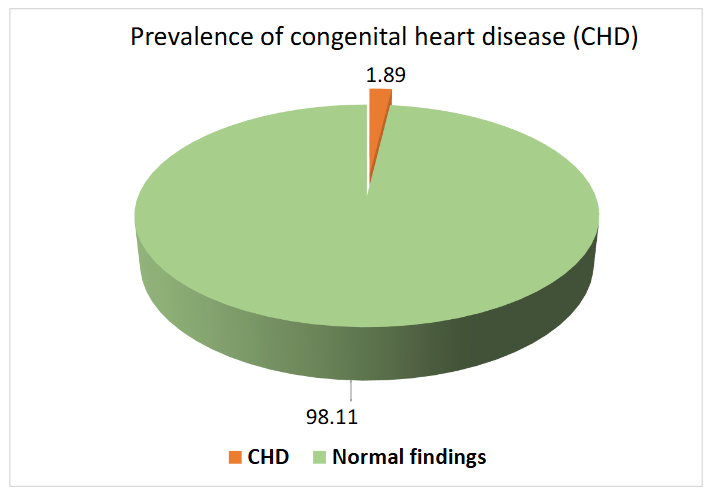
The overall prevalence of CHD was 18.9 per 1000 live births. Out of 116 cases (6455.2%) were female & 52 male (44.8%) with a ratio of 1.21: 1.
Discussion
Congenital heart disease is the most common birth defect and contributes a large portion to infant mortality. The prevalence and pattern of CHD has regional variation worldwide. This variation may be due to different ethnicity and genetics and different environmental exposure. This population-based study was conducted to identify prevalence of congenital heart disease in Bangladesh as we do not have national data registry for congenital heart disease. A total of 6146 children underwent echocardiographic assessment in this study. 116 cases were found to have congenital heart diseases.
The overall prevalence of CHD was found 18.9 per 1000 live births. Study conducted from China found prevalence of CHD was 9.3 out of every 1,000 live births. Prevalence of CHD in paediatric population of central India was found 27.7 out of every 1,000—study population conducted by Pradeep et al. Analyzing 114 studies from all over the world, a meta-analysis showed the highest CHD prevalence in Asia is 9.3/1000 live birth. Whereas prevalence of CHD in Iran ranges from 4.2 to 8.6 per thousand live births.
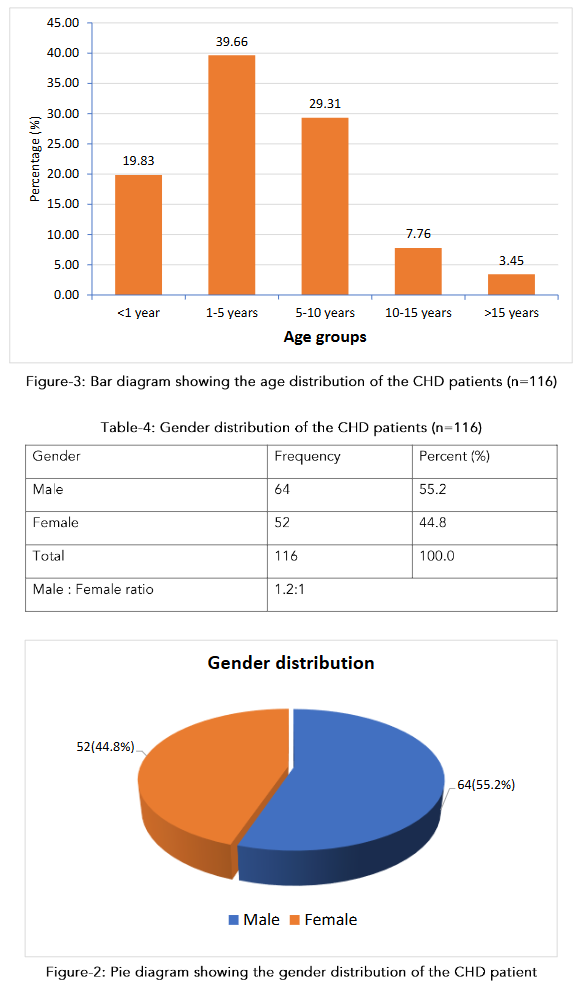
Out of 116 cases, 64 (55.2%) were female and 52 were male (44.8%) with a ratio of 1.2:1. A study conducted by Parvar SY, Ghaderpanah R, Naghshzan A. in Southern Iran on 8145 neonates found male to female ratio 2.6. Qazi and Saqib in their study found 276 (55.5%) children were male with male to female ratio of 1.24. Whereas Wanni et al. in their study found 52.4% male patients with CHD. Sex predilection in occurrence of cardiac disease as male to female ratio was found almost equal in a study conducted among children in Enugu by Chinawa et al.
In this study, age from 0 to 18 years were included and CHD were found mostly in 1 to 5 years (39.7%) while a study conducted in central India found more than half (300/497, 60.4%) of all the CHD patients had presented in the first year of life.
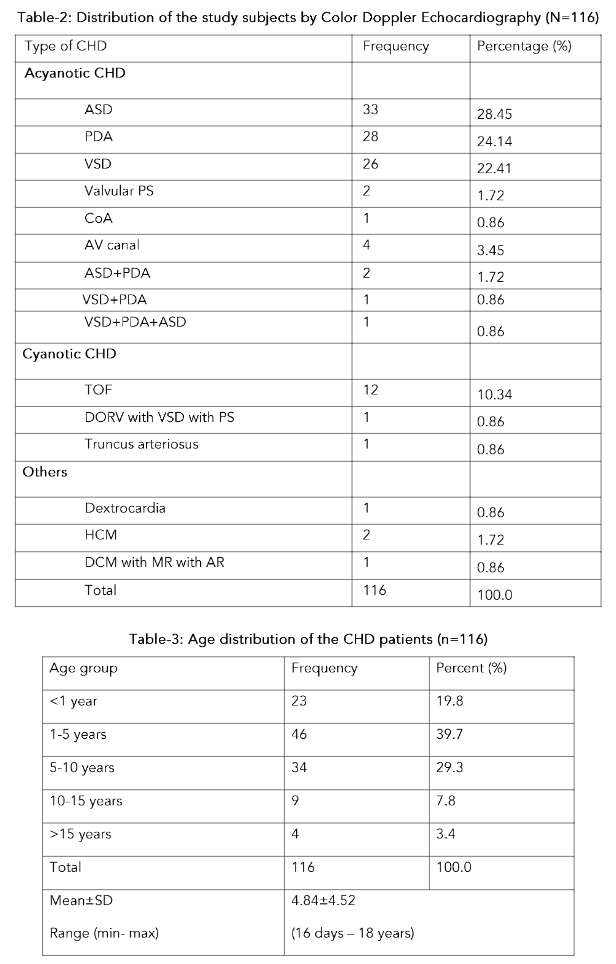
Distribution of type of CHD in this study were Acyanotic CHD 98 (84.5%) and Cyanotic CHD were 14 (12.08%) and other lesions included 4 (3.43%). More than half of the patients (63.6%) in study of Pradeep et al had acyanotic CHD, followed by cyanotic (25.5%) and obstructive (9.6%) lesions. A recently conducted review of trends and pattern of congenital heart disease in Nigeria over five decades also found acyanotic congenital heart disease is the most common type with VSD to be more prevalent.
The most common CHD detected in this study was atrial septal defect 33 (28.15%), followed by patent ductus arteriosus 28 (24.14%), ventricular septal defect 26 (22.41%), AV canal defect 4 (3.45%), tetralogy of Fallot 12 (10.34%), and DORV with VSD with PS & Truncus arteriosus were 1 each (0.86%). Some combined lesions like VSD with ASD 2 (1.72%) and ASD, VSD with PDA 1 (0.86%) and other congenital heart diseases were HCM 2 (1.72%), DCM 1 (0.86%), Dextrocardia 1 (0.86%).
In a meta-analysis conducted by Yingjuan Liu et al. on global birth prevalence of congenital heart defect (1970–2017), they found prevalence of ASD was higher in Asia than Europe and USA. Globally, the prevalence of ASD was significantly negatively correlated with Gross National Income. The data therefore indicate a potentially higher exposure to genetic or environmental factors predisposing to ASD in lower-income countries, particularly in Asia, than in high-income Western countries.
But the most common acyanotic CHD reported was VSD by Meshram and Gajimwar (20.7%), Kapoor and Gupta et al. (21.3%), and Wanni et al. (31.9%). Second most common CHD was ASD (19.7%) found by Meshram and Gajimwar. PDA was the third most common CHD in Pradeep et al. study. They found atrioventricular septal defect in 2% patients similar to Meshram et al.
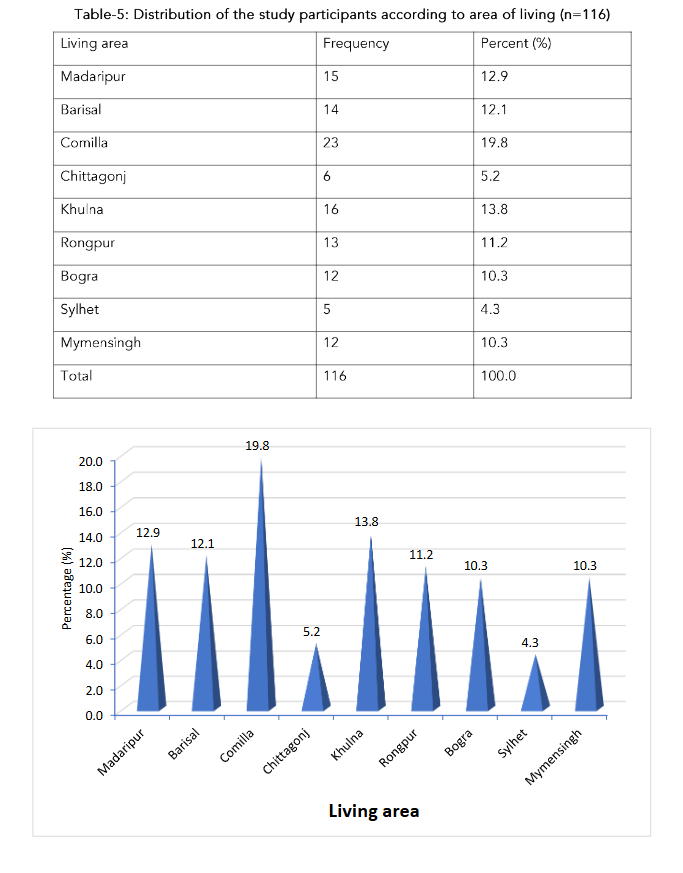
Significantly higher rates of CHD were found in Comilla 23 (19.8%) district, followed by Khulna 16 (13.8%) and Madaripur 15 (12.9%) respectively.
Congenital heart disease awareness was found to be very low among the parents and caregivers. Similar observations were reported by Mukul et al and McLaren, et al and also Marijon, et al. These reflect the need for more focus on health education of CHD among health workers, parents and caregivers for early detection and timely intervention to save lives.
Conclusion
This is the only conducted data on prevalence of CHD in Bangladesh. Our observation is that there is a high burden of CHD in this region, which reflects a continued increase in the reported birth prevalence of CHD. In our country, hospital-based data of incidence of CHD was also found high. ASD was the most common acyanotic CHD while TOF was the commonest cyanotic CHD. Higher prevalence of ASD correlates with Asian CHD data. More than one third of the patients had presented in their first to fifth year of life. This study on prevalence of CHD will help to know the exact burden of CHD in different parts of Bangladesh and will help to strengthen health care services.
Ethical Clearance:
Ethical approval to conduct the study was obtained from University Institutional Review Board.
Funding:
University research grant (Bangabandhu Sheikh Mujib Medical University, Dhaka; Bangladesh).
Conflict of Interest:
None declared.
Author Contributions:
-
Prof Zahid Hussain conceived and designed the article, and did critical appraisal.
-
Dr Tahmina Karim did the article searching, critical appraisal, data extraction, data analysis, interpretation of results, and write-up & review of the manuscript.
-
Prof Md Tariqul Islam was involved in the study design, critical appraisal, interpretation of results, and review of the manuscript.
-
All other authors took part in data collection and read and approved the manuscript.
References
- Limporopulos C, Majnemer A, Michael I, Bester B, Routhledge R, Rochlitz C, Teichler C. Neurologic Status of children with Congenital Heart Defects Before Open Heart Surgery. Pediatrics. 1997; 103 (2): 402.
- Boneva RS, Botto LD, Moore CA, Yang Q, Correa A, Erickson JD. Mortality associated with congenital heart defects in the United States: trends and racial disparities, 1979-1997. Circulation. 2001; 103(19): 2376-2381.
- Pittman JG, Cohen TP. The importance of pediatric cardiac care. N Engl J Med 1964;271:453-60.
- Kapoor G, Gupta R. Prevalence of congenital heart disease. Kanpur, India. Indian Pediatr. 2004; 41: 309-311.
- Misra M, Mittal M, Verma M, Rai R, Chandra G, et al. Prevalence and pattern of congenital heart defects among children of eastern Uttar Pradesh. Indian Heart J. 2009; 61: 68-70.
- Niyazov R, Sedghi M. Iran J. 2007-2008. Iran J. Pediatr. 2008; 18: 1-5.
- McLarren M, Lachman DL, Spiereson R, Rasof B. Prevalence of congenital heart disease in black school children of Soweto. S Afr Med J. 1979; 47: 554-558. PubMed: http://www.ncbi.nlm.nih.gov/pubmed/465225.
- Marino E, Tyne A, Villacis A, Jain D, et al. The prevalence of congenital heart disease in school children of Sub- Saharan Africa, Mozambique. Int J Cardiol. 2006; 113: 1-6. PubMed: http://www.ncbi.nlm.nih.gov/pubmed/17011646.