


Promoting Digital Health Literacy in Older Adults
Using ‘Health’ to Promote Older Adults’ Digital Health Literacy
Caroline A. Lockhart1 Inga Hunter2
- Research Officer, School of Management, Massey University, Palmerston North
- Associate Professor, School of Management, Massey University, Palmerston North
*Corresponding author: [email protected]
ABSTRACT
Aim: This project explored requirements for digital learning to support digital health literacy of older adults within a rural region.
Method: A qualitative study with purposeful sampling and thematic analysis of data. Interviews were held with ten digital educators and seven older adults (four with low vision) living and/or working in rural New Zealand.
Results: All participants recognised the importance of trust and having the right people to provide support and foster positive engagement with digital technologies. The digital educators recognised a missed opportunity to engage older adults using health as a topic for digital learning.
Conclusion: A positive experience with learning to use digital technologies is necessary to facilitate digital health literacy for older adults. Digital educators want access to reputable resources to promote health websites; many don’t know these exist. A wide range of digital literacy learning services exist which need to be better promoted in hard copy and online. The authors recommend building on older adults’ existing relationships, engaging with community groups, providing pop-up sessions, and running events to increase digital technological knowledge and engage with health information online. The key is utilising the right people to support the older adult with opportunities for digital skills uptake.
Keywords: digital literacy, older adult, digital learning, health, technology, skills
OPEN ACCESS
Published: June 30, 2024
CITATION: Lockhart CA, Hunter I, 2024. Using ‘Health’ to Promote Older Adults’ Digital Health Literacy, Medical Research Archives, [online] 12(6).
https://doi.org/10.18103/mra.v12i6.5579
COPYRIGHT: © 2024 European Society of Medicine. This is an open-access article distributed under the terms of the Creative Commons Attribution License, which permits unrestricted use, distribution, and reproduction in any medium, provided the original author and source are credited.
DOI: https://doi.org/10.18103/mra.v12i6.5579
ISSN: 2375-1924
Background
March 2020 saw a marked shift in the significance of digital connection with accessing and providing healthcare in New Zealand. The Covid 19 pandemic widened the already present digital divide between those who could understand and access information online, and those who were not digitally literate, or digitally connected. Health consumers were plunged into a predominantly virtual experience of telehealth with ‘health care delivered using digital technology where participants may be separated by time and/or distance’ over both the first national lockdown (26 March – 27 May 2020) and the second national lockdown (August 2021 – 3 December 2021) with phone, text, email, patient portal, audio consultation, and video consultation with health provider services becoming the default for those needing to access healthcare for both acute and long-term management of health conditions. Preliminary conversations with librarians in the Manawatu – Whanganui region in New Zealand in 2019 (pre-Covid-19) had already identified that the promotion of digital literacy and digital health literacy was lacking. Addressing the need to respond to requests to access digital health information was recognised as increasingly important by librarians. Barriers to accessing health information online was made even more obvious after the second year of Covid 19 lockdowns and restrictions.
Introduction
In today’s digitised world, making informed decisions about one’s health requires not only the necessary level of health literacy but also of digital literacy. In simple terms, digital literacy includes the day-to-day activities that occur in the digital world such as communicating with friends, family or co-workers, using navigation tools, online banking or online shopping and searching for information. These tasks all require a set of skills, including technical, cognitive, physical, cultural and overall level of confidence. Health literacy enables individuals to obtain, understand, appraise, and use information to make decisions and take actions that will have an impact on their health status and is a modifiable risk factor of socioeconomic disparities in health. Digital health literacy extends the definition of health literacy to involve the skills required to navigate digital technology used to access and present health information, as well as the extent to which that information is understood.
New Zealand’s older adult population, 65 years and over, is estimated to reach 22% of the total population by 2031, with many older adults experiencing a decrease in eyesight, hearing, and cognitive skills, providing challenges when engaging with the digital world. Digital inclusion of New Zealand’s older adults has been prioritised by the Ministry of Health, and has been shown to positively impact the quality of life of the older adult and their ability to remain living in the community. To facilitate digital inclusion, older adults need constructive and positive experiences appropriate to their level of literacy and technological ability, supported by people who provide trustworthy technological assistance. Affordable reliable internet services accessible through internet-enabled devices are required, suitable for the individual with applications and platforms that encourage collaboration and participation. For those with physical limitations, design features and accessibility options must be considered.
The Manawatū District is a thriving rural district, population 32,100 expected to grow by 30% by 2043. The majority of growth will be in the 65+ age group (77%), hence the need for improving digital health literacy will increase in this environment where connectivity is currently variable. Therefore, the objective of this study was to explore requirements for digital learning to support the digital health literacy of older adults across a rural region.
Methods
This study used a qualitative approach with semi-structured interviews of digital educators (paid/voluntary roles) and older adults living and/or working in a rural area of New Zealand. A low-risk notification was filed following Massey University’s ethics procedures. Participants were recruited through purposive convenience sampling. Inclusion criteria included living and/or working in the Manawatū District, able to participate voluntarily, give consent, and understand English. There was no age range for inclusion for the digital educators, for the older adult this was 55 years and older. Participants were either known to the lead author (CL) through existing research networks, referred by other participants, or participants responded to an invitation via an organizational newsletter. Interested people were sent the participant information sheet, consent form, and a short survey asking about age, ethnicity and confidence with digital technology. Due to the Covid pandemic, all interviews were held by phone, then audio recorded and transcribed by the lead author. Interviews ranged from 30-60 minutes and were transcribed and thematically analysed by CL (1st author) and IH (2nd author). An inductive approach with thematic analysis was used. The data set was analysed by CL using NVivo (Release 1.7.1 2022) followed by an iterative discussion of both authors around the integration of findings.
Results
In total 10 digital educators and seven older adults took part in individual phone interviews. Of the seven older adults, four identified as visually impaired. Participant demographics are shown in table 1.
| Digital Educators | Participant No. | Gender | Age range (years) | Ethnicity |
|---|---|---|---|---|
| DE1 | Female | 50 – 59 | NZ European | |
| DE2 | Male | 50 – 59 | Other | |
| DE3 | Male | 70 – 79 | Other | |
| DE4 | Male | 60 – 69 | Māori | |
| DE5 | Male | 30 – 39 | Other | |
| DE6 | Female | 40 – 49 | NZ European | |
| DE7 | Male | 70 – 79 | NZ European | |
| DE8 | Female | 30 – 39 | Other | |
| DE9 | Female | 70 – 79 | Other | |
| DE10 | Male | 40 – 49 | NZ European |
| Participant No. | Gender | Age range (years) | Ethnicity |
|---|---|---|---|
| OA1 | Female | 50 – 59 | NZ European |
| OA2 | Female | 80 – 89 | NZ European |
| OA3 | Female | 70 – 79 | NZ European |
| OA4 | Female | 70 – 79 | NZ European |
| OA5 | Female | 60 – 69 | NZ European |
| OA6 | Male | 50 – 59 | Māori/ NZE |
| OA7 | Female | 70 – 79 | NZ European |
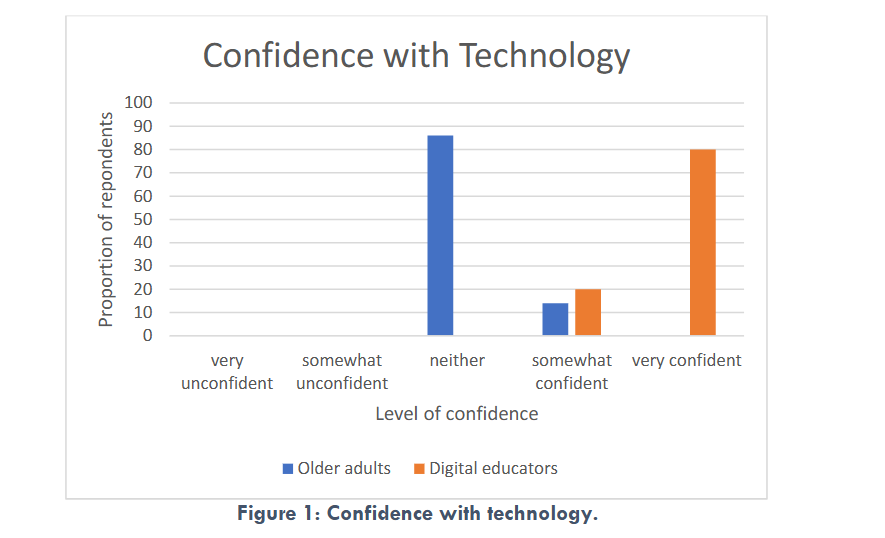
CONFIDENCE WITH TECHNOLOGY Participants identified their level of confidence using a 5-point Likert scale, see figure 1.
Thematic analysis resulted in two major themes: Enablers for digital learning and delivery of digital learning, each with sub-themes (table 2).
| Facilitating digital health literacy | Enablers for digital learning | Delivery of digital learning |
|---|---|---|
| Access to personal devices and connectivity | Service characteristics | |
| Assistance with technology | Accessing health information | |
| Trust in people and the information |
THEME 1: ENABLERS FOR DIGITAL LEARNING
Access to personal devices and connectivity
All older adult participants had personal devices and reliable connectivity, however having a device does not mean that device is suitable. Digital educators noted that older adults may have been gifted a device or were often ‘upsold’ to a model which was too advanced with too many features, or where physical conditions caused limitations on their dexterity.
“…by not doing the research of the need beforehand, this is a gap, and also not knowing what they will be using the device for.” (DE8)
Access to digital technology is impacted by cost, whether that be for the initial purchase of the device, assistive technology, and/or maintaining ongoing costs of the mobile plan or internet payment.
“The thing that has always enraged me, is they come up with these digital ideas, but what about the poor people that don’t have this stuff, and what about elderly that can’t afford it?” (DE9)
In addition, there is concern that the delivery of digital learning is often aimed at a higher level of digital literacy than the older adult has.
“Digital literacy depends so much on basic literacy and numeracy, and people struggle if that’s not possible …., I don’t think we tailor or market, or spend enough time on the lowest common denominator in digital literacy.” (DE8)
Assistance with technology
Older adult participants identified at least one ‘tech expert’ as their first go-to person for troubleshooting. Children, grandchildren, or whānau (extended family) provided advice on technology purchases, apps, and some had remote access. There was a downside though to family assistance: frustration, where the well-meaning family member would take the device…
“then tend to just ‘do it’ – I’d say hold on, I have to do it next time, tell me what you’re doing.” (OA4)
An informal IT community group with regular semi-structured sessions and a trainer, was an enabler for some to learn digital skills and connect to peers in their community. These groups catered specifically to the individual’s needs at their pace.
“…I’m not comfortable exploring (technology) when I’m alone. I prefer to be with someone and explore when we are together.” (OA3)
Participants who were visually impaired also got support from Blind Low Vision (BLV) friends, the Blind Low Vision New Zealand (BLVNZ) assistive technology desk, and some had accessed external mobile digital service providers.
“I think connecting people is important. The disability sector needs to make connections somewhere that is non-physical, because a lot don’t drive, and it’s getting the database of people and managing the challenges, stuff that sighted people can’t understand.” (OA1)
Having an opportunity to touch and try a device was important.
“Tactile is important in our space. Older adults were happy with flip-top phones, they were tactile, had buttons, you could navigate where you were, but with a screen, it’s a flat piece of glass, if you can’t see, you go to voice commands and it’s a new situation that requires familiarization. Experience is a great word.” (OA6)
Conversely, a number of participants commented that sometimes people don’t want help.
“Older adults, sometimes don’t want to accept help, first because it is free, and second, old ladies, don’t want to inconvenience you. It’s a shame!” (ED5)
Trust in people and the information
During the interview process, one digital educator summed up the key factor to be trust.
“I kept coming back to the people – it’s the people around you, the people you have access to, to help navigate technology issues, because the issues are also personal, they are sensitive and there is a high degree of trust because you’re dealing with passwords or pin numbers, let alone the content, and just feeling comfortable with whoever you are asking, or being okay to say ‘I don’t know’, or ‘this is a really scary world, how do I navigate this?” (ED8)
Trust may be about using the technology to do what is expected, however it’s also around one’s own ability to navigate the technology successfully. Changes in cognition, deteriorating eyesight, hearing and dexterity, impact the suitability of devices and the older adult’s confidence to use these.
“I don’t like using the phone, I can’t see properly, I like to use the tablet, but I don’t trust the tablet for banking, which my family say is stupid …… (they) expect that I will know what I actually don’t know ….. and it just seems that I might do that wrong, whereas I didn’t used to care before. I think as you get older, people either say, ‘Oh, you silly old thing, hurry up and do it, or they don’t think you can do it because of your age.” (OA4)
Trust included navigating changes in software or devices. Remembering passwords is a good example with a somewhat tongue in cheek solution!
“(… we could tattoo passwords onto people’s arms.)” (DE10)
Digital educators discussed how digital upskilling requires familiarity and practice, time and patience. Having a trusted relationship with a familiar digital educator can help.
“…. people come in and ask for specific staff for that reason, … this skillset is so important in getting the best out of everyone.” (DE2, DE7, DE8)
Finally, older adults are understandably nervous about misinformation and what to trust.
“Health is a good leg up for us to teach digital skills. We should encourage people to know about these (health) sites as every little bit of knowledge adds to their confidence and a lack of confidence is the big problem with older adults with digital technology.” (DE7)
THEME 2: DELIVERY OF DIGITAL LEARNING
Service characteristics
Participants described a variety of services with different characteristics (table 3) offered by a range of service providers (table 4).
| Individual learning | Group learning |
|---|---|
| In-person (face to face) | Online |
| Opportunistic | Scheduled |
| Episodic, troubleshooting | Prescriptive sessions, ongoing training, Access to 24/7 Learning Management Systems after training (hard copy & digital resources) |
| Informal events (supported by family/ whānau, friends) | Formal sessions (targeting older adults, e.g., Māori, Pasifika) |
| Cost – free, e.g., libraries | Subscription fee, e.g., Senior Net |
| Name of organization | Service provided |
|---|---|
| Senior Net | Peer-to-peer learning, Assistance with purchase of devices and digital learning, Scheduled in-person group sessions, One-on-one scheduled in-person sessions, Access to online learning modules, Newsletters containing links to YouTube tutorials |
| Library | Opportunistic walk-in help, Scheduled sessions, Hospital online with local library access, Translation services (e.g., Press Reader), Digits Help Session (phone, computer, other technologies), Libby (borrow ebooks, audiobooks, magazines on phone/ Tablet), Makerspace –digital mediums for creative projects |
| Housebound Service | Home delivery of physical and digital resources |
| Kanorau Digital (Māori digital learning programme) | Scheduled sessions: setting up Google Accounts, Gmail, Google Drive, My Health Account etc. |
| Marae (Māori meeting house) | Informal technology sessions alongside social activities for Kaumatua (Māori elder) |
| Apple Contact Service/ Apple Plus | Device advice, Online learning modules, Remote troubleshooting technology issues |
| Blind Low Vision New Zealand membership | Assessment of needs, goals, dexterity, Assigned Primary Service Provider for the BLV member’s journey, ACATS – Assistive Communication & Adaptive Technology Specialist manages technology requirements, BLVNZ assessment kit to trial assistive technologies, Assistive technologies to rent (may incur a cost) |
The location used to learn digital skills varied and could involve a combination of online and in-person encounters.
“I would probably go online as I don’t drive. I would use Google to find where to get the assistance, give them a call and make a time to go in person.” (OA1)
For those who were less confident, the preference was to meet in person.
“I like face-to-face, I don’t like pushing buttons.” (OA3)
Group training may be too fast for some older adults and individual in-person, or online training may be preferred. Some older adults prefer family, or peers, whereas others prefer a trained trainer. Some prescriptive sessions are aimed specifically at Māori and Pacifica, while others may be in a relaxed and familiar environment associated with food and a chat.
Accessing health information
Older adults may seek assistance searching for health information using digital technology, but it’s often asked indirectly.
“One lady wanted vegetarian cookbooks. Her husband had had a heart attack and she wanted to keep him well. Exploring her request further enabled better support and showed a need for other health resources.” (DE8)
Some participants used their devices for research prior to a specialist appointment.
“Yes, I use it (Google) a lot. I search for symptoms, illnesses, possible illnesses, treatment, and medications. If I’m going to a specialist I get their biographical details.” (OE2)
The older adult participants were familiar with, and many used the functions within the patient portals to book appointments and renew prescriptions, and some reviewed their notes after GP or specialist consultations. All participants were aware of the importance of accessing health information from a reputable source. Most were aware of Healthline, however few were familiar with the Healthify (previously Health Navigator) website and there was very little awareness that some health information sites were rated zero-data (previously sponsored data) and could be visited at no cost.
“Yes, they (older adults) do ask for assistance with searching for health information. I have helped with Manage My Health and My Indici (patient portals) and shown them how to get their prescriptions or bookings. I refer to respected websites such as the Ministry of Health website and show them the ‘Contact Us’ option. I suggest they email these people if they have questions.” (DE6)
However, digital educators had varying levels of comfort with assisting older adults to use patient portals or to access health information online citing insufficient resources to provide accurate and current information and not wanting to give misleading advice. During the interview, many educators recognised a missed opportunity to digitally engage older adults with health.
In summary, findings show that trust and support from the right people with the right skills is necessary for most older adults to positively engage with digital technologies. Barriers and enablers for digital learning are presented in Table 5.
| Barriers | Enablers |
|---|---|
| Limited literacy skills | Basic literacy & numeracy skills |
| Fear of, or disinterest in technology | Finding a passion to explore |
| Isolated, lack of exposure to technology | Regular exposure to digital devices/ technology |
| Need to learn (resistance) | Want to learn (opportunity) |
| English as second language | Options for translation |
| Lack of research prior to purchase, overwhelmed with choice. | Being ‘upsold’ device/ internet charges |
| Opportunity to explore devices prior to purchase. | Digital hands on – ‘playing with the stuff’ |
| Multi-purpose devices | Simple devices with consistency |
| Time commitment, unsuitable learning environment | Ability to progress & practice at own pace. |
| One-on-one learning. | Options for digital learning |
| Lack of ongoing support and lack of confidence | Trusted relationships, readily accessible support, e.g., family, whānau (extended family), community groups, Learning Management System, help desk with remote access, Facebook & online groups for those with similar conditions |
| Fear to interact with others post Covid-19 | Sociable and enquiring |
| Digital natives teaching older adults | Trainers with a combination of hard and soft skills |
| Agism by others and self-agism | Recognition of ability and willingness to learn |
| Lack of awareness of resources | Unsuitable digital design and delivery |
| Knowledge about accessibility options, helplines, call centers and online assistance, hardware, and software designs for assistive technology |
Discussion
The initial requirement for older adults to access and manage health information online, is to possess a suitable level of literacy followed by digital literacy, and then to use that same set of skills to explore digital health. Searching websites, purchasing goods, completing online forms, connecting via Skype, or having a telehealth consultation, all help to familiarise the older adult with digital applications, and normalise access to health online. Support for older adults to engage with digital technologies comes from a variety of sources, and may be in-person, online, or both, meeting the older adult’s preference for pace, repetition, cultural learning, such as ‘by Māori for Māori’, or opportunistic encounters, to name a few.
Trust in those teaching digital skills and the validity of the material is important, and in the context of health this includes support for digital educators, and for health providers who interact with health consumers. Of the ten digital educators interviewed for this study, most were not comfortable with introducing health as a conduit to digital learning due to a lack of confidence or knowledge on where to access current, reliable health information, demonstrating a need to promote resources and reputable sites. Further to this, many digital educators were unaware of the zero-data Te Whatu Ora – Health New Zealand (sponsored websites) such as Healthify (Health Navigator).
Most older adults have family, whānau or a friend who is their usual go-to ‘Tech expert’. Similarly, a health workforce skilled in both healthcare and digital technology, is integral in facilitating digital inclusion suitable for the older adult’s experience and level of technological comfort. Encouraging and normalising family or whānau to sit in on a health consultation, could assist with clinical understanding, translation, and technology issues particularly with virtual consultations. Offering online consultations may be better received using familiar programmes and apps rather than the health provider’s platform of choice. Replicating the opportunistic ‘pop-up’ digital help sessions from the Covid-19 lockdown period, and demonstrating apps, telehealth, and websites secondary to recreational activities for older adults such as hui (meetings) on the marae, garden groups, school pet-days, and places where older adults congregate (in person and online), may capture those who may not otherwise engage.
For older adults unable or unwilling to engage with digital technology, assessments ascertaining needs and limitations prior to purchasing devices, scheduled learning sessions, and online form-filling could be made available at senior centres or libraries. Permanent access to both paper and online Learning Management Systems is recommended for reference, maintaining continuity and the commitment to practice after digital training sessions end.
Word-of-mouth is best to promote digital learning resources. Both hard copy and digital resources, printed posters, advertising on TV, newspapers, magazines, alongside digital platforms that target older adults and their support people who facilitate their digital learning, may attract attention to the large range of learning options that are available.
Older adults are often stereotyped as being disinterested, slow, and lacking ability with digital technologies, when some are quick to try, and many have the means and the time to play with and learn how to use digital devices. For those with disabilities there can be a similar assumption. The older adults with low vision in this study self-identified their confidence level on par with those who did not identify as visually impaired. Similarly, self-agism and the belief that one is ‘too old to learn’, hinders digital learning and the missed opportunity to engage.
Where access to the internet is a barrier such as for rural older adults with unreliable connectivity or shared devices, mobile health services visiting rural village halls, pubs, cafes, or marae for digital learning sessions, could facilitate remote digital engagement. Incorporating mobile visits with sessions on patient portals, remote monitoring, or enabling access to health providers via telehealth, could address accessibility issues and increase familiarisation with online healthcare.
Limitations
A small number of participants (ten digital educators, seven older adults) were interviewed for this study, however there was repetition of themes in the data gathered supporting the validity of the findings. Recruitment of participants captured older adults who had a high level of digital literacy and were able to utilize existing contacts and online posters due to restrictions imposed by Covid-19, resulting in older adult participants who were digitally connected with reliable WiFi and who were comfortable using the phone rather than in-person interviews. Populations of older adults from lower socio-economic situations were thereby not well represented in this study. This may have implications on the richness of information and could introduce possible selection bias; however, the data is potentially generalizable to other New Zealand rural regions with a demographically similar older adult population. Due to the limited number of Māori participants, the researchers are unable to extrapolate the findings to be indicative of rural Māori in other geographically similar regions.
Conclusions
This research has shown there is a need for a level of general literacy, digital literacy, and a positive experience to facilitate digital engagement for older adults. Limitations in digital health literacy negatively impact the relationship between health behaviours and use of preventative services. Digital educators want access to an up-to-date compendium of reputable resources from official sources to promote health websites; many don’t know these resources exist, and therefore fail to promote them. There is a range of services assisting with digital health literacy, it is unnecessary to create more. Existing services facilitating digital health literacy need to be promoted in hard copy and online.
Finally, we need to explore and build on the older adult’s existing relationships and engage in digital interactions relevant to them. Reaching out and engaging with existing groups, hosting workshops, providing pop-up sessions, and running events to increase digital technological knowledge and exploring reputable options for engaging with health information online, will add value and build on digital health understanding. The key is to utilise the right people at the right time to support the older adult with opportunities for digital skills uptake, thereby making health services more accessible to the proportion of the population with low health literacy as a means to reaching greater equity in health across populations.
Conflicts of interests: None declared.
Acknowledgements: The authors would like to thank all participants for their time, enthusiasm for the topic, and willingness to share their thoughts.
Funding Statement: internal University funding only
References
- About Telehealth. NZ Telehealth forum and resource centre. 2024. Accessed May 23, 2024. https://www.telehealth.org.nz/health-provider/what-is-telehealth/
- Parker R, Ratzan SC. Health literacy: a second decade of distinction for Americans. J Health Commun. 2010;15 Suppl 2:20-33. doi:10.1080/10810730.2010.501094
- Dunn P, Hazzard E. Technology approaches to digital health literacy. Int J Cardiol. 2019;293:294-296. doi:10.1016/j.ijcard.2019.06.039
- McCosker A, Critchley C, Walshe J, Tucker J, Suchowerska R. Accounting for diversity in older adults’ digital inclusion and literacy: the impact of a national intervention. Ageing and Society. 2023;43(11):2629-2649. doi:10.1017/S0144686X21001550
- Nutbeam D, Lloyd JE. Understanding and responding to health literacy as a social determinant of health. Annu Rev Public Health. 2021 Apr 1;42(1):159-73. doi:10.1146/annurev-publhealth-090419-102529
- Stormacq C, Van den Broucke S, Wosinski J. Does health literacy mediate the relationship between socioeconomic status and health disparities? Integrative review. Health Promot Int. 2019;34(5):e1-e17. doi:10.1093/heapro/day062
- Associate Minister of Health. Healthy Ageing Strategy. Ministry of Health NZ. 13 December 2016. Accessed 11 October 2022. https://www.health.govt.nz/system/files/documents/publications/healthy-ageing-strategy_june_2017.pdf
- Jung SO, Son YH, Choi E. E-health literacy in older adults: an evolutionary concept analysis. BMC Med Inform Decis Mak. 2022;22(28). https://doi.org/10.1186/s12911-022-01761-5
- The New Zealand Health Strategy 2016. Ministry of Health NZ. 18 April 2016. Accessed 11 October 2022. https://www.health.govt.nz/publication/new-zealand-health-strategy-2016
- Grimes A, White D. Digital Inclusion and Wellbeing in New Zealand. Motu Working Paper 19-17. Motu Economic and Public Policy Research. A report to the Department of Internal Affairs. October 2019. Accessed 11 October 2022. https://motu-www.motu.org.nz/wpapers/19_17.pdf
- Alhassan MD, Adam IO. The effects of digital inclusion and ICT access on the quality of life: A global perspective. Technology in Society. 2021;64:101511.
- Peek ST, Luijkx KG, Rijnaard MD, et al. Older Adults’ Reasons for Using Technology while Aging in Place. Gerontology. 2016;62(2):226-37.
- Crengle S, Luke JN, Lambert M, et al. Effect of a health literacy intervention trial on knowledge about cardiovascular disease medications among Indigenous peoples in Australia, Canada and New Zealand. BMJ Open. 2018;8(1):e018569. doi:10.1136/bmjopen-2017-018569
- Penchansky R, Thomas JW. The concept of access: definition and relationship to consumer satisfaction. Med Care. 1981;19(2):127-140. doi:10.1097/00005650-198102000-00001
- May CR, Eton DT, Boehmer K, et al. Rethinking the patient: using Burden of Treatment Theory to understand the changing dynamics of illness. BMC Health Serv Res. 2014;14(1).
- Hunter I, Lockhart C, Rao V, et al. Enabling Rural Telehealth for Older Adults in Underserved Rural Communities: Focus Group Study. JMIR Form Res. 2022;6(11):e35864.
- O’Connor S, Hanlon P, O’Donnell CA, Garcia S, Glanville J, Mair FS. Understanding factors affecting patient and public engagement and recruitment to digital health interventions: a systematic review of qualitative studies. BMC Med Inform Decis Mak. 2016;16(1).
- Henni SH, Maurud S, Fuglerud KS, Moen A. The experiences, needs and barriers of people with impairments related to usability and accessibility of digital health solutions, levels of involvement in the design process and strategies for participatory and universal design: a scoping review. BMC Public Health. 2022;22(1). doi:10.1186/s12889-021-12393-1
- Urban rural New Zealand [Internet]. Stats NZ. 2021. Accessed 11 October 2022. https://storymaps.arcgis.com/stories/f98ae8750e8d4690a48ed3e827b1efdc
- Long-term projections for Manawatū region: Executive summary. 2020. Accessed 11 October 2022. https://ceda.nz/wp-content/themes/ceda/uploads/Long-Term-Projections-2020-Manawatu-Report.pdf
- Massey University. Code of ethical conduct for research, teaching and evaluations involving human participants. 2017. Accessed 22 October 2022. https://www.massey.ac.nz/documents/1590/Code_Ethical_Conduct_Research_Teaching_Evaluations_Involving_Human_Participants.pdf
- Braun V, Clarke V. Using Thematic Analysis in Psychology. Qual Res Psych. 2006;3(2):77-101.