

Psychometric Validation of the QUEST_Resilience Scale
Preliminary Psychometric Validation of the Adult QUEST_Resilience Mapping Scale
George Souza Barbosa
President of the Brazilian Society of Resilience (SOBRARE)
OPEN ACCESS
PUBLISHED: 31 May, 2025
CITATION Barbosa, George Souza. Preliminary Psychometric Validation of the Adult QUEST_Resilience Mapping Scale. Medical Research Archives, [online] 13(5). https://doi.org/10.18103/mra.v13i5.6456
COPYRIGHT © 2025 European Society of Medicine. This is an open-access article distributed under the terms of the Creative Commons Attribution License, which permits unrestricted use, distribution, and reproduction in any medium, provided the original author and source are credited.
DOI: https://doi.org/10.18103/mra.v13i5.6456
ISSN 2375-1924
Abstract
This study presents preliminary psychometric findings of the QUEST_Resilience Mapping Scale (Adult Version), developed to evaluate belief systems underlying resilient behaviors in daily contexts. Based on the Resilient Approach (ARslnt) proposed by Barbosa, the scale defines resilience as a neurocognitive process involving the strategic regulation of beliefs and emotional responses through eight independent yet interrelated Belief Model Determinants. These models were statistically validated as distinct cognitive structures that, when coordinated, guide the attribution of meaning and intensity to thoughts, emotions, and behaviors in adversity.
Unlike personality inventories, the QUEST_Resilience Scale functions as a belief-mapping tool. It comprises 72 Likert-scale items across the eight Belief Model Determinants (BMDs): Self-Control, Conscious Stress Reactions, Context Analysis, Optimism toward Life, Self-Confidence, Enchantment and Maintenance of People, Empathy, and Meaning of Life. Responses are interpreted through three behavioral patterns—Passivity, Intolerance, and Balance—classified into four resilience conditions: Weak, Moderate, Good, and Strong. An additional level, Excellent, reflects balanced cognitive functioning across all BMDs. If more than three BMDs fall within the “Weak” condition, cognitive vulnerability is indicated, recommending psychological and/or medical follow-up.
The scale underwent semantic validation by 13 experts in Education and Health, with data collected from adults between 2008 and 2010 via SOBRARE’s online platform. There were no exclusion criteria regarding gender, marital status, religion, or education. Beyond cognitive mapping, the instrument includes sociodemographic and life history data to create personalized resilience profiles.
The QUEST_Resilience Scale has wide applications in clinical psychology, resilience-based interventions, coaching, and educational settings. It has also supported empirical studies on coping, stress management, and emotional regulation. Its use requires prior authorization from SOBRARE, which oversees its ethical and legal distribution. Statistical analyses demonstrated internal reliability and factorial coherence, providing evidence of its viability for clinical and academic purposes.
Keywords: Resilience, Psychometric Validation, Belief Model Determinants, PAR, QUEST_Resilience Scale, Cognitive Assessment
1. Introduction
The QUEST_Resiliência Scale is not a personality inventory but a mapping tool that evaluates clusters of beliefs linked to resilient behavior. The theoretical framework supporting this scale is ARslnt. Based on a neurocognitive perspective, proposed a theoretical framework known as the Resilient Approach (ARslnt) in which resilience is defined as the strategic processing of information across eight independents yet interrelated cognitive belief models. Initially they were called Models of Beliefs Determinants (MBDs), and from 2014 onwards they became known as Belief Model Determinants (BMDs), which form the basis of resilient behavioral patterns. These models were statistically identified as distinct and significant structures that, when operating in coordination, guide the attribution of intensity and meaning to beliefs and emotions, depending on the circumstances, in support of effective coping with challenges and adversity. Although this cognitive capacity is innate, it requires intentional training for its development and maturation.
The ARslnt is a theoretical organization that primarily enables focus on the development and consolidation of psychological resilience in clinical and training settings. While other models aim to foster human resilience, they tend to do so indirectly through broader psychosocial approaches.
The change in terminology from MBDs to BMDs was adopted to improve clarity and consistency within the theoretical framework, particularly in its English-language dissemination.
The QUEST_Resilience scale operationalizes these BMDs into measurable domains, offering a matrix of cognitive constructs that form the psychological foundation for adaptive responses. In each individual assessment, all eight BMDs can be classified according to one of three distinct behavioral patterns: Passivity, Intolerance, or Balance when facing stress. This classification enables the precise identification of the cognitive structure (BMD) in question and the dominant behavioral pattern modulating its current expression. This study aims to demonstrate the structure, theoretical foundation as well as the initial statistical properties of the QUEST_Resilience scale, including its internal consistency and interrelations among BMDs, within the framework of the ARslnt.
2. Methods
2.1. SCALE STRUCTURE AND DOMAINS
The semantic consistency of 72 scale items was evaluated by 13 expert judges in the fields of Education and Health. Data were collected from adult respondents between 2008 and 2010 through SOBRARE’s online platform. There were no inclusion or exclusion criteria regarding gender, marital status, religion, or other sociodemographic variables. The scale is composed of two parts:
- Sociodemographic and life history mapping: including personal history, major life challenges, and contextual information.
- 72 Likert-type items distributed across eight BMDs.
2.2. PARTICIPANTS
A total of 282 Brazilian adults participated in the study, recruited across professional and educational contexts. The mean age was 30.3 years (SD = 8.4), with a balance of sex and educational levels.
2.3. INSTRUMENT
The QUEST_Resilience scale comprises eight cognitive domains, referred to as Belief Model Determinants (BMDs):
- AC (Analysis of the Context): interpreting circumstances and defining life priorities.
- SCnf (Self-Confidence): Decision-sharing. Mobilizing inner strength and security when facing challenges – overcoming challenges.
- SCntrl (Self-Control): Emotion regulation, behavior control, determination, impulse regulation.
- EMP (Enchantment and Maintenance of Relationships): building, sustaining, and nurturing social bonds, social engagement and empathy.
- EPT (Empathy): understand and connect with the emotions and perspectives of others and reconnect from this new perception.
- CSR (Conscious Stress Reactions): recognizing and acting upon bodily sensations and signals under stress.
- OTL (Optimism Toward Life): framing stress positively and embracing hope and possibilities, problem-solving, creativity; hope.
- ML (Meaning of Life): attributing existential sense and coherence to one’s trajectory.
These eight BMDs domains reflect various conditions of resilience in the behavioral styles: Passivity, Intolerance, and Balance in the face of adversity.
Behavioral Pattern of Passivity in the Face of Stress:
- Weak: Very high belief intensity; pronounced passivity.
- Moderate: High belief intensity; moderately passive behavioral style.
- Good: Moderate belief intensity; protective stance with mild passivity.
- Strong: Low belief intensity; mild passivity and stable coping posture.
Behavioral Pattern of Intolerance in the Face of Stress:
- Strong: Low belief intensity; mild intolerance and adaptive control.
- Good: Moderate belief intensity; moderate intolerance.
- Moderate: High belief intensity; moderately intolerant.
- Weak: Very high belief intensity; rigid beliefs and strong intolerance.
Behavioral Pattern of Balance in the Face of Stress:
- Excellent: Balanced attribution of belief intensity across the BMDs, enabling coherent and effective coping responses to adversity.
Note: When more than three BMDs are classified as Weak condition, the individual is in a state of cognitive vulnerability. In such cases, psychological and/or medical monitoring is recommended.
2.4. SCORES
In each domain were obtained through structured questions and converted into numerical indicators ranging from negative to positive resilience expressions.
2.5. PROCEDURE
Participants completed the scale voluntarily. Data were analyzed using Python and pandas, with the calculation of descriptive statistics, Cronbach’s alpha for internal consistency, and Spearman correlation coefficients among domains.
3. Results
3.1 DESCRIPTIVE STATISTICS
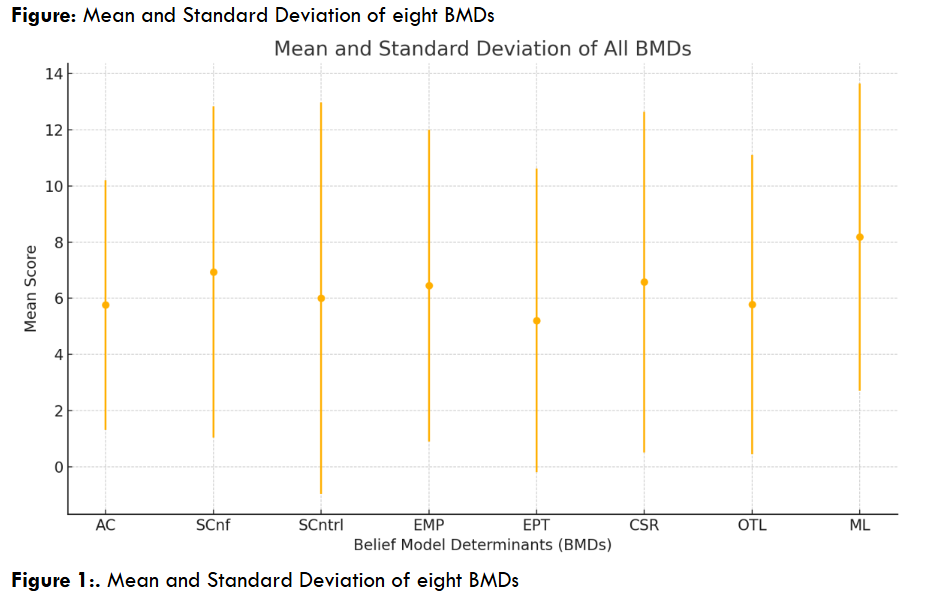
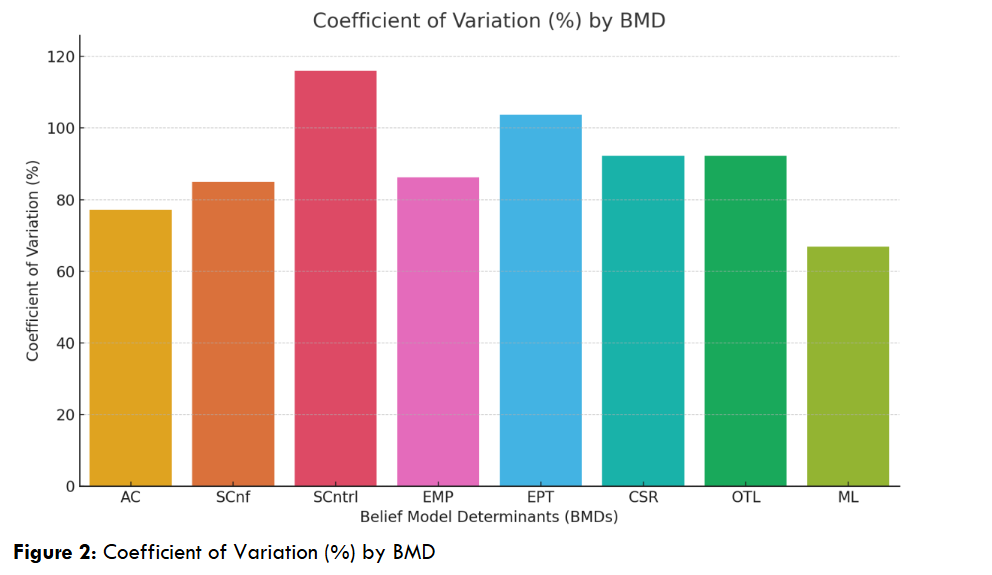
Most domains presented high dispersion, especially SCntrl, EPT and CSR, suggesting heterogeneity in the resilience profiles.
| BMD | Mean | SD | Min | Q1 | Median | Q3 | Max | CV (%) |
|---|---|---|---|---|---|---|---|---|
| AC | 5.76 | 4.45 | -5.03 | 2.76 | 5.03 | 8.04 | 17.09 | 77.16 |
| SCnf | 6.94 | 5.90 | -8.08 | 3.03 | 6.82 | 10.86 | 20.20 | 84.97 |
| SCntrl | 6.01 | 6.97 | -14.14 | 1.77 | 5.81 | 9.85 | 20.20 | 115.99 |
| EMP | 6.45 | 5.56 | -10.10 | 3.03 | 6.06 | 9.09 | 20.20 | 86.23 |
| EPT | 5.21 | 5.41 | -8.04 | 1.76 | 4.77 | 7.79 | 20.10 | 103.75 |
| CSR | 6.58 | 6.07 | -4.02 | 2.01 | 5.78 | 9.06 | 20.08 | 92.27 |
| OTL | 5.78 | 5.33 | -3.03 | 2.02 | 4.80 | 8.08 | 19.19 | 92.30 |
| ML | 8.18 | 5.47 | -3.02 | 5.03 | 9.80 | 12.09 | 20.10 | 66.87 |
3.2 INTERNAL CONSISTENCY
Cronbach’s alpha for the eight domains was 0.836, indicating a high level of internal consistency among the BMDs. Its categorical interpretation framework provides clinicians and researchers with a precise mapping of resilient belief patterns.
3.3 CORRELATION BETWEEN DOMAINS
<.57.58
| AC | SCnf | SCntrl | EMP | EPT | CSR | OTL | ML |
|---|---|---|---|---|---|---|---|
| 1 | .53 | .43 | .47 | .45 | .43 | .43 | .43 |
| .53 | 1 | .59 | .53 | .52 | .51 | .51 | .50 |
| .43 | .59 | 1 | .61 | .60 | .57 | .55 | .57 |
| .47 | .53 | .61 | 1 | .66 | .60 | ||
| .45 | .52 | .60 | .66 | 1 | .62 | .56 | .61 |
| .43 | .51 | .57 | .60 | .62 | 1 | .55 | .56 |
| .43 | .51 | .55 | .57 | .56 | .55 | 1 | .55 |
| .43 | .50 | .57 | .58 | .61 | .56 | .55 | 1 |
| AC | SCnf | SCntrl | EMP | EPT | CSR | OTL | ML |
|---|---|---|---|---|---|---|---|
| — | .000 | .000 | .006 | .000 | .003 | .000 | .000 |
| .000 | — | .000 | .000 | .000 | .000 | .000 | .000 |
| .000 | .000 | — | .000 | .000 | .000 | .000 | .000 |
| .006 | .000 | .000 | — | .000 | .008 | .000 | .000 |
| .000 | .000 | .000 | .000 | — | .002 | .000 | .000 |
| .003 | .000 | .000 | .008 | .002 | — | .000 | .000 |
| .000 | .000 | .000 | .000 | .000 | .000 | — | .000 |
| .000 | .000 | .000 | .000 | .000 | .000 | .000 | — |
4. Discussion
The descriptive statistics and variation indices across the eight Belief Model Determinants offer important insights into the scale’s psychometric behavior. Especially, the domain “Meaning of Life” presented the highest average score (M = 8.18) and the lowest coefficient of variation (= 66.87%), suggesting high stability and consistency across respondents. In contrast, domains such as “Self-Control,” and “Empathy,” and “Conscious Stress Reactions” showed greater dispersion with coefficients of variation exceeding 100%, indicative of heterogeneous patterns of cognitive attribution in the population.
Perhaps it is a characteristic present in the Brazilian population, considered in common sense as very emotional, and therefore SCntrl does not correlate with EPT and CSR.
Figure 1 illustrates how BMDs like SCnf, EMP, and CSR groups within a similar performance range, while ML stands apart with superior consistency. Figure 2 reinforces this by visually differentiating the variability magnitude in each domain.
These findings underscore that the QUEST_Resilience Scale is sensitive to interindividual differences, especially in domains of emotional regulation and relational attune. High CVs in SCntrl and EPT, for example, may point to underlying psychological diversity or external contextual influences such as occupational stress or life stage. Such dispersion supports the relevance of including these constructs in future resilience enhancement interventions, while also inviting refinement of item clarity or response format where inconsistency is excessive.
The internal consistency of the scale (α = 0.836) aligns with the theoretical expectation of convergence among interdependent belief models and validates the scale’s multidimensional structure. The moderate and significant correlations between all BMDs support the systemic and interrelated foundation of the Resilient Approach, where changes in one cognitive belief domain likely influence others. These findings reinforce the PAR model’s applicability in psychotherapeutic, educational, and coaching contexts.
Future research should explore factorial invariance across demographic variables such as gender, education, and cultural background to explain high variability in certain BMDs. Stratified analyses may also clarify whether extreme scores in SCntrl and EPT relate to developmental, clinical, or environmental factors.
The findings support the structural logic of the QUEST_Resilience scale, with satisfactory internal reliability and consistent interdomain correlations. The high coefficient of variation in some domains signals the need for further refinement in items or scoring procedures. However, the presence of significant correlations among all constructs validates the theoretical foundation of the scale.
Limitations include its inapplicability to individuals diagnosed with Schizophrenia, Schizotypal, or Delusional Disorders, due to difficulties in interpreting the 72 items accurately.
5. Conclusion
The QUEST_Resilience scale demonstrates promising psychometric properties as an innovative measure grounded in cognitive belief patterns. The QUEST_Resilience Mapping Scale is a conceptually grounded and statistically supported tool for assessing resilient behavior in adults. These findings open pathways for its use in psychotherapy, education, and resilience-based public health interventions. Its use supports diagnostic and interventional strategies in education, coaching, and psychology, such as the Psychotherapy in One Resilience-Based Approach (PAR). Future research should explore its cross-cultural adaptability and use in longitudinal designs.
Acknowledgment
Marco Aurélio A. Barbosa made contributions to the recruitment of human resources and technical services on the SOBRARE platform. The author also acknowledges the support of AI assistance via ChatGPT (OpenAI, 2025) for formatting and statistical visualization throughout the preparation of this manuscript. The intellectual design, analysis, and interpretation remain the sole responsibility of the author.
About the Author:
George Souza Barbosa is a Pedagogue and Psychologist, holding a Master and a Ph.D. in Psychology. He is the President of the Brazilian Society of Resilience (SOBRARE). His areas of specialization include Couple and Family Therapy, Cognitive-Behavioral Therapy, Neuroscience, and Neuropsychology.
Contact: [email protected]
ORCID: https://orcid.org/0000-0001-9910-355X
Lattes: http://lattes.cnpq.br/3919088456441783
References
- Barbosa GS. Os pressupostos nos estilos comportamentais de se expressar resiliência. In: Kreinz G, Pavan OH, Gonçalves RM, eds. Divulgação científica: enfrentamentos e indagações. São Paulo: NJR/USP; 2010.
- Barbosa GS, Barbosa PA. Brazilian adult scale of resilience: QUEST_Resiliência. São Paulo: SOBRARE; 2014. https://www.researchgate.net/publication/260597551. Accessed March 29, 2025.
- Sociedade Brasileira de Resiliência (SOBRARE). QUEST_Resiliência. https://sobrare.com.br/pagina/quest. Accessed March 29, 2025.
- Barbosa GS. Resiliência: desenvolvendo e ampliando o tema no Brasil. São Paulo: SOBRARE; 2015. ISBN: 978-85-66312-04-1. https://tinyurl.com/4fpxbjch. Accessed March 29, 2025.
- Barbosa GS. Psychotherapy in one approach of resilience (PAR). In: Mazurek H, ed. Pratiques basées sur la résilience. 4ème Congrès Mondial sur la Résilience, Marseille, France; 2018. https://hal.archives-ouvertes.fr/hal-02465380. Accessed March 29, 2025.
- Barbosa GS. Roteiro dos índices de resiliência – completo 2010. 2nd ed. São Paulo: SOBRARE; 2015. https://www.amazon.com.br/dp/8566312066. Accessed March 29, 2025.
- Miguel MEGB. Mapeamento das condições de resiliência de docentes de enfermagem [doctoral thesis]. Ribeirão Preto, SP: Universidade de São Paulo; 2012.
- Rodrigues RTS, Barbosa GS, Chiavone PA. Personalidade e resiliência como proteção contra o burnout em médicos residentes. Rev Bras Educ Med. 2013;37(2):245–253. http://www.scielo.br/scielo.php?script=sci_arttext&pid=S0100-55022013000200012. Accessed March 29, 2025.
- Brandalise MH, Barbosa GS, Centeno RS, Yacubian EMT, de Araujo Filho GM. Depressive and anxiety symptoms exert negative impact on resilience to stressful events in patients with refractory temporal lobe epilepsy with late seizure recurrence after surgery. J Psychol Psychother. 2016;6:269. https://doi.org/10.4172/2161-0487.1000269. Accessed March 29, 2025.
- Barbosa GS. Psychotherapy in one approach of resilience (PAR): report of partial results in clinical psychology. Hosp Palliat Med Int J. 2024;7(4):143–149. https://doi.org/10.15406/hpmij.2024.07.00259. Accessed March 29, 2025.
- Viktor EF. A vontade de sentido: fundamentos e aplicações da logoterapia. São Paulo: Paulus; 2011.
- Barbosa GS, Barbosa PA. Brazilian adult scale of resilience: QUEST_Resiliência. São Paulo: SOBRARE; 2014. https://www.researchgate.net/publication/260597551. Accessed March 29, 2025.