

Stuttering Awareness in Children: Direct Question Study
Investigating Stuttering Awareness in Children Who Stutter: A Cross-sectional Study Using Direct Questions
Toshihiro Umezaki, MD2, PhD1; Daisuke Murakami, MD3, PhD2,3; Kazuo Adachi, MD; Yumi Yamaguichi, PhD1; Aoi Sato1, Takashi Nakagawa, MD2, PhD
- Yoshikazu Kikuchi, MD, PhD Department of Otorhinolaryngology, Graduate School of Medical Sciences, Kyushu University, Fukuoka, Japan.
- Toshiro Umezaki, MD, PhD Voice and Swallowing Center, Fukuoka Sanno Hospital, Fukuoka, Japan; International University of Health and Welfare, Fukuoka, Japan.
- Daisuke Murakami, MD, PhD Department of Otorhinolaryngology, Graduate School of Medical Sciences, Kyushu University, Fukuoka, Japan.
- Kazuo Adachi, MD Voice and Swallowing Center, Fukuoka Sanno Hospital, Fukuoka, Japan.
- Yumi Yamaguchi, PhD Department of Otorhinolaryngology, Graduate School of Medical Sciences, Kyushu University, Fukuoka, Japan.
- Aoi Sato Department of Otorhinolaryngology, Graduate School of Medical Sciences, Kyushu University, Fukuoka, Japan.
- Takashi Nakagawa, MD, PhD Department of Otorhinolaryngology, Graduate School of Medical Sciences, Kyushu University, Fukuoka, Japan.
OPEN ACCESS
PUBLISHED:31 May 2025
CITATION: KIKUCHI, Yoshikazu et al. Investigating Stuttering Awareness in Children Who Stutter: A Cross-sectional Study Using Direct Questions. Medical Research Archives, [S.l.], v. 13, n. 5, may 2025. Available at: <https://esmed.org/MRA/mra/article/view/6468>
COPYRIGHT: © 2025 European Society of Medicine. This is an open-access article distributed under the terms of the Creative Commons Attribution License, which permits unrestricted use, distribution, and reproduction in any medium, provided the original author and source are credited.
DOI: https://doi.org/10.18103/mra.v13i5.6468
ISSN 2375-1924
Abstract
Stuttering is a childhood-onset fluency disorder affecting 5–11.2% of children aged 2–4 years. The natural recovery rate of stuttering within five years of onset is approximately 80%, while the prevalence of stuttering in elementary school-aged children is approximately 11%. Persistent stuttering can lead to risks such as bullying, social anxiety disorder, and school refusal. This study aimed to investigate children’s social experiences with stuttering through direct questions. The study included 13 five-year-olds, 15 six-year-olds, 21 seven-year-olds, 20 eight-year-olds, 14 nine-year-olds, 11 ten-year-olds, 6 eleven-year-olds, and 6 twelve-year-olds, of whom 79 were male and 27 were female. Stuttering was assessed using the Japanese Standardized Test for Stuttering, and stuttering frequency was calculated using the number of core stuttering symptoms. A chi-square test was conducted to analyze the relationship between perception of stuttering and teasing/bullying. The results indicate that awareness of stuttering increased significantly with age, reaching near-universal levels by age 8. In contrast, experiences of teasing and bullying were less prevalent. Parents often attempt to prevent stuttering in their children, but the effectiveness of these efforts remains uncertain. This study highlights the importance of understanding children’s awareness of their stuttering and the social implications that arise from it.
Keywords: stuttering, children, awareness, teasing, bullying
Introduction
Stuttering, also known as childhood-onset fluency disorder, affects 5–11.2% of children aged 2–4 years. The natural recovery rate of stuttering within five years of onset is approximately 80%, while the prevalence of stuttering in elementary school-aged children is approximately 11%. Persistent stuttering can lead to risks such as bullying, social anxiety disorder, and school refusal, which negatively affects quality of life, social status, and income.
Parents often attempt to prevent stuttering in their children, but the effectiveness of these efforts remains uncertain. This study aimed to investigate children’s social experiences with stuttering through direct questions.
Methods
The study included 13 five-year-olds, 15 six-year-olds, 21 seven-year-olds, 20 eight-year-olds, 14 nine-year-olds, 11 ten-year-olds, 6 eleven-year-olds, and 6 twelve-year-olds, of whom 79 were male and 27 were female. Stuttering was assessed using the Japanese Standardized Test for Stuttering, and stuttering frequency was calculated using the number of core stuttering symptoms.
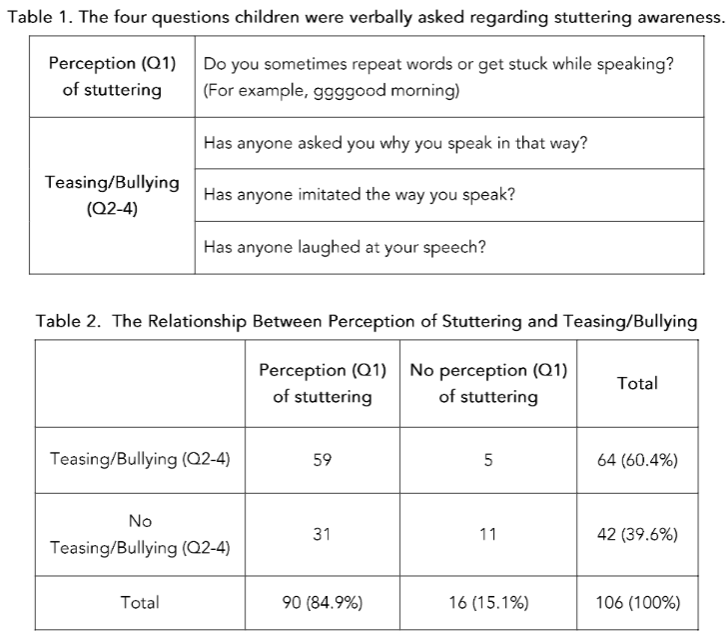
During the initial consultation at Kyushu University, the children were asked a series of questions regarding their stuttering. The questions aimed to assess their awareness of stuttering and their social experiences related to it.
Results
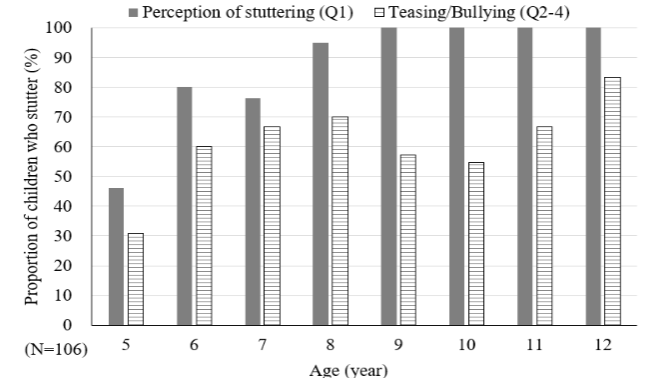
The results indicate that awareness of stuttering increased significantly with age, reaching near-universal levels by age 8. In contrast, experiences of teasing and bullying were less prevalent. The chi-square test revealed significant differences between the age groups regarding the perception of stuttering and experiences of teasing/bullying.
| Question | Yes (%) | No (%) |
|---|---|---|
| Do you sometimes repeat words or get stuck while speaking? | 64.40 | 35.60 |
| Has anyone asked you why you speak that way? | 44.60 | 55.40 |
| Have you ever laughed at the way you speak? | 11.50 | 88.50 |
Discussion
The findings demonstrate a clear trend: awareness of stuttering increased significantly with age, while experiences of teasing and bullying were less prevalent. This confirms that even young children are aware of their stuttering. Early interventions for children who stutter, such as the Lidcombe Program, may help mitigate negative bullying and peer interactions.
Future research should focus on identifying strategies to reduce bullying and enhance the social experiences of children who stutter.
Conclusion
Including questions about perception in addition to teasing/ bullying helped identify children’s awareness of their stuttering. These questions may be useful for promoting early intervention and preventing disadvantages associated with stuttering.
References
- Battle DE. Diagnostic and statistical manual of mental disorders (DSM). CoDA, 2013; 25:191-192.
- Manolson H. Childhood stuttering. J Fluency Disord. 2009; 23:247-277.
- Reilly S, Onslow M, Packman A, et al. Predicting early onset of stuttering: A prospective, community cohort study. Pediatrics. 2009; 123:270-277.
- Reilly S, Onslow M, Packman A, et al. Natural history of stuttering to 4 years of age: A prospective community cohort study. Pediatrics. 2013; 132:460-467.
- Yairi E, Ambrose NG. Early childhood stuttering: persistence and recovery. J Speech Lang Hear Res. 1999; 42:1097-1112.
- Yairi E, Ambrose NG. Early childhood stuttering: persistence and recovery. J Speech Lang Hear Res. 1999; 42:1097-1112.
- Boey YR, van der Linde M, Wuyts FL, Heylen L, Stoop R, De Bock A. The reactions of young children who stutter. J Commun Disord. 2009; 42:1-10.
- Kizuki T, Umezaki T, Adachi K, et al. The Communication Attitude Test (CAT) has been widely used to investigate speech attitudes among elementary school children who stutter. J Fluency Disord. 2013; 38:1-10.