

High-Intensity Focused Ultrasound for Eyelid Sagging
Clinical Experience and Practical Considerations of High-Intensity Focused Ultrasound for Eyelid Sagging
Yousun Hwang1, Kyu-Ho Yi2
- Haedrin Clinic, Center of Aesthetic Medicine, Shinchonro 107, Seodaemungu, Seoul, Korea 03779
- Division in Anatomy and Developmental Biology, Department of Oral Biology, Human Identification Research Institute, BK21 FOUR Project, Yonsei University College of Dentistry, Seoul, South Korea; Maylin Clinic (Apgujeong), Seoul, South Korea
Orcid: http://orcid.org/0000-0001-5688-1992
OPEN ACCESS
PUBLISHED 31 August 2025
CITATION Hwang, Y., and Yi, K., 2025. Clinical Experience and Practical Considerations of High-Intensity Focused Ultrasound for Eyelid Sagging. Medical Research Archives, [online] 13(8). https://doi.org/10.18103/mra.v13i8.6872
COPYRIGHT: © 2025 European Society of Medicine. This is an open-access article distributed under the terms of the Creative Commons Attribution License, which permits unrestricted use, distribution, and reproduction in any medium, provided the original author and source are credited.
DOI https://doi.org/10.18103/mra.v13i8.6872
ISSN 2375-1924
ABSTRACT
Background: Eyelid sagging is a common sign of aging that impacts both aesthetic appearance and visual function. Non-invasive modalities, including high-intensity focused ultrasound (HIFU) have emerged as promising alternatives to surgical correction.
Methods: This prospective observational study evaluated the efficacy and safety of HIFU for upper and lower eyelid sagging. Twenty Korean women aged 35–57 years with mild-to-moderate eyelid sagging underwent a single HIFU session using a 2.0‑mm, 4‑MHz probe. Topical anesthetic cream was applied for 40 minutes before treatment. Standardized photographs were obtained at baseline and 12 weeks post-treatment. Two blinded clinicians evaluated outcomes using a 4‑point clinical grading scale. Patient satisfaction and changes in eyelid length were also assessed.
Results: Seventeen of 20 patients (85%) demonstrated visible improvement at 12 weeks. Clinician assessment confirmed improvement in 15 patients (75%), and mean eyelid length was reduced compared to baseline. No severe adverse effects were reported.
Conclusion: HIFU is a safe and effective non-invasive option for upper and lower eyelid sagging, providing measurable improvement with minimal downtime. Future controlled studies with larger cohorts are warranted to validate and expand these findings.
Keywords
High-Intensity Focused Ultrasound, Eyelid Sagging, Non-Invasive Treatment, Aesthetic Medicine
INTRODUCTION
The human eyelid is a delicate and dynamic anatomical region, and also the thinnest area of the face. It is one of the first facial areas to exhibit visible signs of aging such as fine wrinkles and skin laxity. These age-related changes in the eyelids contribute significantly not only to a tired or aged appearance but also in severe cases, to functional impairment such as ptosis or visual field obstruction.
Given that the eyes are considered a central feature of facial beauty and facial expression, sagging of the upper and lower eyelids not only significantly impacts the facial appearance but also patient perception and self-confidence.
Traditionally, interventions, such as upper blepharoplasty, eyelid reconstruction, and brow lifting have long been established as effective corrective surgeries. While these procedures can deliver dramatic results, they also carry the potential for significant downtime, possible complications, and occasionally, less natural-looking outcomes. Understandably, many patients are hesitant to pursue surgical solutions, leading to a growing interest in non-invasive alternatives that offer more subtle, natural results with minimal recovery.
During the last few decades, High Intensity Focused Ultrasound (HIFU) treatment has emerged as a particularly promising modality in this regard. HIFU is already well established for skin tightening and rejuvenation. Initially developed for tumor ablation, its application has become widespread, especially for lifting and tightening the lower face and neck. HIFU works by delivering focused ultrasound energy into specific dermal and subdermal layers without disrupting the skin surface. This energy causes controlled thermal injury in the target tissue, promoting collagen contraction and stimulating neocollagenesis over time. One of its key advantages is precision with specific transducers targeting multiple depths from 1.5mm to 6.0 mm, and practitioners can customize treatment according to anatomical needs.
Despite its popularity, use of HIFU in the periocular region has been approached with caution given the delicate anatomy of the eyelid region and concerns about risk of ocular injury. This article presents clinical experience and practical considerations for the use of HIFU in the treatment of eyelid sagging, and I will also integrate findings from my own study, “The Efficacy of Intense Focused Ultrasound Treatment for Sagging of Upper and Lower Eyelids” to provide an evidence-based perspective on this approach.
Background of the study
Aging of the eyelid region is multifactorial, involving not only thinning of the dermis, and loss of elasticity but also structural changes in the underlying fat compartments and supporting tissues. These changes often manifest as drooping, hooding and the development of fine wrinkles around the eyes. Non-invasive technologies have revolutionized aesthetic medicine by providing alternatives to surgery that can address these issues with fewer risks and less downtime. Among these, HIFU stands out for its ability to induce controlled thermal injury in the deeper dermal and subdermal layers, promoting neocollagenesis and tissue tightening without disrupting the overlying epidermis. HIFU devices deliver focused ultrasound energy at various depths stimulating collagen remodeling at targeted tissue planes.
However, using HIFU in the periocular area introduces unique challenges due to the thinness of the eyelid skin and the proximity to sensitive ocular structures. These factors raise safety concerns that have limited widespread adoption of HIFU for eyelid rejuvenation. Nonetheless, clinical observations suggest that with proper techniques and patient selection, HIFU can offer meaningful improvements for patients seeking non-surgical eyelid tightening.
Methods
This was a prospective observational study involving 20 Korean women aged 35 to 57 years presenting with mild to moderate upper and lower eyelid sagging. Exclusion criteria included prior eyelid surgery, active skin disease, and use of energy-based devices within 6 months. All treatments were performed using a high‑intensity focused ultrasound device (Ultraformer III, Classys) with a 2.0‑mm, 4‑MHz probe. Topical anesthetic cream (lidocaine-prilocaine) was applied for 40 minutes before the procedure. Treatment was delivered along the upper and lower eyelids and lateral canthal area, avoiding direct contact with the globe. A single treatment session was performed for all participants.
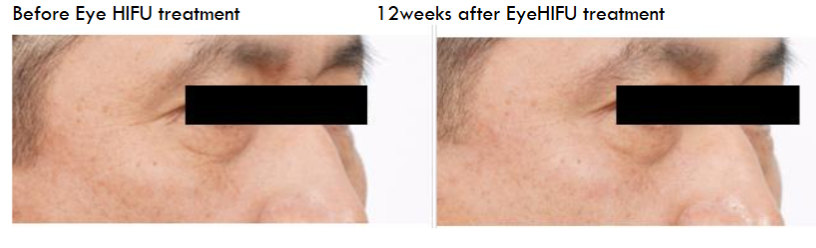
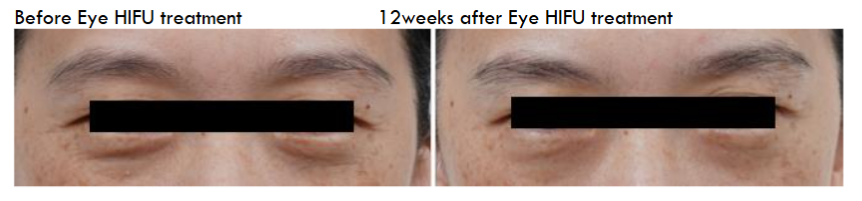
Clinical outcomes were evaluated using standardized photographs obtained at baseline and 12 weeks post-treatment. Two independent clinicians, blinded to treatment sequence, graded improvement on a 4‑point scale (0 = none, 3 = marked). Patient satisfaction and eyelid length measurements were also recorded. Descriptive statistics were used to summarize findings.
Results
Patient-reported improvement: 17 out of 20 (85%) reported a noticeable degree of improvement. The average score on a 4-point scale (1= little or no improvement, 2 = mild improvement, 3 = moderate improvement, 4 = marked improvement) for overall improvement was 2.35 ± 0.81.
Physician rated improvement: 15 (75%) cases showed improvement based on blinded evaluations. The average clinician-reported scores were 2.30 ± 0.86 for overall improvement, 2.15 ± 0.81 for skin tightening, and 2.16 ± 0.93 for crow’s feet.
Measure outcome: A statistically significant reduction in average lid length (ALL), defined as the distance from the upper rim of the eye to the eyebrow along the midline. The mean ALL decreased significantly from 18.3 ± 2.75 mm to 17.2 ± 2.69 mm at 12 weeks post-treatment (p < 0.0001). No major adverse events were reported. Temporary erythema and mild edema resolved within 24~48 hours.
Discussion
Our findings demonstrate that high‑intensity focused ultrasound is a safe and effective non‑invasive modality for addressing upper and lower eyelid sagging. The majority of patients achieved visible improvement with a single treatment session, consistent with previous studies evaluating HIFU for periocular rejuvenation. By stimulating neocollagenesis in the dermis and SMAS layer, HIFU achieves tissue contraction without the risks associated with blepharoplasty.
Several key considerations are essential for optimizing HIFU treatment outcomes:
- Patient Selection and Expectations: Ideal candidates are individuals seeking periorbital improvement who are either unwilling or not yet ready for surgery. It is crucial to manage patient expectations. They must understand that HIFU cannot replicate the dramatic lifting achieved with blepharoplasty, but can provide a noticeable yet subtle improvement that aligns well with a natural aesthetic. Educating patients about gradual improvements and the potential need for maintenance treatments helps ensure satisfaction.
- Probe Positioning and Technique: Maintaining the probe perpendicular to the skin surface is essential for consistent energy delivery. The eyelids should be gently stretched to flatten skin folds and avoid energy stacking. This technique enhances uniformity of treatment while reducing the risk of focal overheating.
- Ocular Safety: Corneal shields are recommended to protect the eyes from accidental energy exposure. When shields are not available, stretch the upper eyelid upward and the lower eyelid downward to ensure complete treatment coverage of the periorbital skin while minimizing the risk of contact with the globe of the eye.
- Conservative Energy Delivery: Apply a conservative number of shots (no more than 200 shots) to minimize fat atrophy and consider lower energy settings especially for older patients or those with thinner dermis.
- Patient Communication and Follow‑up: Real-time feedback enhances the patient experience. Allowing patients to compare the treated and untreated sides during the session reinforces perceived results. Follow-up assessments at 3 to 6 months are recommended for reassessment and potential maintenance treatments.
Adjunctive Treatments: HIFU can be performed as a standalone treatment or in combination with modalities such as radiofrequency (RF) treatment, botulinum toxin injections or hyaluronic acid fillers, with no observed interference or adverse interactions in this study.
While surgical blepharoplasty remains the gold standard for dramatic results, non-invasive options like HIFU serve as an important middle ground. Patients seeking natural enhancement, minimal downtime or postponement of surgery often find HIFU appealing. Unlike surgery, which can alter eyelid contour and risk complications like asymmetry or hematoma, HIFU offers gradual and progressive improvements with minimal recovery time. Compared to fractional lasers, radiofrequency, and injectables also play roles in periocular rejuvenation, HIFU offers the unique benefit of deep tissue tightening without compromising the skin surface. Combining HIFU with other treatments such as Botox or dermal fillers can enhance results and further delay the need for surgery.
Additionally, as East Asian patients tend to have thicker subcutaneous tissue and greater orbital fat volume, excessive volume reduction or aggressive tissue tightening may compromise their natural features and lead to dissatisfaction. For this reason, conservative approaches are particularly valued to preserve ethnic harmony and avoid unnatural outcomes.
Conclusion
In conclusion, HIFU treatment is a valuable non-invasive option for addressing mild to moderate eyelid sagging. My clinical experience and research demonstrate that, when performed safely and with appropriate patient selection, HIFU can achieve meaningful improvements in eyelid appearance while minimizing risk. It serves as an excellent alternative or adjunct to surgery, helping meet the growing patient demand for natural, gradual rejuvenation with minimal downtime.
I hope that by sharing my experience and insights, other clinicians will be inspired to explore HIFU in their own practices and continue to refine its use through collaboration and research. As always, patient safety and education must remain at the forefront of our approach to aesthetic medicine.
References
- Chopra K, Calva D, Sosin M, Tadisina KK, Banda A, De La Cruz C, et al. A comprehensive examination of topographic thickness of skin in the human face. Aesthet Surg J. 2015;35(8):1007‑1013.
- Parikh S, Most SP. Rejuvenation of the upper eyelid. Facial Plast Surg Clin North Am. 2010;18(3):427‑433.
- Gupta MA, Gupta AK, Schork NJ, Ellis CN, Voorhees JJ. The aging face: a psychocutaneous perspective. J Dermatol Surg Oncol. 1990;16(10):902‑904.
- Ayatollahi A, Gholami J, Saberi M, Hosseini H, Firooz A. Systematic review and meta‑analysis of safety and efficacy of high‑intensity focused ultrasound for face and neck rejuvenation. Lasers Med Sci. 2020;35(5):1007‑1024.
- Chan NP, Shek SY, Yu CS, Ho SG, Yeung CK, Chan HH. Safety study of transcutaneous focused ultrasound for noninvasive skin tightening in Asians. Lasers Surg Med. 2011;43(4):366‑375.
- Shome D, Vadera S, Ram MS, Khare S, Kapoor R. Use of micro‑focused ultrasound for skin tightening of mid and lower face. Plast Reconstr Surg Glob Open. 2019;7(4):e2498.
- White WM, Makin IR, Barthe PG, Slayton MH, Gliklich RE. Selective creation of thermal injury zones in the superficial musculoaponeurotic system using intense ultrasound therapy: a new target for noninvasive facial rejuvenation. Arch Facial Plast Surg. 2007;9(1):22‑29.
- Phenix CP, Togtema M, Pichardo S, Zehbe I, Curiel L. High‑intensity focused ultrasound technology: its scope and applications in therapy and drug delivery. J Pharm Pharm Sci. 2014;17(1):136‑153.
- Hwang Y, Yi KH. The efficacy of intense focused ultrasound treatment for sagging of upper and lower eyelids. Korean Assoc Laser Dermatol Trichol. 2022;3(1):1‑5.
- Damasceno RW, Avgitidou G, Belfort R Jr, Dantas PE, Holbach LM, Heindl LM. Eyelid aging: pathophysiology and clinical management. Arq Bras Oftalmol. 2015;78(5):328‑331.
- Kwon HH, Lee WY, Choi SC, Jung JY, Bae Y, Park GH. Combined treatment for skin laxity of the aging face with monopolar radiofrequency and intense focused ultrasound in Korean subjects. J Cosmet Laser Ther. 2018;20(8):449‑453.
- Park JY, Byun EJ, Kim HS. Rejuvenation of periocular region in Koreans: a multimodal approach combining botulinum toxin, fillers, and micro‑focused ultrasound with visualization for optimal results. Dermatol Ther. 2020;33(3):e13159.
- Suh DH, So BJ, Lee SJ, Song KY, Ryu HJ. Intense focused ultrasound for facial tightening: histologic changes in 11 patients. J Cosmet Laser Ther. 2015;17(4):200‑203.
- Lam SM, Azizzadeh B. Asian Facial Cosmetic Surgery. Elsevier; 2015.
- Kwon JH, Kim Y, Lee D, et al. Ethnic and anatomical considerations in aesthetic eyelid surgery: a systematic review. Plast Reconstr Surg. 2020;145(2):456e‑465e.
- Shome D, Kapoor R, Vadera S, et al. Anatomical differences in East Asian eyelids and considerations for nonsurgical treatments. J Cosmet Dermatol. 2019;18(3):692‑698.
- Suh DH, Park HJ, Lee SJ, Song KY, Shin MK. Superficial intense focused ultrasound on periorbital wrinkle. J Cosmet Laser Ther. 2019;21(7‑8):412‑416.
- Park JY, Byun EJ, Kim HS. Rejuvenation of periocular region in Koreans: a multimodal approach combining botulinum toxin, fillers, and micro‑focused ultrasound with visualization for optimal results. Dermatol Ther. 2020;33(3):e13159.
- Suh DH, Park HJ, Lee SJ, Song KY, Shin MK. Superficial intense focused ultrasound on periorbital wrinkle. J Cosmet Laser Ther. 2019;21(7‑8):412‑416.