





COVID-19 Resource Quality for Spinal Cord Injuries
Evaluation of the Quality of Current COVID-19 Resources Developed for Individuals with Spinal Cord Injuries: A Scoping Review
Pegah Derakhshan¹²³, William C. Miller²³⁴, Ethan Simpson²³⁴, Christopher B. McBride⁵, Jaimie Borisoff³⁴⁶, Julia Schmidt²⁴, W. Ben Mortenson²³⁴
- Graduate Program in Rehabilitation Sciences, UBC, Vancouver, BC, CA
- Centre for Aging Smart Rehabilitation Research Program, GF Strong Rehabilitation, UBC, Vancouver, BC, CA
- International Collaboration on Repair Discoveries (ICORD), Vancouver, BC, CA
- Department of Occupational Science & Occupational Therapy, UBC, Vancouver, BC, CA
- Spinal Cord Injury British Columbia, Vancouver, BC, CA
- British Columbia Institute of Technology (BCIT), Burnaby, BC, CA
OPEN ACCESS
PUBLISHED: 31 August 2024
CITATION: Derakhshan P., Miller W.C., et al., 2024. Evaluation of the Quality of Current COVID-19 Resources Developed for Individuals with Spinal Cord Injuries: A Scoping Review.
Medical Research Archives, [online] 12(8).https://doi.org/10.18103/mra.v12i8.5803
COPYRIGHT: © 2024 European Society of Medicine. This is an open-access article distributed under the terms of the Creative Commons Attribution License, which permits unrestricted use, distribution, and reproduction in any medium, provided the original author and source are credited.
DOI https://doi.org/10.18103/mra.v12i8.5803
ISSN 2375-1924
Abstract
Introduction: During the COVID-19 pandemic, there was an urgent need for information on dealing with it among people with spinal cord injuries (SCI). Organizations provided resources, but many of them were generic. In some cases, the information was provided by dubious sources, contradictory, or not assessed for usability with individuals with SCI. This study reviewed COVID-19 web-based resources for individuals with SCI and evaluated their quality.
Methods: A scoping review for COVID-19-related web-based resources for individuals with SCI was performed by first identifying SCI-relevant organizations and, subsequently, targeted website searching using a systematic search strategy in May 2021. The included resources were categorized based on their content and format (e.g., video, infographic, text). The resources were evaluated using tools that had been previously validated.
Results: Our search identified 71 SCI organizations and 10,538 potential resources. Based on inclusion and exclusion criteria, 112 resources were included and categorized based on their content into ten main domains: prevention, caregivers, exercise, mental health, stories, telehealth, specific organs/systems, report of evidence, SCI network COVID-19 response and COVID-19 communication rights toolkit. The average score for the quality of the text, infographic, and video resources are 9.72/28 (Range:3-24), 37.75/44 (Range:35-41), and 59.14/80 (Range: 49-75), respectively.
Conclusion: Website resources mainly focused on preventing COVID-19. Only five of them addressed telehealth during COVID-19 for individuals with SCI. The results of this study will inform the development of SCI-oriented toolkits for future pandemics.
Keywords
- COVID-19
- Spinal Cord Injury
- Resources
- Scoping Review
- Quality Evaluation
Introduction:
The COVID-19 pandemic had a considerable impact on the lives of all individuals. The necessity of physically distancing lead to widespread disruptions of social activities and interactions. While necessary, the broader impacts of COVID-19 measures have shown substantial deficits in areas such mental and physical health, education, economy and domestic abuse. Vulnerable populations, such as individuals with spinal cord injury (SCI), may experience exacerbated negative impacts. For example, the requirement could make it especially problematic for wheelchair users to maintain effective hand washing and social distancing in certain situations. Individuals with SCI have a higher level of loneliness than the average population, COVID may have led to increased social isolation. What is more, the access to essential services for individuals with SCI is of concern during the pandemic. These include accessing the sufficient caregiver coverage and risk of infection by contacting caregivers, maintenance of specialised equipment, and access to medical care.
COVID-19 web-based resources appeared almost overnight. Some targeted the general population while others targeted vulnerable segments of the population. Many of these targeted resources were developed and hosted by organisations created to provide support and address and alleviate COVID-19 related concerns. Such is the case for individuals with SCI. Given the immediate need for the resources many were expedited towards publication. It remains unclear how well they actually address the experiences, needs and coping requirements of individuals with SCI. For instance in some cases the information provided was not evidenced based, contradictory, or not evaluated for individuals with SCI. For example, a study by Stillman et al. (2020) found that many COVID-19 guidelines failed to consider the specific vulnerabilities and healthcare needs of SCI patients, such as respiratory complications and limited access to personal care assistance, which are critical during the pandemic.
Accurate, comprehensive and practical information resources is necessary for management of public prevention behaviour and maintaining the mental health of individuals with SCI. The objective of this scoping review was to systematically catalog, evaluate and synthesize COVID-19 web-based resources for individuals with SCI.
Methods:
The scoping review was executed in five stages, described by Arksey and O’Malley’s framework, including (1) identifying the research question; (2) identifying relevant studies; (3) selecting the studies; (4) charting the data; (5) collating, summarizing, and reporting the results.
The scoping review co-created with SCI-BC, is built on two main research questions: “What is the extent, range, and focus of the web-based information resources on COVID-19 for individuals with spinal cord injury during the COVID-19 pandemic?” and “What is the quality of the available information resources?”
IDENTIFYING SCI-RELATED RESOURCES:
A grey literature search plan was established in collaboration with a research librarian. This plan involved two steps of identifying relevant organizations and search & documentation strategies.
Step 1: Identify Relevant Organizations:
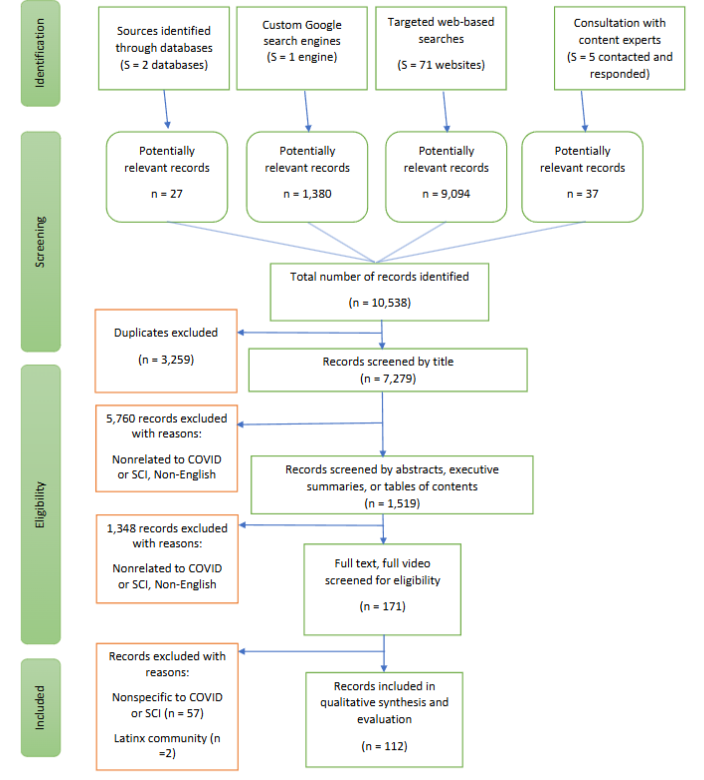
To search for relevant spinal cord injury organization websites and other web-based sources of SCI information we applied three different strategies including: 1) conducting a google search on the topic of ‘spinal cord injury’ and searching through the first ten pages to find their publishers; 2) reviewing grey material from the Canadian Agency for Drugs and Technologies in Health (CADTH) checklist of health organizations; and 3) organizing a brainstorm session with expert research team members to identify potential organizations, or partners relevant to spinal cord injury. Using these three steps we found 71 SCI related organizations.
Step 2: Search & Documentation Strategies:
This step is an integration of four different searching strategies for searching and documenting information sources. These strategies were adapted from the method outlined in an article by Godin et al.
- Grey literature databases: This step enabled us to search databases that list grey literature records and provide indexing for web-based resources. A search was conducted on May 25, 2021 and included two databases: The Canadian Electronic Library—Canadian Public Policy Collection, and the Canadian Electronic Library—Canadian Health Research Collection. We adapted our search terms to fit each database including using two group search terms: 1) “Spinal cord injury” and 2) “COVID-19”. An Excel spreadsheet was used to list the results of our database search and the inbuilt ‘remove duplicates’ function excluded any duplication.
- Customized Google search engines: Conducting a Google search for information resources published on the internet is our second and main strategy. In order to narrow our search result to the specific subject of our research we use the customized google search engine for Canadian public health information and government documents, which allows for a more targeted and refined search. Websites searched this way include ones by public health agencies, collaborating centers, provincial and federal health departments of Canada. This custom search engine created by the association of Ontario’s Public Health Libraries. The search strategy in Appendix 1 was implemented. The following search strategy was applied: Potentially relevant records were bookmarked in the web browser used at the time of searching (Google Chrome) and later entered into an Excel spreadsheet.
- Targeted websites: Websites of relevant health agencies and organizations, which were identified in the first step, were browsed and each website’s homepage was thoroughly searched for relevant information resources. The date of this search was May 29, 2021. Furthermore, the same strategy was applied to a search on the custom Google search engine for the website of each organization. The top 100 results, were checked for relevancy (text underneath the title was considered). An Excel spreadsheet was used to compile the URL and organization name of each website. With the help of a combination of keywords each website was subsequently searched in detail.
- Consultation with contact experts: This strategy, used to identify information resources for screening, involved contacting content experts to identify other items for possible inclusion in the review. Content experts are considered to be individuals who are experienced in the field of spinal cord injury and most likely to be familiar with relevant resources. In this study we contacted five experts including from Spinal Cord Injury BC, and Spinal Cord Injury Research Evidence project, as well as the International Collaboration on Repair Discoveries and Rehabilitation Sciences of the University of British Columbia.
SELECTING THE RESOURCES:
Inclusion criteria for selecting resources were as follows: 1) Resources specifically designed for individuals with spinal cord injury, 2) Resources specifically designed for the COVID-19 pandemic, 3) Resources designed in English for English language speakers. In discussion with two undergraduate students, the original database search was conducted by the first author. A total of 10,538 potentially relevant results were identified and compiled on an Excel sheet. The first author removed duplicates (n= 3,259) leaving 7,279 remaining to screen. A subsequent discussion among the three researchers about the inclusion or exclusion of each resource based on its relevancy reduced this number to 171 resources.
The most common reason for the exclusion of a resource was that the website has some sub link with COVID-19 caution or information, but that information resource was not describing any information about COVID-19 (n=4578). Other resources excluded were either not designed specifically for COVID-19 and/or individuals with spinal cord injury (n=2347) and designed for non-English audiences (n=183).
CHARTING THE DATA:
One hundred and seventy-one selected resources were reviewed using a template designed by all three authors. A study flow diagram, recommended by PRISMA, for describing the selection and screening process of our study was applied to the methods of grey literature search. A numeric code was assigned to each resource to detail the reason for exclusion. This numeric code was recorded for each resource at both stages of the screening process. All items still deemed relevant after full-text screening are included in this scoping review.
COLLATING, SUMMARIZING, AND REPORTING THE RESULTS:
After a full review of each resource included in our case study, core data was extracted related to the date of realization, the organization publishing the resource, the focus topic of the resource’s content, the date and time each resource was first reviewed by one of our three researchers, the estimated time to study the resource, and the format of the resource. Using a narrative synthesis, each resource’s content was summarized. Based on this narrative, the focus of the content of each resource was chosen as theme of the resource by the three researchers. The included resources were categorized based on their format, including video, infographic, and text.
Evaluating the Quality of Resources:
We evaluated the content quality of the included resources using the following tools based on the format of each resources.
- DISCREN: The DISCERN questionnaire was used to evaluate the quality of video resources. The University of Oxford and employees of the British Library collectively developed the underlying DISCERN scoring system. It can be used by health professionals as well as their patients and the general population as a critical assessment tool to evaluate health information by providing a standardized quality index containing the health information of consumers. With the help of patients in a self-help group, health information providers and an expert panel, the questionnaire was systematically derived. DISCERN includes 16 questions in three sections, including reliability, dependability, and trustworthiness of web-based resources (question 1 to 8), quality of information about treatment choice (question 9 to 15), and overall quality (question 16). All questions are on the continuous Likert scale of 1 (definite NO) to 5 (definite YES). The total score of the first 15 questions is reported; ranging from 5 to 75; A higher score represents a better quality of health information. Cronbach’s alphas within the current study ranged from 0.73 to 0.80.
- QUEST- Quality of Web-based Health Information: QUEST is used to evaluate the quality of information resources in text format. It lets users assess the quality of web-based articles in a reliable and valid way and is accessible for researchers and health care professionals alike. A total of seven different aspects with regards to the quality of health information available online is measured quantitatively by the questionnaire. A weighted score, detailed in the following, is assigned to each of the seven aspects: Authorship (score range from 0-2, weighting 1), attribution/presence of references (score range from 0-3, weighting 3), attribution/type of study (score range from 0-2, weighting 1), conflict of interest (score range from 0-2, weighting 3), currency (score range from 0-2, weighting 1), complementarity (score range from 0-1, weighting 1), and tone (score range from 0-2, weighting 3). The total score is given in a range between 0 and 28; higher scores represent a better quality. Cronbach’s alphas within the current study ranged from 0.91 to 0.94.
- Infographic Design Rubric (IDR): We used IDR to evaluate the quality of infographic resources. Centered on content generation and on the dimensions of IDM for visual design generation, which are to be applied in the process of evaluating and creating infographics, the following criteria of IDR were generated. This rubric measures three aspects of the quality of infographics, including content generation (main heading and sub-headings), organization of information (grouping, systematics, and consistency), and the quality of information (essential information, key concepts, description, exemplification, outcome, and identity). All questions are on the continuous scale of 1 (unacceptable) to 4 (exemplary). The total score of all questions is reported; ranging from 11 to 44; higher scores shows a better quality of infographic.
Results:
The included 112 resources from 28 organisations were categorised, based on narrative synthesis, into ten themes, including General Information and Prevention, Caregivers, Exercise and Rehabilitation, Mental Health, Stories Regarding the Impact of COVID-19 on Individuals with SCI, Report & Review of Evidence/Publications, SCI Network Covid Response, Specific Organ Systems, Telehealth & Virtual Care, and the COVID-19 Communication Rights Toolkit. The characteristics of the categorised resources based on their theme were described in Table 2, including the organisations which designed and published them, the format of these resources, and the mean time of reading/watching the resources.
| Country | Number of resources |
|---|---|
| Australia | 3 |
| Canada | 49 |
| United States | 49 |
| United Kingdom | 11 |
| Name of Organization | Number of Resources |
|---|---|
| Agency for clinical innovation | 1 |
| American Spinal Injury Association | 2 |
| Back Up | 2 |
| FacingDisability | 4 |
| International Spinal Cord Society | 1 |
| Kennedy Krieger | 1 |
| Kessler foundation | 2 |
| North American Spinal Cord Injury Consortium | 11 |
| New Mobility | 11 |
| National Institute for the clinical application of Behavioral Medicine | 1 |
| The Perry Cross Spinal Research Foundation | 1 |
| Praxis- Spinal Cord Institute | 2 |
| Paralyzed Veterans of America | 1 |
| Rick Hansen Foundation | 1 |
| South Carolina Spinal Cord Injury Association | 1 |
| SCI Everything | 3 |
| Spinal Cord Injury- Ontario | 1 |
| Spinal Cord Injury- Washington | 1 |
| Spinal Cord Injury- British Columbia (BC) | 18 |
| Spinal Cord Injury- Canada | 5 |
| The Spinal Cord Injury Research Evidence (SCIRE) Project | 17 |
| Spinal Cord Injury- Saskatchewan | 2 |
| Shepherd Center | 1 |
| Spinal Cord Injury Research Center at Mount Sinai | 1 |
| Spinal Cord Injury Zone | 6 |
| Spinal Cord Injury- UK | 9 |
| Spine universe | 2 |
| United Spinal Association | 3 |
Themes of the resources:
- General Information and Prevention of COVID-19: Resources in this theme mainly contain information about the coronavirus and its symptoms, how differently it affects individuals with spinal cord injury, risks for this specific part of the population and the steps of preventing an infection. This information is covered by 18 organizations using three types of resources: video, infographic, and text.
- Caregivers: Two out of four resources in the caregivers’ theme give general information on steps and instructions for caregivers during COVID-19 to be more helpful for individuals with SCI and about the different ways they can manage their stress as well as improve the mental health of them and their patients.
- Exercise and Rehabilitation: There are seven resources included which focus on exercise and rehabilitation. Before the full text screening step, based on the inclusion and exclusion criteria, we had a list of 16 resources on exercise and rehabilitation, but most of them were excluded as they were not designed for COVID-19 or individuals with SCI specifically.
- Mental Health: Twelve resources are included, focusing on the mental health of individuals with spinal cord injury during COVID-19. These resources provide information to aid the understanding of social isolation and how to manage it, identifying mental health concerns during social isolation and different strategies of coping with it while supporting others during COVID-19.
- Stories Regarding the Impact of COVID-19 on Individuals with SCI: Three organizations developed 10 resources in total on the personal experience of individuals with spinal cord injury, letting them use their own words.
- Telehealth & Virtual Care: There are five resources which focus on telemedicine. Two of them are webinars within the SCI community to connect and have an open dialogue about virtual care and assistance.
- Specific Organs/Systems: Three of the included studies are specifically focused on one organ system including the respiratory system and the urinary tract system, and the effect of COVID-19 on them for individuals with spinal cord injury.
- Report & Review of Evidence/Peer-Reviewed Publication: This theme, including ten resources, consists of peer-reviewed publications on spinal cord injury, uploaded to the website of the organizations.
- SCI Network Covid Response: This theme consists of six resources, all of them giving information on how their own organization responds to or addresses challenges of the spinal cord injury community during COVID-19.
- COVID-19 Communication Rights Toolkit: There is only one resource which focuses on the communication right of individuals with spinal cord injury during a quarantine, an emergency, and in the hospital.
Evaluation of the Quality of the Resources:
The included resources consist of four infographics, 28 videos, 80 website texts. Generally, the average score for the quality of the text, infographic, and video resources is 9.72/28 (Range:3-24), 37.75/44 (Range: 35-41), and 59.14/80 (Range: 49-75), respectively.
Videos: Twelve (44%) and fourteen (52%) videos have a good and excellent score, respectively. In general, videos score poorly with regards to the shared decision making. In the “reliability” domain, approximately 70% of the videos mention or cite which sources of information are used to compile the resource.
Infographics: There are only four resources designed in infographic format and all of them had good to excellent scores (35 to 41 out of 44).
Text: In general, most of the texts score poorly regarding the tone, i.e., the authors’ claims are not balanced by caution, and repeatedly contain statements of contrasting findings or limitations.
Discussion:
This study applies a comprehensive and explicit method of scoping review with systematic review search strategies to identify 112 website resources from 28 organizations, extracting ten different themes, which detail the focus of each resource. Our study shows that this focus is unevenly distributed. More than half of the sites focus on answering the question of what the coronavirus and its symptoms are, how differently it affects individuals with SCI, and how to prevent it.
Moreover, individuals with SCI were thought to need different measures and guidelines to prevent an infection with COVID-19 compared to the general population due to the nature of their impairment; for instance, a specific protocol for hand washing while also having to use their hands to propel a manual wheelchair.
However, there is still a need for improvement with regards to the quality of information by providing scientific citations and weighing conclusions with caution. Our study shows that the second most common theme, but only subject of about 10% of the resources, was focused on mental health.
Other SCI-related themes are covered by less than ten resources, perhaps due to resources not being specifically designed for individuals with SCI in times of COVID-19. COVID-19 communication rights and tele-health are emerging subjects.
However, we must take into account that a low rating in this area does not mean that the information is not accurate. Instead, having a high rating demonstrates that the source of the evidence is explicit, thus meeting our criterion.
Conclusion:
In conclusion, this review provides helpful information regarding information resources for individuals with SCI. A significantly uneven distribution of subjects covered by the examined resources is identified. Resources are mainly focused on preventing COVID-19, and only three of them address tele-health and virtual care during COVID-19 for individuals with SCI.
References:
- Moran K, Stevanovic D, Touré AK. Macroeconomic uncertainty and the COVID‐19 pandemic: Measure and impacts on the Canadian economy. Canadian Journal of Economics/Revue canadienne d’économique. 2022;55(Journal Article):379-405.
- Klaiber P, Wen JH, DeLongis A, Sin NL. The ups and downs of daily life during COVID-19: Age differences in affect, stress, and positive events. The Journals of Gerontology: Series B. 2021;76(2):e30-e37.
- Savage RD, Wu W, Li J, et al. Loneliness among older adults in the community during COVID-19: a cross-sectional survey in Canada. BMJ open. 2021;11(4):e044517.
- Dozois DJ. Anxiety and depression in Canada during the COVID-19 pandemic: A national survey. Canadian Psychology/Psychologie canadienne. 2020;(Journal Article).
- Kotwal AA, Holt‐Lunstad J, Newmark RL, et al. Social Isolation and Loneliness Among San Francisco Bay Area Older Adults During the COVID‐19 Shelter‐in‐Place Orders. JAmGeriatrSoc. 2021;69(1):20-29.
- Pietrabissa G, Simpson SG. Psychological consequences of social isolation during COVID-19 outbreak. Frontiers in psychology. 2020;11(Journal Article):2201.
- Monden KR, Andrews E, Pilarski C, Hearn J, Wudlick R, Morse LR. COVID-19 and the spinal cord injury community: Concerns about medical rationing and social isolation. Rehabilitation Psychology. 2021;66(4):373.
- Hearn JH, Rohn EJ, Monden KR. Isolated and anxious: a qualitative exploration of the impact of the COVID-19 pandemic on individuals living with spinal cord injury in the UK. JSpinal Cord Med. 2021;(Journal Article):1-9.
- Boyle CA, Fox MH, Havercamp SM, Zubler J. The public health response to the COVID-19 pandemic for people with disabilities. Disability and Health Journal. 2020;13(3):100943.
- Lee H, Miller VJ. The disproportionate impact of COVID-19 on minority groups: a social justice concern. Journal of Gerontological Social Work. 2020;(Journal Article):1-5.
- Armitage R, Nellums LB. The COVID-19 response must be disability inclusive. The Lancet Public Health. 2020;5(5):e257.
- Venegas-Vera AV, Colbert GB, Lerma EV. Positive and negative impact of social media in the COVID-19 era. Reviews in cardiovascular medicine. 2020;21(4):561-564.
- Morgan K, Heeb R, Walker K, Tucker S, Hollingsworth H. Impact of the COVID-19 Pandemic on Psychosocial Health of Persons With Spinal Cord Injury: Investigation of Experiences and Needed Resources. Topics in Spinal Cord Injury Rehabilitation. 2022;28(2):185-195.
- Arksey H, O’Malley L. Scoping studies: towards a methodological framework. International journal of social research methodology. 2005;8(1):19-32.
- Jackie Stapleton. Searching the Literature: A Guide to Comprehensive Searching in the Health Sciences. Published online 2018. https://guides.library.utoronto.ca/c.php?g=577919&p=4123572
- Godin K, Stapleton J, Kirkpatrick SI, Hanning RM, Leatherdale ST. Applying systematic review search methods to the grey literature: a case study examining guidelines for school-based breakfast programs in Canada. Systematic reviews. 2015;4(1):1-10.
- Kaicker J, Borg Debono V, Dang W, Buckley N, Thabane L. Assessment of the quality and variability of health information on chronic pain websites using the DISCERN instrument. BMC medicine. 2010;8(1):1-8.
- Robillard JM, Jun JH, Lai JA, Feng TL. The QUEST for quality online health information: validation of a short quantitative tool. BMC medical informatics and decision making. 2018;18(1):1-15.
- Nuhoğlu Kibar P, Akkoyunlu B. Fostering and assessing infographic design for learning: the development of infographic design criteria. Journal of Visual Literacy. 2017;36(1):20-40.
- Coelho CM, Suttiwan P, Arato N, Zsido AN. On the nature of fear and anxiety triggered by COVID-19. Frontiers in psychology. 2020;11(Journal Article):581314.
- Sánchez-Raya J, Sampol J. Spinal cord injury and COVID-19: some thoughts after the first wave. Spinal Cord. 2020;58(8):841-843.
- Mikolajczyk B, Draganich C, Philippus A, et al. Resilience and mental health in individuals with spinal cord injury during the COVID-19 pandemic. Spinal Cord. 2021;59(12):1261-1267.
- Hou T, Zhang T, Cai W, et al. Social support and mental health among health care workers during Coronavirus Disease 2019 outbreak: A moderated mediation model. Plos one. 2020;15(5):e0233831.
- COVID-19 Communication Rights Toolkit. 2024 2019. https://communicationfirst.org/covid-19/
- Breton M, Sullivan EE, Deville-Stoetzel N, et al. Telehealth challenges during COVID-19 as reported by primary healthcare physicians in Quebec and Massachusetts. BMC family practice. 2021;22(1):1-13.
- Marco-Ahulló A, Montesinos-Magraner L, González LM, Morales J, Bernabéu-García JA, García-Massó X. Impact of COVID-19 on the self-reported physical activity of people with complete thoracic spinal cord injury full-time manual wheelchair users. JSpinal Cord Med. 2021;(Journal Article):1-5.
Appendix 1:
Search strategy: (“COVID” OR “COVID-19” OR “coronavirus” OR “corona-virus” OR “corona”) AND (“Spinal Cord Ischemia “OR “Spinal Cord Vascular” OR “Spinal Cord Neoplasms” OR “Spinal Cord Diseases” OR “Central Cord Syndrome” OR “Paraplegia” OR “Quadriplegia” OR “spinal cord injur*” OR “SCI” OR “tetraplegia”)
Preferred Reporting Items for Systematic reviews and Meta-Analyses extension for Scoping Reviews (PRISMA-ScR) Checklist
| SECTION ITEM | PRISMA-ScR CHECKLIST ITEM REPORTED ON |
|---|---|
| Title | Identify the report as a scoping review. |
| Abstract | Provide a structured summary that includes (as applicable): background, objectives, eligibility criteria, sources of evidence, charting methods, results, and conclusions that relate to the review questions and objectives. |
| Introduction | Describe the rationale for the review in the context of what is already known. Explain why the review questions/objectives lend themselves to a scoping review approach. |
| Objectives | Provide an explicit statement of the questions and objectives being addressed with reference to their key elements (e.g., population or participants, concepts, and context) or other relevant key elements used to conceptualize the review questions and/or objectives. |
| Methods | Indicate whether a review protocol exists; state if and where it can be accessed (e.g., a Web address); and if available, provide registration information, including the registration number. |
| Eligibility criteria | Specify characteristics of the sources of evidence used as eligibility criteria (e.g., years considered, language, and publication status), and provide a rationale. |
| Information sources | Describe all information sources in the search (e.g., databases with dates of coverage and contact with authors to identify additional sources), as well as the date the most recent search was executed. |
| Search | Present the full electronic search strategy for at least 1 database, including any limits used, such that it could be repeated. |
| Selection of sources of evidence | State the process for selecting sources of evidence (i.e., screening and eligibility) included in the scoping review. |
| Data charting process | Describe the methods of charting data from the included sources of evidence (e.g., calibrated forms or forms that have been tested by the team before their use, and whether data charting was done independently or in duplicate) and any processes for obtaining and confirming data from investigators. |
| Data items | List and define all variables for which data were sought and any assumptions and simplifications made. |
| Critical appraisal of individual sources of evidence | If done, provide a rationale for conducting a critical appraisal of included sources of evidence; describe the methods used and how this information was used in any data synthesis (if appropriate). |
| Synthesis of results | Describe the methods of handling and summarizing the data that were charted. |
| Results | Give numbers of sources of evidence screened, assessed for eligibility, and included in the review, with reasons for exclusions at each stage, ideally using a flow diagram. |
| Characteristics of sources of evidence | For each source of evidence, present characteristics for which data were charted and provide the citations. |
| Critical appraisal within sources of evidence | If done, present data on critical appraisal of included sources of evidence. |
| Results of individual sources of evidence | For each included source of evidence, present the relevant data that were charted that relate to the review questions and objectives. |
| Synthesis of results | Summarize and/or present the charting results as they relate to the review questions and objectives. |
| Discussion | Summarize the main results (including an overview of concepts, themes, and types of evidence available), link to the review questions and objectives, and consider the relevance to key groups. |
| Limitations | Discuss the limitations of the scoping review process. |
| Conclusions | Provide a general interpretation of the results with respect to the review questions and objectives, as well as potential implications and/or next steps. |
| Funding | Describe sources of funding for the included sources of evidence, as well as sources of funding for the scoping review. Describe the role of the funders of the scoping review. |